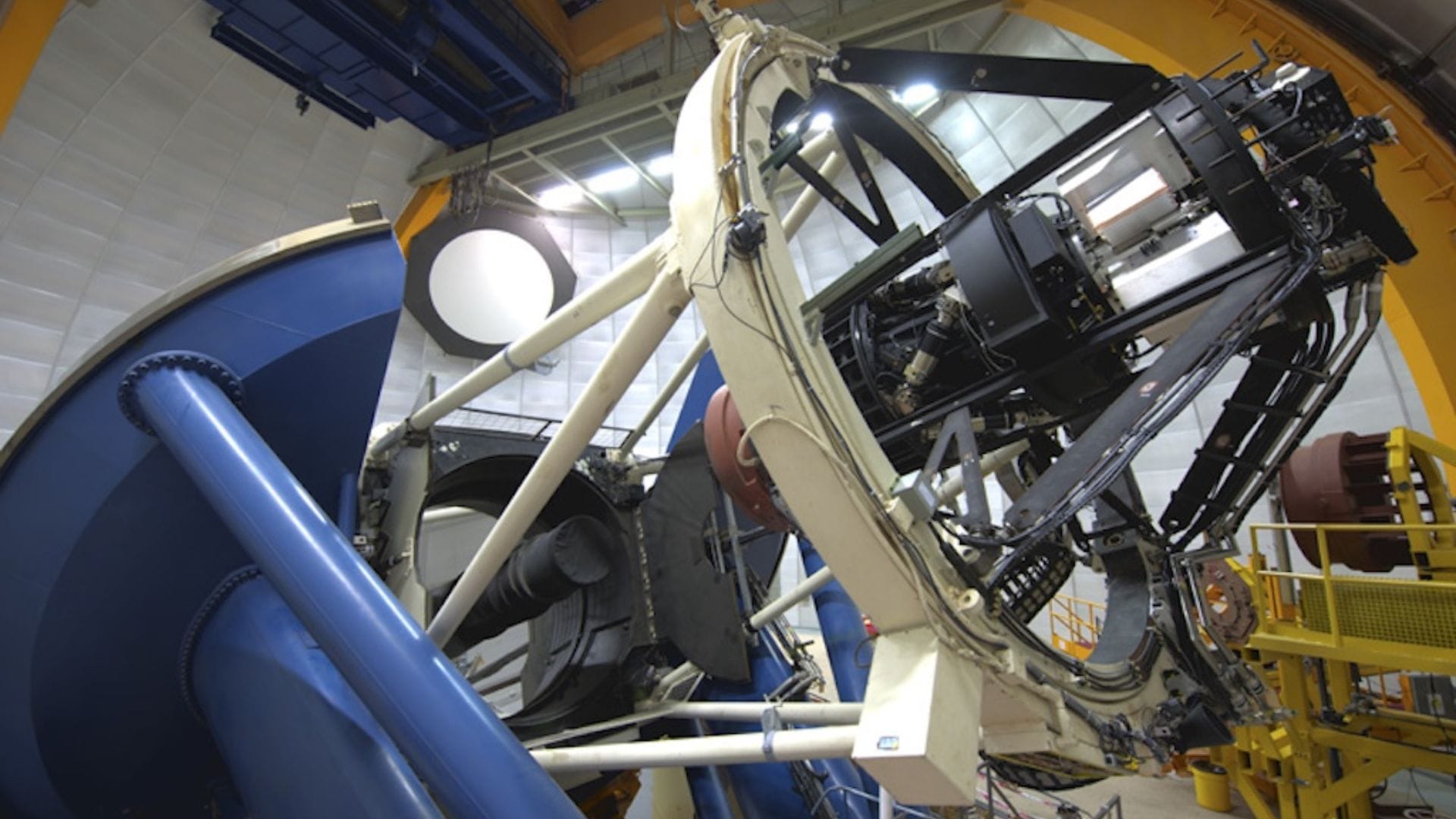
New Delhi: The Dark Energy Survey (DES) collaboration has relased its final legacy results, combining all six years of data captured between 2013 and 2019 for the first time. The analysis integrates weak lensing and galaxy clustering probes, and for the first time incorporates all the four planned probes, baryon acoustic oscillations (BAO), type Ia supernoave, galaxy clusters and weak gravitational lensing. These observations allow scientists to map the distribution of visible matter or baryonic matter, as well as the invisible dark matter. This multi-probe approaches using the same sky images marks a unique achievement among current-generation dark energy experiments.
The results are summarised in a paper drawing from 18 supporting studies and provides tighter cosmological constraints, more than twice as strong as previous DES analyses, while remaining consistent with earlier findings. Advanced methods improved weak lensing calibration by reconstructing matter distribution across six billion years of cosmic history through galaxy pair separations and shared distortions. Tests against the standard Lambda Cold Dark Model (ΛCDM) with a constant density of dark energy showed good alignment with the observations. An extended wCDM model, allowing for dark energy density that evolves with the universe, fit the data equally well, but offered no significant improvement.
An emerging tension?
A persistent discrepancy emerged in matter clustering in the early universe and the local universe. Predictions based on early-universe measurements such as cosmic microwave background data differ from the late-universe or local universe observations, with the gap widening slightly in the latest data, even when combined with other experiments. This tension remains below the threshold for ruling out the standard model, but may just hint at physics beyond what scientists know. The methodologies developed establish foundations for the next-generation of surveys, including the upcoming Legacy Survey of Space and Time by the Vera C Rubin Observatory. More precise measurements are expected in the coming years, potentially resolving the pending mysteries of dark energy.