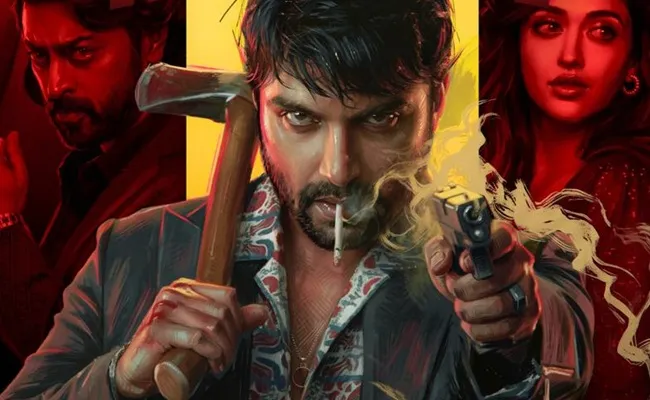
Vishwaksen has directed and acted in “Cult”, which he has touted as India’s first slasher thriller. The actor-director has also made several sensational claims about the film.
But does this bloody thriller have an engaging narrative to back up its bold premise? Let’s find out.
Story
Elvin (Tarak Ponnappa), the son of a home minister, celebrates his birthday with a party at a Goa nightclub called Cult. Just as the party gets underway, the police receive information that RDX bombs have been planted at the club’s main entrance, leaving everyone trapped inside.
As panic sets in, people inside the club begin getting killed one after another. The home minister finds some relief in knowing that DSP Sanki (Vishwaksen) is already at the venue. Can Sanki identify the killer and stop the bloodshed?
Performances
Vishwaksen plays Sanki more like a tapori than a police officer. His body language suits his usual screen persona, but the character demands a more convincing portrayal of a cop. He also relies heavily on expletives and double-meaning dialogues, which become excessive after a point.
Gayatri Bharadwaj appears lost in a role that gives her little scope to make an impression. Tarak Ponnappa portrays the spoilt son of a politician in a fairly routine manner. Murali Sharma plays another one-dimensional character in his familiar style, while Srikanth Iyengar has little new to offer. Chepuri Vivek, who appears in a key role towards the climax, gets a few effective moments.
Technical Aspects
Ravi Basrur, known for his work on the “KGF” franchise, is among the few technicians who make a positive contribution. His background score captures the party atmosphere and supplies the necessary sonic intensity for a slasher thriller.
The cinematography is functional, without offering much that stands out. The action choreography largely revolves around graphic killings and body slashing. The writing and editing are major weaknesses.It is particularly disappointing to see Tharun Bhascker associated with such weak dialogue writing.
Highlights
Vishwaksen
Music
Drawbacks
Tedious proceedings in the first half
Graphic violence
A logic-defying setup
Profanity
Analysis
“Cult” is neither a conventional action film nor a typical mass entertainer. It is a slasher thriller, a genre built around graphic violence and brutal killings. Set almost entirely inside a nightclub, the film attempts to turn a birthday party into a deadly game, bringing to mind elements of Netflix’s “Squid Game”. However, unlike that series, Vishwaksen’s film struggles to generate tension or make its games compelling.
The proceedings are largely dull, with the narrative moving from one violent episode to another without building any meaningful suspense. The graphic killings continue relentlessly, but gore alone cannot make a thriller engaging.
The film opens with Elvin and the other guests enjoying the party. For nearly 45 to 50 minutes, little happens beyond party sequences, conversations and comic episodes involving three youngsters who have travelled from Hyderabad to Goa. Their attempts at humour feel silly and add little to the central premise. Vishwaksen makes his entry only about 15 minutes before the interval, leaving the first half painfully slow.
After the interval, Vishwaksen attempts to inject some energy through his swagger and aggressive dialogue delivery. His liberal use of uncensored expletives and double-meaning lines might appeal to a section of the youth audience, but the language feels more like a substitute for strong writing than a natural part of the character.
A slasher thriller needs more than graphic killings. The characters must feel vulnerable, the danger must be palpable, and the audience should remain uncertain about what will happen next. “Cult” fails on these fronts. The games are largely unexciting, and the identity of the person orchestrating the killings becomes fairly obvious early on. The film reveals too much too soon, leaving little room for genuine mystery.
The second half continues in much the same vein, piling on gruesome sequences without giving the narrative enough substance. One particularly bizarre episode involves people playing football with a severed head. Such moments may appeal to viewers seeking extreme gore, but they do little to improve the storytelling.
The film finally finds some purpose when the flashback is revealed, explaining the killer’s motives and the reasons behind the events. But that pasrt was very weakly written.
Overall, “Cult” is a difficult watch, not merely because of its graphic violence, but because it fails to turn its premise into an engaging thriller. The screenplay lacks tension, the characters are thinly written, and the excessive gore becomes repetitive. The film may find an audience among viewers who enjoy unrestrained violence and slasher games, but it is unlikely to work for the wider Telugu audience.