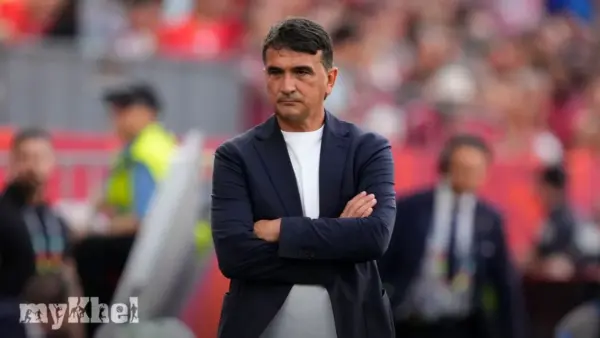
Zlatko Dalic condemned the officiating and video reviews after Croatia’s 2-1 World Cup loss to Portugal, saying the decisions removed all joy from the game.
Croatia led, saw three goals disallowed for offside and thought they had equalised in stoppage time, before a final VAR check confirmed their elimination at Toronto Stadium.
The decisive moment arrived deep into added time. Josko Gvardiol stabbed the ball past Diogo Costa after a cross from Mario Pasalic. VAR ruled that Igor Matanovic had touched the delivery while Pasalic collected the ball from an offside position. Referee Espen Eskas watched the replay and disallowed what Croatia believed was a late leveller.
Earlier in stoppage time, Portugal had turned the match around. Goncalo Ramos met a cross in the 94th minute and directed a firm header into the net. That goal followed Cristiano Ronaldo’s equaliser from the penalty spot, which arrived after Renato Veiga was pulled down inside the area by Nikola Vlasic.
Croatia had started the second half in control. Ivan Perisic struck on 53 minutes, finishing calmly for a seventh World Cup goal. The advantage appeared to spark Portugal, though. Rafael Leao almost replied with a fierce shot from distance that struck the crossbar, before Ronaldo had another effort ruled out for offside.
VAR had already intervened several times before the final decision. Nikola Vlasic thought Croatia had doubled the lead, only to see the goal cancelled for offside. Later, Petar Sucic finished past Diogo Costa in the 80th minute and celebrated what seemed a winning strike, but another offside call removed that goal as well.
Dalic expressed strong frustration with how those incidents shaped Croatia’s World Cup exit. It was very bad refereeing, Dalic told reporters.But Croatia lost. I’m not going to find any excuses. We could have won this earlier. You were able to see to what extent emotions have literally been killed, and altogether, these decisions take you back and actually take the joy out of football. I’m not saying that sometimes VAR can’t be of help, but it kills the emotions, it kills everything, it kills what you are experiencing, and it’s not easy to deal with all of this.
The defeat also carried personal weight for Luka Modric. The midfielder played a 23rd World Cup match, with only four players managing more appearances in the tournament’s history. Reports in Croatia suggest Modric could now end a 20-year international career that brought a national-record 201 caps.
Dalic admitted the scenario was not the farewell imagined for Modric on the World Cup stage. Well, this was probably his last World Cup, Dalic said of the midfielder. And I’m sorry that it ended this way. Croatia’s World Cup journey had previously included a runners-up finish in 2018 and third place four years later.
Croatia World Cup squad profile and Dalic future
The starting side that faced Portugal was one of the oldest seen in recent World Cup knockout matches. Croatia’s line-up averaged 30 years and 99 days. That figure is the highest for a non-group game since Croatia’s team in the 1998 third-place play-off, which averaged 30 years and 126 days.
Despite the age profile and the looming exit of Modric, Dalic expressed belief in Croatia’s next World Cup cycle. I’m not afraid for the future of the Croatian team, Dalic added. We have a lot of young players coming in and some of them have shown the quality today. We’ve come to an end of a wonderful era, he added. And some new beginnings await us.
Dalic did not give clarity about personal plans beyond this World Cup. Dalic has led Croatia since 2017, overseeing 111 matches across all competitions. During that spell, Croatia recorded 57 wins, 26 draws and 28 defeats. God knows what will happen in the next World Cup, but we’ll talk about it in Croatia, Dalic said.
For Croatia, the match against Portugal closed an era shaped by deep World Cup runs and Modric’s influence, yet also hinted at change. A controversial night of VAR calls, a late winner by Goncalo Ramos and the narrow margin of elimination left Croatia disappointed, but Dalic pointed towards younger players and another chapter for the national team.