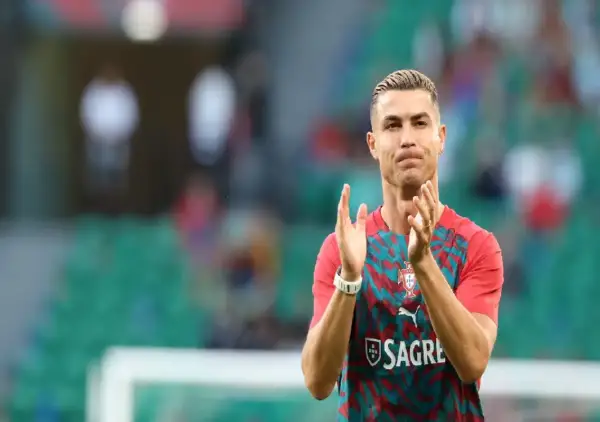
Lisbon: Portugal football icon Cristiano Ronaldo could face a suspension of up to six months after leaving the national team camp last month following an alleged fallout with manager Jorge Jesus.
However, the forward’s admission of responsibility and public apology could help him secure a reduced punishment under the Portuguese Football Federation’s (FPF) disciplinary regulations.
Ronaldo, who featured in only one of Portugal’s Nations League matches during the three-week international break, left the squad after being named on the bench for Portugal’s 4-2 victory over Denmark in Copenhagen. His departure has raised questions about disciplinary action and the potential consequences for one of the most influential players in Portuguese football.
In a statement released on Tuesday, Ronaldo addressed his decision, apologised to his teammates and supporters, and called for a fine to be imposed on him. His response could prove significant as the federation considers the appropriate punishment under its rules.
FPF regulations allow suspension of up to six months
Article 160 of the Portuguese Football Federation’s disciplinary regulations provides for strict action against players who fail to fulfil their national team obligations without a valid justification.
According to the provision, a player who is regularly called up but is absent or fails to attend a training session, match or activity connected with the national team without justification can face a suspension ranging from one month to six months, in addition to a fine.
The rule applies to activities involving Portugal’s sporting representation and is intended to ensure that players fulfil their responsibilities when called up for international duty.
In Ronaldo’s case, the circumstances surrounding his departure from the national team camp will be central to the disciplinary proceedings. The federation will have to consider the available facts, his explanation and the relevant provisions before determining the final penalty.
Although the regulations prescribe a potentially lengthy suspension, the final outcome could depend on how the disciplinary authorities assess Ronaldo’s admission and the circumstances of the incident.
Ronaldo’s suspension reportedly began with camp exit
According to Goncalo Almeida, a legal expert associated with Portuguese sports newspaper A Bola and a FIFA judge, Ronaldo’s suspension was effectively activated when he left the national team camp last month.
Almeida explained that the incident would be followed by formal disciplinary proceedings through the federation’s Disciplinary Council. Ronaldo would be notified of the proceedings and given an opportunity to present his position, in keeping with the principle of due process.
“The Federation’s Disciplinary Council will begin proceedings, and Cristiano will be notified, in accordance with the principle of due process, to give his opinion,” Almeida explained.
He added that a decision was likely to follow swiftly once the necessary procedure had been completed.
The distinction between the activation of a suspension and the formal determination of its duration is important. While the incident may trigger disciplinary provisions, the final sanction and its precise terms must be established through the applicable process.
Consequently, the maximum six-month punishment should not be interpreted as a confirmed outcome. The federation’s disciplinary authorities must determine the appropriate sanction after considering the case.
Article 244 could help Ronaldo reduce his punishment
One of the most significant factors in Ronaldo’s favour could be Article 244 of the FPF disciplinary regulations, which deals with an accused person’s admission of the facts under investigation.
The provision allows a person facing disciplinary proceedings to acknowledge the facts at any stage. Where the admission is complete, contains no reservations and raises no doubts about its credibility, the regulations provide for the minimum and maximum applicable sanctions to be reduced by half.
Under this provision, an admission of responsibility could substantially change the range of penalties Ronaldo faces.
Almeida highlighted that Ronaldo had acknowledged his actions without reservations, suggesting that the federation’s disciplinary board could apply the reduction.
If the provision is applied in full to the sanction prescribed under Article 160, the potential suspension range of one to six months could be reduced to 15 days to three months. The corresponding fine could also be affected by the applicable rules, depending on how the disciplinary provisions are applied.
However, the reduction is not something that should be treated as an automatically confirmed decision in Ronaldo’s case. The disciplinary authorities would need to determine whether the admission meets the requirements set out in Article 244 and how the provision applies to the specific proceedings.
Public apology and admission could prove decisive
Ronaldo’s public response could play an important role in shaping the outcome. By apologising to his teammates and fans and calling for a fine, the Portugal captain has indicated a willingness to accept responsibility for his actions.
His statement may help establish that he is not contesting the central facts of the incident. Under the regulations described by Almeida, a complete and credible admission could provide grounds for a reduced sanction.
Nevertheless, the disciplinary board will have to assess the circumstances independently. The nature of the alleged disagreement, the reasons for Ronaldo’s departure and the extent to which his explanation satisfies the relevant rules may all be important in determining the final decision.
The case also highlights the disciplinary obligations that apply to international players, regardless of their standing in the sport. Even a player of Ronaldo’s stature remains subject to the federation’s regulations when representing Portugal.
What the potential ban could mean for Ronaldo
A lengthy suspension would be a significant development for Ronaldo and the Portuguese national team, particularly if it affected his participation in upcoming international fixtures. The impact would depend on the final duration of the sanction, when it takes effect and the competitions or activities covered by the decision.
A reduced punishment, on the other hand, could limit the disruption caused by the incident. If Article 244 is applied, Ronaldo could benefit from a substantial reduction in the potential suspension period.
For now, the final outcome rests with the FPF’s Disciplinary Council. Ronaldo’s apology and reported admission could work in his favour, but the precise punishment will depend on the formal proceedings and the federation’s interpretation of its regulations.
The case remains a reminder that disciplinary rules apply to even the biggest names in football. While Ronaldo faces the possibility of a suspension, the provisions governing admissions of responsibility could prove crucial in determining whether he receives a shorter ban or a more severe penalty