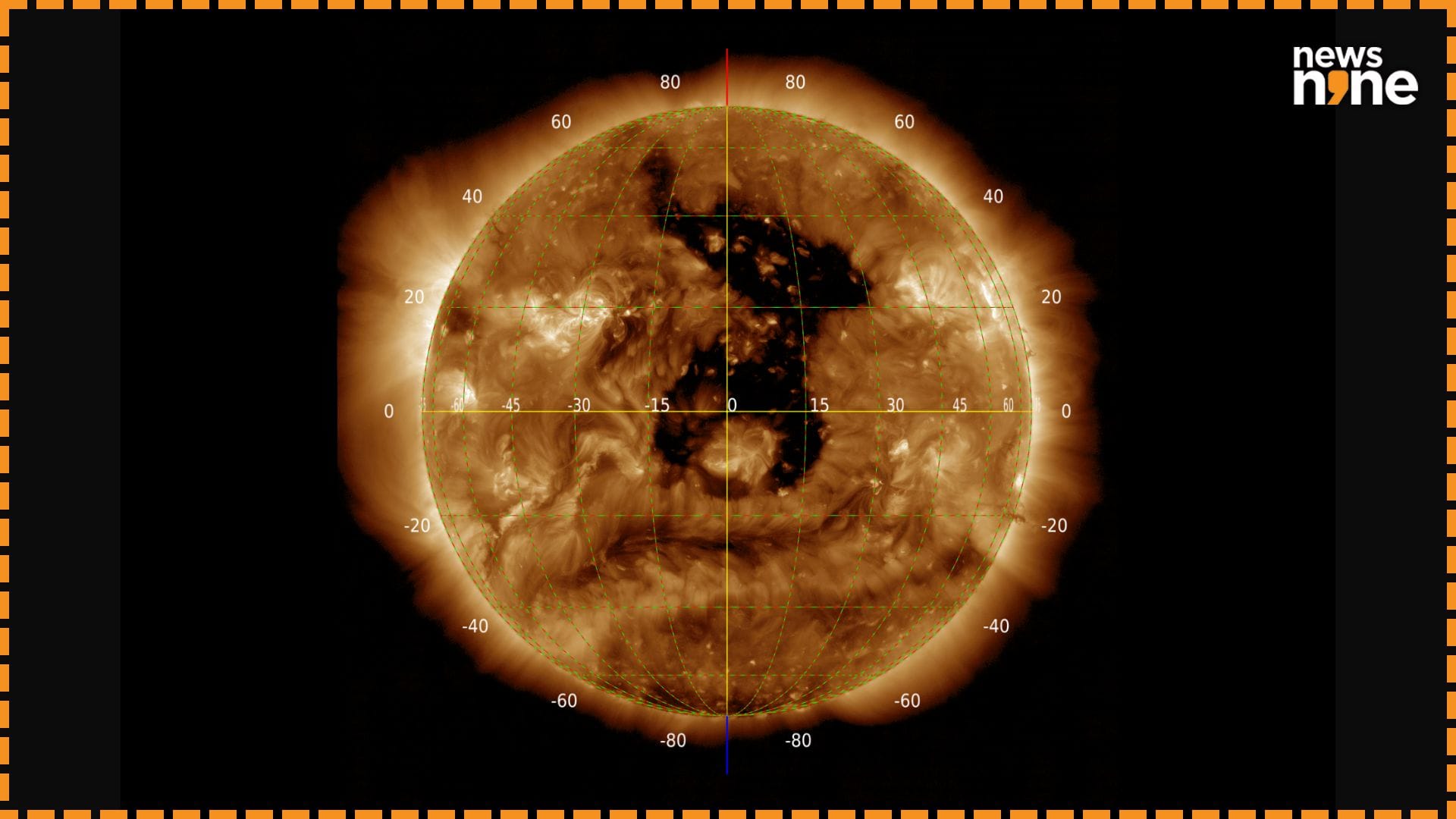
New Delhi: The geomagnetic field of the Earth was disturbed by a minor to moderate storm, because of the influence of a coronal hole high speed stream (CH HSS) that has recently crossed the central meridian. A coronal hole is a vast region on the surface of the Sun, where all the magnetic field lines are aligned outwards. This results in an increase in hot gas or plasma from the Sun streaming out into space, all in the same direction. These high speed streams are not as fast moving, violent or chaotic as coronal mass ejections (CMEs), but are sufficient to induce geomagnetic storms.
More disturbed periods are expected over the next 24 hours, as the CH HSS continues to wash over the Earth. Initial analysis indicated that the solar wind speed could increase to as much as 700 km/s. The Earth is within the fast solar wind stream, with observations indicating that the solar wind speed rose close to 600 km/s, before reducing to 520 km/s. The high speed stream is from a coronal hole designated as SIDC Coronal Hole 147, and is a large coronal hole that has grown in size since the previous rotation, when it also caused geomagnetic disturbances.
Space Weather Forecast
According to the forecast by the Space Weather Prediction Centre (SWPC) operated by the US National Oceanic and Atmospheric Administration (NOAA), “Enhanced solar wind conditions are expected to gradually taper off on 20-21 Apr as the CH HSS moves from its geoeffective position. A return to mostly nominal conditions are expected by 22 Apr.” According to the forecast by the Solar Influences Data Analysis Centre (SIDC) operated by the Royal Observatory of Belgium, “Similar fast solar wind conditions can be expected for the next 24 hours.” The coronal hole is now rotating out. Events of this intensity are not unusual, and there is no cause for concern.