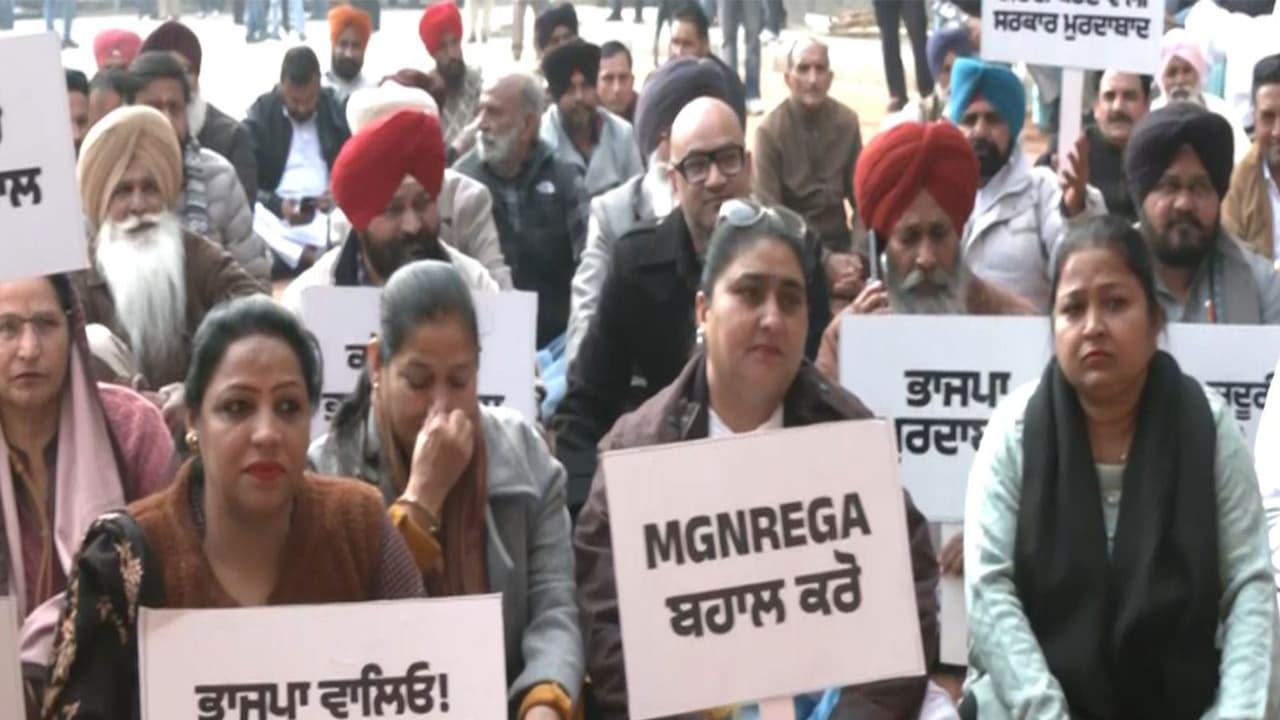
The Congress party launched nationwide protests against the new Viksit Bharat–G RAM G Act, which replaces MGNREGA. Congress leaders call the bill an attack on the poor’s livelihood, while the BJP government defends it as a progressive reform.
The Congress party on Sunday launched multiple protests against the overhaul of the national rural employment scheme, Viksit Bharat Guarantee for Rozgar and Ajeevika Mission (Gramin) (VB–G RAM G) Act, 2025, across the country. President Droupadi Murmu gave assent to the Viksit Bharat–Guarantee for Rozgar and Ajeevika Mission (Gramin) (VB–G RAM G) Bill, 2025, marking a significant milestone in the transformation of rural employment policy, as per a release by the President’s Secretariat.
Congress Alleges ‘Destruction’ of MGNREGA
The party has alleged that the scheme, known previously as Mahatma Gandhi National Rural Employment Guarantee Act (MGNREGA), is a “lifeline for the poor” and that the Bharatiya Janata Party (BJP) is “purposely destroying that Act and they want to make the poor villagers and farm labourers slaves of the rich.”
The Act enhances the statutory wage employment guarantee to 125 days per financial year for rural households. It seeks to advance empowerment, inclusive growth, convergence of development initiatives and saturation-based delivery, thereby strengthening the foundation for a prosperous, resilient and self-reliant Rural Bharat.
“MGNREGA is a lifeline for the poor. They are purposely destroying that Act and they want to make the poor villagers and farm labourers slaves of the rich. That’s why we fought to retain the MGNREGA law, and all its provisions should remain as they are. I condemn the new law, which is only helping the government,” said the party chief, Mallikarjun Kharge.
Congress leader Jairam Ramesh also said the fundamental character of MGNREGA has been changed, announcing that the Congress Working Committee meeting scheduled for December 27 will finalise an action plan for a nationwide movement across all states against the Viksit Bharat Guarantee for Rozgar and Ajeevika Mission (Gramin) (VB-G-RAM-G) Bill passed in Parliament. Speaking to ANI, Ramesh said the new legislation has taken away employment opportunities from rural, deprived and exploited sections of society.
“The fundamental character of MGNREGA has been changed; the basic structure of the scheme has been altered. The employment that was being provided to rural, deprived, and exploited people has been taken away,” he said.
Key Changes in the New Scheme
The new scheme brings in significant changes to the rural employment guarantee. The central government has increased the number of days for work from 100 days to 125 days, changed the share of centre-state fund sharing, with the Centre giving 60 per cent of funds and 40 per cent to be given by states, while northeastern states and Himalayan states, Uttarakhand, Himachal Pradesh, and Jammu and Kashmir, will have a 90-10 share. The law also allows the government to notify, in advance, an aggregating period of 60 days in the year where the scheme will be paused, covering peak agricultural seasons such as sowing and harvesting.
Nationwide Protests and Criticisms
The party, through its state units, launched several protests across the country, including in Jammu, Puducherry, Madhya Pradesh, and others. Apart from protesting on the streets, the party also held several press conferences.
‘Mahatma Gandhi Killed a Second Time’: Chidambaram
Addressing a press conference at Chennai’s Satyamurthy Bhavan, P Chidambaram claimed that by removing Mahatma Gandhi’s name from the bill, he has been “killed for the second time.” He also criticised the nomenclature of the legislation, alleging that it is neither proper English nor Indian, but merely Hindi words written in English letters, which even ministers find difficult to understand.
“Mahatma Gandhi has been killed a second time by altering the scheme. It is neither proper English nor Indian, but merely Hindi words written in English letters, which even ministers find difficult to understand,” he said.
The new scheme will not be implemented nationwide. The Central Government will decide which districts and regions receive work. It states that the scheme cannot be implemented for 60 days a year, without specifying which 60 days. If a district is declared as having ‘no work’, people cannot even demand employment. The new law contains several serious flaws… This is no longer an employment guarantee scheme. There is no guarantee at all, and the ones who will suffer the most are the poor,” said Chidambaram.
Congress leader Udit Raj also criticised the passage of the Viksit Bharat Guarantee for Rozgar and Ajeevika Mission (Gramin) (VB-G-RAM-G) Bill in Parliament, alleging that the legislation weakens the legal right to employment under MGNREGA and adversely affects rural labourers.
Protests in Puducherry and Jammu
Puducherry Congress also held a demonstration against the renaming restructuring of the scheme. “Today, Puducherry saw a demonstration against the renaming and restructuring of MGNREGA–the landmark social welfare programme that transformed the lives of millions of rural farmers, labourers and deprived sections,” the party posted on X.
“Under the leadership of its president, Ve Vaithilingam, along with the former CM of Puducherry, V Narayanasamy, and several other leaders and workers, the Puducherry PCC led the protest, raising slogans against the Modi government for their insensitivity towards the right to work guaranteed to the poor and its vendetta politics,” the party said.
Meanwhile, in Jammu, Congress workers clashed with the police while protesting against the act. “Today, the JKPCC, under the leadership of Tariq Karra, held a fierce protest against the BJP government’s move to snatch away the livelihoods of millions of poor workers and labourers. During the protest, the J&K police attacked the Congress workers and sealed the Congress headquarters’ entrance to stop them from raising this critical issue,” the party said.
Government Hits Back at Opposition
Meanwhile, Union Ministers have hit back against the opposition to the scheme, saying that a “conspiracy” is being hatched to mislead the country.
‘Conspiracy to Mislead’: Shivraj Singh Chouhan
In a video message released, Union Minister Shivraj Singh Chouhan alleged that a conspiracy is being hatched to mislead the country in the name of MNREGA and said that ‘Viksit Bharat – G Ram G’ law is in favour of the poor and development, and that this law provides a complete guarantee of employment to workers.
“A conspiracy is being hatched to mislead the country in the name of MNREGA. Misinformation is being spread…For our labourer brothers and sisters, there is now a guarantee of 125 days of work, not just 100 days…There is a provision for providing additional payment if wages are delayed and on the other hand, a huge sum of money, which is proposed for this year, is more than Rs 1,51,282 crore,” he said.
‘Progressive Bill’: Pralhad Joshi
Union Minister Pralhad Joshi also dismissed the claim that the act is an attempt to snatch employment opportunities from people, saying that the scheme instead will bring in more transparency, improve infrastructure and help with reverse migration.
“It is the most progressive bill. Some people are opposing it, claiming it will snatch employment opportunities in rural areas, which is false. It will bring transparency, and the number of job days has been increased from 100 to 125. It will improve rural infrastructure, support higher employment and consumption, and help in reverse migration,” the Union Minister said.
Earlier, Parliament passed the Viksit Bharat – Guarantee for Rozgar and Ajeevika Mission (Gramin) Bill, 2025, marking a decisive reform in India’s rural employment and development framework. The Act replaces the Mahatma Gandhi National Rural Employment Guarantee Act (MGNREGA), 2005, with a modern statutory framework that enhances livelihood security and is aligned with the national vision of Viksit Bharat @2047.
According to the government, the act is anchored in the principles of empowerment, growth, convergence and saturation, the Act seeks to transform rural employment from a standalone welfare intervention into an integrated instrument of development. It strengthens income security for rural households, modernises governance and accountability, and links wage employment with the creation of durable and productive rural assets, thereby laying the foundation for a prosperous and resilient Rural Bharat. (ANI)
(Except for the headline, this story has not been edited by Asianet Newsable English staff and is published from a syndicated feed.)