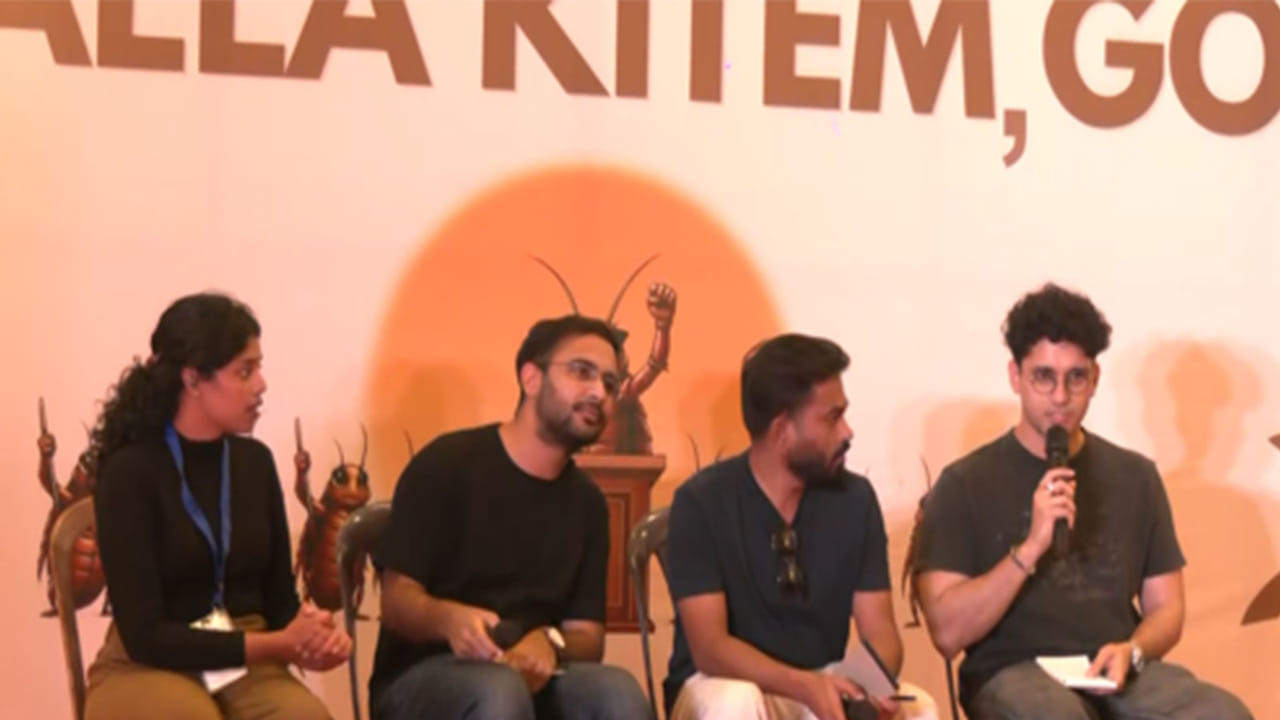
CJP activists launched the ‘Kya Bolti Public’ campaign in Goa, advocating for land rights, employment, and cultural preservation. They criticized government policies, including Section 39A, and announced the formation of ‘Cockroach Clubs’.
Cockroach Janta Party (CJP) activists Abhijit Dipke, Saurabh Das, Ashutosh Ranka and Ajinkya Shinde on Sunday attended the launch of the ‘Kya Bolti Public’ campaign in Goa, where they raised concerns over land rights, employment opportunities and the preservation of the state’s cultural identity. Addressing a gathering in Goa, Dipke praised the people who extended solidarity to the CJP movement despite having no prior association with the organisation, describing the spirit of standing up against injustice as the essence of being a ‘cockroach’.
Recalling the support extended by people in Goa during the movement’s protest at Jantar Mantar, Dipke said, “While we were sitting at Jantar Mantar, we had no clue that Goa was also on the streets. And you did that despite not knowing anybody from the CJP. You didn’t know anything about us, but still you were out on the streets. You were fighting for somebody you didn’t even know. You were showing solidarity for somebody you have never even heard about. And I think that is what a cockroach is. A cockroach is someone who fights for somebody who they don’t know, but they see the injustice, and they fight against it. That is CJP, and that is what it takes to be a cockroach.”
He also responded to remarks by Goa Chief Minister Pramod Sawant, who had reportedly questioned the presence of outsiders at CJP protests, and raised questions over the allocation of forest and land resources in the state. Referring to the Chief Minister’s remarks, Dipke said, “Many reporters told me—when I was speaking to the media this morning—many reporters were asking me that the Chief Minister of Goa, Mr. Pramod Sawant, said that in CJP’s protest, people from outside had come, and people from Goa were not there. I want to say to Mr. Pramod Sawant: there is no need to be afraid. There is no need to be afraid. Pramod bab, there is no need to be afraid. And I want to ask: who did you give Goa’s forests to? The people who come to CJP’s protests, you call them outsiders. Tell us, who did you give Goa’s forests to? Who did you give Karapur’s land to? Did you give it to the people of Goa? Who did you give it to? You gave it to your builder friends. So then, who are you to tell us who is an outsider and who is an insider? They are Indians! Indians!”
Dipke further demanded that Section 39A be scrapped, claiming that the provision could affect Goans’ ability to secure homes in their own state. He said, “Coming to the most important thing. What I believe is that this 39A… 39A… what should be done with it? It must be scrapped. 39A must be scrapped. Because if 39A remains, Goa will not remain. Goans will not remain, Goenkars will not remain. 39A is a way to ensure that Goans don’t get their own houses, don’t get their own homes.”
Highlighting the concerns of local residents over land access, Dipke also narrated his interaction with an elderly woman from Karapur, who, according to him, was facing restrictions while visiting a hill where a township project was underway. Recalling the woman’s account of collecting and selling fruits from the hill, he accused ministers and builders of taking over villagers’ land and questioned the treatment meted out to local residents. “Yesterday I had gone to Karapur. There, a 70-80-year-old grandmother met me, and she was telling me that she used to go up on that hill, gather some fruits, and sell those fruits. And now, when she goes up on that hill where that township project is going on, the security guards there call that grandmother a thief. Now who are the real thieves? Those who stole the land, they are the thieves. That land belongs to the grandmother; it belongs to the villagers. The thieves are all these ministers and their builder friends who stole their lands. And now you are calling those very villagers, those village residents, thieves? Have some shame. You’re stealing away the land of the people, and when the people are trying to visit their lands again, when they’re fighting to save their lands, you’re calling them thieves. This is so shameful. This is so shameful,” he said.
Meanwhile, CJP activist Saurabh Das highlighted the challenges faced by the country’s youth, particularly the shortage of employment opportunities and the growing gap between economic conditions and young people’s aspirations. Speaking about the employment situation, Das said that the government should be generating around one crore jobs annually to accommodate the growing workforce, while questioning the fulfilment of earlier employment promises. “In India today, you see the workforce shrinking. You see the economy completely unable to keep up with the aspirations of this generation. And that is the collective frustration and anger that we all face today.The government should be generating somewhere around one crore jobs a year. But what is happening? They said they will give 2 crore jobs. The youth are asking, where are those jobs? Today, if you are unable to generate even one crore jobs, how are you going to absorb the workforce, the young people coming out and searching for jobs? This is not going to happen. And hence you see people finally venting out, either on the streets or in their own way, in a peaceful way. And that is what this generation faces.”
Das also spoke about the launch of the ‘Cockroach Club’, a platform intended to bring young people and supporters together to discuss issues, exchange ideas and develop a political vision for the country. He said, “This is why we, as a movement, were thinking – what is it that we need to do next? Why are we here? What are the issues that we need to take up? You would have read that we have come up with a concept called the Cockroach Club. We had the launch yesterday in Pune, our very first Cockroach Club. And I am sure very soon we will have one Cockroach Club here in Goa too. In this club, we want to bring together young people, our supporters, bring them together under one roof and ask them – what is it that they want to discuss? What are the ideas that they want to debate? And we want to build a path forward for this generation, by ourselves. We want to ask what is the idea of India that this generation wants to create? What is the idea of India?”
Emphasising the need for a different approach to politics, Das said that dissent should not be treated as a law-and-order issue and that political discourse should reflect people’s lived experiences rather than narratives presented through television news. He asserted, “It is our attempt that through this Cockroach Club, through these kinds of public meetings, we actually create a path forward for a nation. Because enough of this politics. We are in need of a new kind of politics. One that does not treat dissent as a law and order problem. One that actually respects traditions, values, cultures and learns from them. And a politics that is created by the lived realities of the people, not the manufactured reality that they show us on 24×7 news.”
Das also referred to the concerns surrounding Section 39A and the role of the judiciary in matters affecting communities, citing the 2019 Supreme Court judgment concerning Scheduled Tribe communities. He said, “And guys, I want to finally say that with so many issues – 39A is such a big issue in Goa. If the government does not create issues, the courts create them. You saw the 2019 judgment of the Supreme Court against the Scheduled Tribe communities. The entire ST community across India was out on the streets because their rights were being violated by the very protectors of the Constitution – the courts, the Supreme Court. So we realised that we need a new kind of politics. And that politics is only achievable when enough number of people come together and resolve to do something to change the system. And if enough people come together, it is an achievable task. We will be able to get something done, if not all things done. And that is the power of the people. That is the power of the people that CJP wants to harness, wants to give a structured voice to.”
CJP activist Ashutosh Ranka, meanwhile, called on people in Goa to lead the fight for the protection of natural resources and land, saying that the issues faced by the coastal state were also relevant to other parts of the country. Describing Goa as a state that could lead the movement for the protection of ‘Jal, Jungle and Zameen’, Ranka said, “As Saurabh said, this is the smallest state of India. But I really do believe that the fight for Jal, Jungle and Zameen will be led by Goans. And we want you guys to show us the way. That is the spirit of India which we have forgotten. What happens to Goa is not outside us. I come from a state which hosts a lot of tourists, probably not as much as Goa, but a lot of tourists. And I am worried about my identity as well. So I understand where you guys are coming from. And that is why this platform was created for you. We are very uncomfortable when we have to sit here. Sorry, this is not the idea of CJP for us. We are not here to become leaders.”
Ranka further stressed that the CJP platform was built through the participation of people from different states and communities, rather than being limited to its initial organisers. Emphasising that the movement belonged to people across the country, he said, “We were just like you guys and we were still trying to make our voices heard. In all humility, we accept the fact that CJP as a platform was not made by us. He was the first person who took the plunge, but it was you – the Goans, the Malayalis, the Telugus, the Rajasthanis, everyone who came together and built this platform. While talking to a reporter, he casually asked me, “Sir, when are you coming to Delhi?” Forget that. Delhi might be the capital of India, but India also lives in Goa, India also lives in Maharashtra, India also lives in Kerala. Why should Delhi always dictate how this country will work and how this country will not work? Delhi will not dictate to you what you should do. They want all of us to speak the same language. They want all of us to eat the same food. They want all of us to have the same culture. We will not allow that. This is not the idea of India which our forefathers had in mind. This is not the idea of India. What makes India is the beauty of these states, of this diversity. And we will fight hard to protect this identity.”
Ranka said the gathering was organised to provide local residents with a platform to express their concerns and that the activists intended to listen to their views and experiences. He said, “The main idea of this event, of this platform, was to give you guys the voice, the platform, the space to talk and to make your voices heard. And that is exactly how we are going to proceed for the next one hour, two hours, whatever time it takes. We will sit here and we will just listen to what you have to say. It is not just about saving India. A lot of people think, even our own volunteers think, that we have to fight the long game. Cockroaches will never die. You know, we were silent for one month because we were enjoying a break, trying to spend time with family during Diwali. And already there is a small section that started writing obituaries – CJP is done, bro. And this will keep happening.”
Calling on young people to play a decisive role in shaping the country’s future, Ranka said that the next generation should determine the direction of India and that Goa should lead the way in defining the movement’s agenda. He said, “The youth of this country will decide what our future looks like, not the 75-year-old Mahamanav. The youth of this country will decide. You will not be there in 2047, we will be there. You will not be there. Goa should show the way to the country and we will listen to you. The idea of India will be decided, defined and demanded by Indian citizens, not by anyone else. This is just the very beginning. We are here for the long run. And together we will force the agenda of what we want for Goa and what we want for the rest of India.”