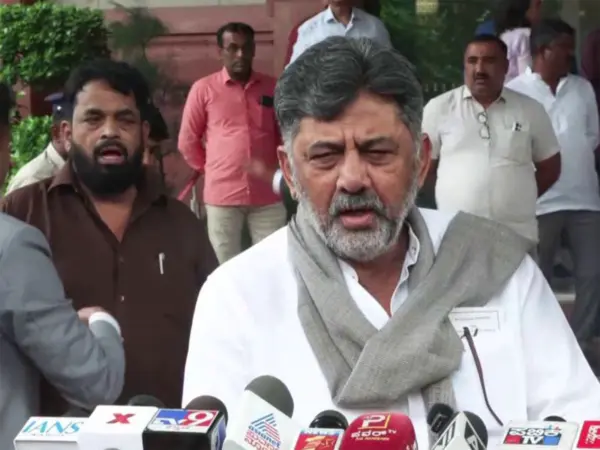
Karnataka Chief Minister DK Shivakumar on Wednesday said the state government will appeal against the order directing it to release Cauvery water, adding that he will discuss the matter with opposition leaders after returning to Bengaluru.
Speaking to the media, Karnataka CM said, “Regarding the irrigation matter, yesterday they issued an order saying that a little water should be released. We don’t know about that yet. They had rejected their request twice earlier. So, I have discussed with our ministers, including Minister MB Patil, and all the officials about filing an appeal against it. We are appealing against it. After that, we will make a decision. Once that is done, after I go to Bengaluru, I will also speak with the opposition party leaders.”
“Meanwhile, Tamil Nadu has also expressed a desire to come and speak to me about a few matters. The Chief Secretary has also written to me. They have also spoken to me on the phone. It is our duty to treat them with respect and give them what is due. I have told them, ‘Okay, come.’ Along with that, I have also made a request regarding our state’s Cauvery basin area. I have asked for helicopters to be arranged to inspect it,” he further added.
The Cauvery Water Regulation Committee (CWRC) has recommended that Karnataka release 3500 cusecs of water per day to Tamil Nadu for the next 15 days. The committee has also recommended releasing a total of 4 TMC of water.
Further, Deputy Chief Minister G Parameshwara also questioned how Karnataka could be directed to release Cauvery water to Tamil Nadu amid severe drought conditions in the state.
Parameshwara said it was unjustified to order Karnataka to release 3,500 cusecs of Cauvery water when the state itself was facing a drinking water shortage. “We release water when we have more than what we need. However, when Karnataka itself is facing a shortage of drinking water, such an order is not justified,” he said.
He said the Chief Minister had proposed convening an all-party meeting on the issue. “When water is available, we release it even without being asked. We have released more than the stipulated quantity in the past. But this year, when we do not have enough water even for drinking, how is it justified to direct us to release 3,500 cusecs?” he asked.
Parameshwara said Tamil Nadu Chief Minister may visit Bengaluru on August 3, although the visit had not yet been confirmed. “If he visits, we will raise the issue with him as well. The Chief Minister will meet legal experts in Delhi today and may take a decision after consultations,” he said.
On the protest call issued by pro-Kannada organisations over the Cauvery issue, he said farmers’ organisations and various groups in Mandya and surrounding regions would naturally protest. “They protested yesterday as well. They know that there is no water and are concerned that the Government may release whatever little water is available. That is why they are protesting,” he said.
Responding to Tamil Nadu writing to the Union Government opposing the Mekedatu project, Parameshwara said Karnataka had a legal right to implement the project and did not require Tamil Nadu’s consent. “The court has stated that Karnataka has a legal right over the Mekedatu project and does not require Tamil Nadu’s consent. They are free to write letters, and we have no objection. However, the Prime Minister is not above the court. The court’s decision is final,” he said.
On the BJP opposing CM Vijay’s visit to Karnataka over his stand against Mekedatu, he said disputes between neighbouring states were common in a federal system and should be resolved through dialogue.
He cited the recent presence of Andhra Pradesh Chief Minister Chandrababu Naidu, Telangana Chief Minister Revanth Reddy and Karnataka Chief Minister at the inauguration of new gates at the Tungabhadra reservoir.
“They discussed interlinking rivers and sharing water and agreed that the States should resolve these issues among themselves. When the proposal to build another reservoir was raised, the Union Minister for Jal Shakti said at the same event that the Union Government would bear 90% of the cost and the State would contribute 10%,” he said.
“If neighbouring States can discuss their concerns and resolve them amicably, why is the BJP objecting? Does it want States to remain in constant conflict? Perhaps the BJP’s policy is that States should not cooperate with one another,” he said.
On the Union Government’s response to the drought, Parameshwara said rainfall would be monitored until the end of August, after which another report would be submitted. “Normally, after a report is submitted in August, a Central team visits the State in September to assess the situation. It then examines the assistance sought by the State and determines the amount of relief to be released,” he said.
He said a comprehensive report on the prevailing drought situation had already been submitted to the Union Government. “We have primarily requested that Karnataka’s drought-affected regions be declared as areas affected by a natural disaster. We have also sought relaxation of some of the criteria prescribed by the Union Government for declaring drought,” he said. “Under the existing norms, some taluks facing rainfall deficits of up to 80% cannot be declared drought-affected. We have therefore requested that these criteria be relaxed,” he said.
On Cabinet expansion, Parameshwara said Rahul Gandhi, the AICC President, the party’s Karnataka in-charge, its general secretaries and the Chief Minister would discuss the matter in Delhi and take a final decision.
“Rahul Gandhi was on a foreign visit, and therefore there had been no opportunity for discussions. As Parliament is currently in session, greater priority must naturally be given to it,” he said.
Asked about discussions on appointing additional Deputy Chief Ministers, he said, “I have no information about it. We must accept whatever decision the High Command takes.”