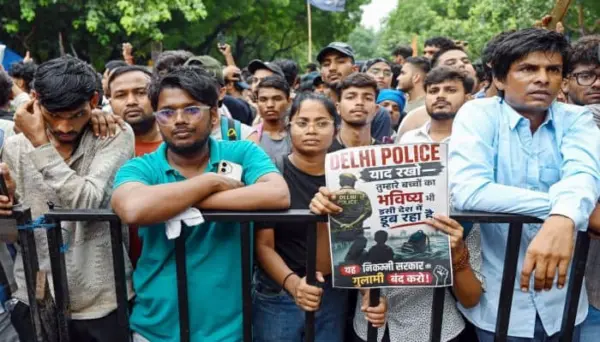
New Delhi: Public protests have long been a part of India’s democratic culture. In a country as diverse as India, demonstrations over political and social issues are common.
Over the past few years, however, there have been very few protests that appeared to put a strong central government under visible pressure.
The Cockroach Janta Party (CJP) emerged after comments were made about India’s democratic framework. What began as an online campaign has now turned into a street movement demanding resignation of Union Education Minister Dharmendra Pradhan over alleged NEET paper leak.
The way the Narendra Modi government initially responded to the CJP protest and social activist Sonam Wangchuk’s hunger strike suggested that it did not expect the movement to gather such momentum. The government appeared to believe that the protest would eventually lose steam on its own.
However, the events of Monday (July 20) painted a different picture. The demonstrations no longer appeared to be limited to CJP supporters. Large numbers of people who were unhappy with the government also joined the protests.
During the course of the agitation, several developments involving both the government and the protesters have made it difficult to piece together the sequence of events. They have also raised a number of unanswered questions. Let’s begin with the government’s decisions.
Why was the Delhi Police commissioner suddenly replaced?
On July 17, the Ministry of Home Affairs (MHA) unexpectedly removed Delhi Police Commissioner Satish Golcha from his post and appointed 1994-batch IPS officer Anurag Kumar as the new police commissioner for a three-year term.
According to The Indian Express, one of the reasons behind Golcha’s premature removal was reportedly the manner in which the police handled the CJPs protest at Jantar Mantar. The Telegraph also reported that the CJP protests were among the reasons for his transfer.
Quoting sources, the English daily reported, “Though the Home Ministry did not officially gave any reason for removing Golcha, the government was unhappy with some of his administrative decisions. One of them was the way the ongoing CJP protest at Jantar Mantar was handled.”
It further reported, “The news of Golcha’s removal came while he was attending a public tree plantation programme along with a Delhi government minister. This is the second time in less than a year that a Delhi Police commissioner has been transferred before completing his tenure.”
It added, “Last August, a day after an attack on Chief Minister Rekha Gupta during a public gathering outside her residence, the Centre transferred the then Delhi Police Commissioner S.B.K. Singh.”
The appointment of the new commissioner came just days before the start of Parliament’s Monsoon Session, which began on July 20. Golcha’s early exit and Kumar’s appointment have been viewed as a sign that the government was dissatisfied with the way the CJP protest had been handled.
Why did JP Nadda meet CJP leaders?
On Monday, the CJP claimed that the central government had reached out for talks for the first time since the protest began.
As thousands of supporters gathered for the ‘Chalo Sansad’ march, CJP spokespersons Saurav Das and Ashutosh Ranka met Union minister and former BJP president J.P. Nadda.
However, the minister said that it was the CJP representatives who had approached him for talks.
In other words, the CJP claimed the government initiated contact, while the government said that the initiative came from the protesters.
The meeting ended without any breakthrough. The government gave no assurance on whether it would accept the protesters’ demand seeking Pradhans resignation.
At the very time when thousands of students were trying to cross police barricades on their way towards Parliament, Prime Minister Narendra Modi was delivering his customary address before the Monsoon Session began. He made no reference to the developments taking place just a few hundred metres away.
While congratulating a Hyderabad-based company for the successful launch of a rocket, the prime minister also made an indirect reference to Leader of Opposition (LoP) Rahul Gandhi. Referring to the young team behind the achievement, he said it had been accomplished by people with an average age of 28 years, “not by a 56-year-old youth.
The comment was interpreted as a reference to the 56-year-old LoP in the Lok Sabha.
Questions over Wangchuk’s conditions for ending his fast
The government’s response to the CJP movement changed little during the early days of the protest. It had not formally acknowledged either the demonstrations led by the CJP or Wangchuk’s three-week hunger strike. But that changed only after the agitation began posing a bigger political challenge during Parliament’s Monsoon Session.
As the protest gathered strength, the police forcibly removed Wangchuk from the protest site and rushed him to the Safdarjang Hospital. His wife, Geetanjali Angmo, later said the family wanted to move him to a private hospital, but the authorities did not permit the transfer.
The government may not have expected students and young people from different parts of the country to travel to Delhi in such large numbers. What had largely played out on social media turned into a massive street protest, with thousands gathering in support of Wangchuk and the CJP.
The situation eventually led Nadda to meet a CJP delegation. Even after police used brute force to stop protesters during the march towards Parliament, many demonstrators continued with the protest.
Before this, the Modi government had stepped back from a major public agitation only once, when it repealed the three farm laws after the year-long farmers’ protest at Delhi’s borders.
Some political observers believe Prime Minister Modi could have sought the resignation of Pradhan. They argue that such a move would have been seen as an admission that the government had mishandled the issue.
In the initial phase, the government’s response was to avoid engaging with those on an indefinite hunger strike, while many of its supporters portrayed them on social media as ideological opponents of the BJP.
As Wangchuk’s health and that of the other hunger strikers continued to deteriorate, the government appeared to realise that any medical emergency could put its handling of the situation under greater scrutiny.
On Sunday, Wangchuk’s wife announced that he would end his fast if leaders of political parties met him and assured him that the issue of accountability in the education system would be taken up during Parliament’s Monsoon Session beginning on Monday.
Many viewed this as a relatively modest condition because it did not seek any direct commitment from the government.
However, the announcement was criticised by some commentators. Political commentator Professor Apoorvanand wrote, Very disappointing. The burden of accountability has now moved from the government to the Opposition. He is now asking Opposition leaders to come to him and assure him that they will make education an issue during this session of Parliament. It is deeply ironic. You have made accountability optional and treated it as equivalent to demanding accountability.”
He added, “Wangchuk is no longer at the centre of this movement. The people are. They have returned to the streets to reclaim their voice. Such a large turnout is a warning for the government. This is the people’s moment, and it has its own importance. Look at the crowds on the streets of Delhi and other cities. People have found their voice. Every such moment gives fresh energy to democracy. Wangchuk has now moved into the background. The people are speaking.”
Until Wangchuk began his indefinite fast, the CJP protest had attracted relatively modest crowds. Attendance rose after he was forcibly taken to hospital by the police.
From the beginning, CJP leaders maintained that they were willing to engage in dialogue. However, the government did not show much interest during the early stages of the protest. Wangchuk had previously been jailed by the government, and many believed he was aware that persuading it to change course would not be easy.
Why did Abhijeet Deepke end his hunger strike?
CJP founder Abhijeet Deepke announced an indefinite hunger strike after Wangchuk was admitted to the hospital. Until then, he had not been participating in the fast.
On Monday morning, he unexpectedly ended his hunger strike, saying he had done so at Wangchuk’s request.
Speaking from the protest site, Geetanjali Angmo said Wangchuk had asked Deepke to end his fast because the movement would need his energy in the days ahead. He then broke his fast by drinking juice.
Soon after ending the hunger strike, he and Angmo joined the march towards Parliament.
Unlike many student leaders, he did not emerge from university campus politics. Earlier, he had worked as a volunteer for the Aam Aadmi Party (AAP) during its anti-corruption campaign. His political opponents, including the Bharatiya Janata Party (BJP), have used that association to question his political independence. However, he has maintained that the CJP will continue as an independent movement.
Senior journalist and media analyst Ammu Joseph described the rapid rise of the CJP as noteworthy. Speaking to The Hindu, she said, “The swift and entirely justified public response to the shocking and completely unacceptable words used by the Chief Justice of India about young Indians has been encouraging.”
She added, “Several respected and credible news organisations reported the Chief Justice’s observation while addressing a lawyer in open court. In such circumstances, the claim that his statement was misrepresented is difficult to accept.”
Referring to the movement’s rapid growth, Joseph further said, “The Chief Justice’s remark reminded many people of the language used a few months ago to insult New York Mayor Zohran Mamdani. In that case, the comment came from a right-wing radio host, who apologised and deleted the post after facing public criticism. The speed with which the CJP has developed, complete with its own website, anthem, manifesto and campaign material, is truly remarkable. I will certainly continue to follow this movement in the coming days.”