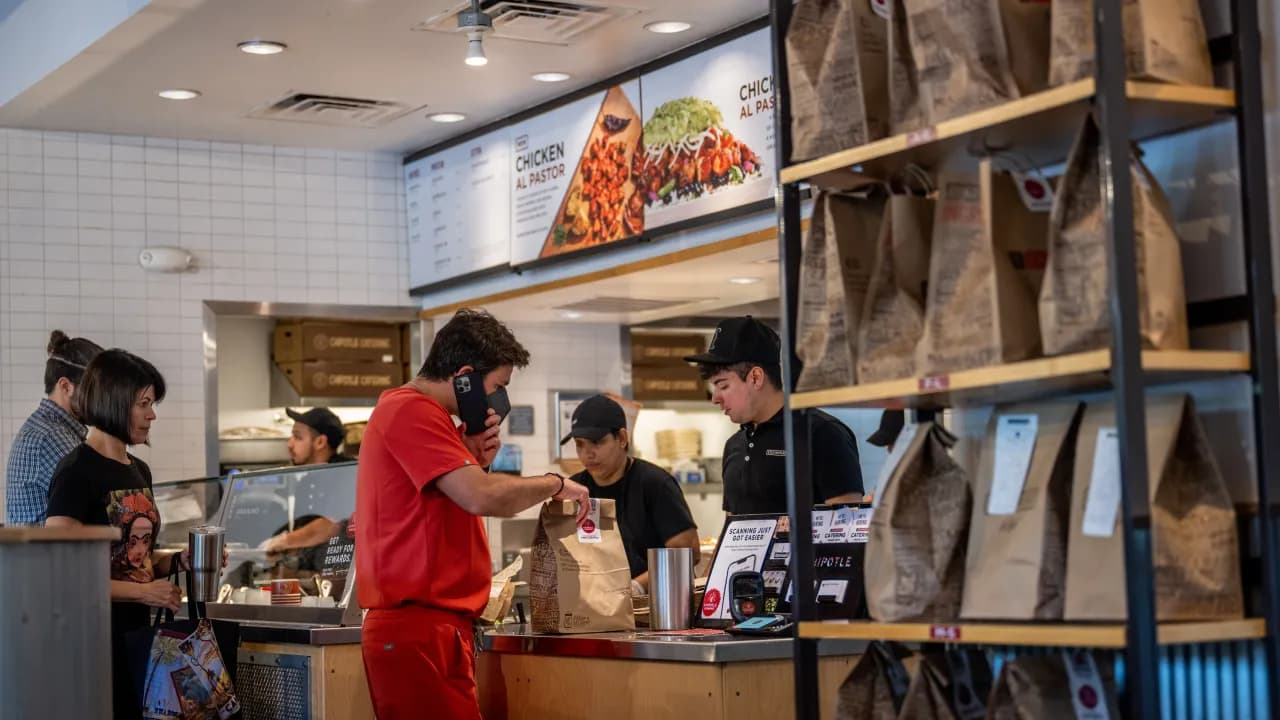
An interim who was named full-time CEO of Chipotle and has the backing of Bill Ackman is navigating a highly volatile fast-food environment burdened by higher costs, tariffs and slowing consumer spending.
- After Chipotle’s turnaround, CEO Brian Niccol left for Starbucks, and operating head Boatwright was named as the interim to helm the burrito chain.
- This year, Chipotle signed a development agreement with Alsea to open restaurants in Mexico for the first time, with the first opening by early 2026.
- In December, Chipotle announced its first-ever high-protein menu, which rolled out in the U.S. and Canada on Wednesday.
Since late 2024, Chipotle Mexican Grill has had a new CEO at the helm, leading the famous burrito chain through a volatile period of consumer uncertainty and macroeconomic burdens following its previous head’s departure to lead coffee giant Starbucks.
Under Scott Boatwright, revenues have steadily grown, and Chipotle has doubled down on its menu offerings to attract customers as the restaurant industry faces a slowdown in traffic due to macroeconomic pressures that weigh on consumer spending across the board.
Boatwright’s COO Experience
When Chipotle’s turnaround CEO, Brian Niccol, left for Starbucks, the operating head, Boatwright, was named interim to helm the burrito chain. Boatwright, who joined Chipotle in 2017, along with Niccol, had helped pull the restaurant out of its struggles after an E. coli outbreak.
When Boatwright was named the interim head, Bill Ackman, whose Pershing Square Capital Management is one of Chipotle’s biggest investors, had noted that the company was in good hands.
Wall Street had expected Boatwright back in 2024 to deliver on every initiative in place for the company to succeed, even with Niccol, who was supposed to be Chipotle’s crown jewel, departing.
Building on the plans, Chipotle signed an agreement earlier this year with Alsea to open restaurants in Mexico for the first time, with the first opening by early 2026.
Burritos And Bowls – Out Of Style?
The changing consumer landscape has also hit Chipotle, which has weathered a slowdown in demand during the COVID-19 pandemic, driven by digital orders.
Boatwright, in October, noted that slowing wage growth and rising unemployment have pressured the younger generation, mainly, to pare back spending on dining out and cooking at home to save money.
On the earnings call, Boatwright said that consumers with household incomes below $100,000 represent about 40% of the chain’s total sales. “A particularly challenged cohort is the 25- to 35-year-old age group. We believe that this trend is not unique to Chipotle and is occurring across all restaurants, as well as many discretionary categories,” Boatwright.
The company, like other fast-food chains — including Jack in the Box — is facing higher commodity costs, mainly for beef, as well as tariffs, which have also pushed up the prices of avocados, a key ingredient used by Chipotle.
Menu Innovation Under Boatwright
Boatwright said that the promotional environment has intensified, with value as a price point and menu innovation escalating throughout the year. To keep younger consumers interested, Chipotle has been refreshing its product offerings.
Chipotle announced its first-ever high-protein Menu, which rolled out in the U.S. and Canada on Wednesday. The curated menu features fresh grilled, hand-cut Adobo Chicken, at 32 grams of protein, meeting consumer demand for a quick, protein-packed snack.
The company has been researching how to keep Gen Z customers ordering. One way it has built on this is through a partnership with Zipline, the autonomous delivery system, to fly digital orders to guests’ locations in greater Dallas.
How Are Stocktwits Users Reacting?
Retail sentiment on Chipotle turned ‘bearish’ from ‘neutral’ a week ago, with message volumes at ‘low’ levels, according to data from Stocktwits. The retail user message count on the stock has jumped 450% in the last year, while followers have jumped by 8%.
Sentiment on Starbucks also dipped to ‘neutral’ from ‘extremely bullish’ territory a week ago, with message count at ‘normal’ levels.
Overall, this year has not been kind to restaurant stocks. Shares of Chipotle have slumped by over 37% this year, while Starbucks stock has declined by nearly 5% and Cava has seen its shares tumble by 45% year-to-date.
For updates and corrections, email newsroom[at]stocktwits[dot]com.<