New Delhi: A team of researchers from the Institute of Vertebrate Palaeontology and Palaeoanthropology from the Chinese Academy of Sciences have discovered two bird fossils in Jurassic rocks from the Fujian Province in southeast China. The rocks date to approximately 149 million years ago. The fossils fill a spatiotemporal gap in the record of early bird evolution, and provide evidence that birds diversified by the end of the Jurassic period. A paper describing the research has been published in Nature. Birds are the most diverse group of terrestrial vertebrates. Some macroevolutionary studies indicate that their earliest diversification occurred 145 million years ago in the Jurassic period.
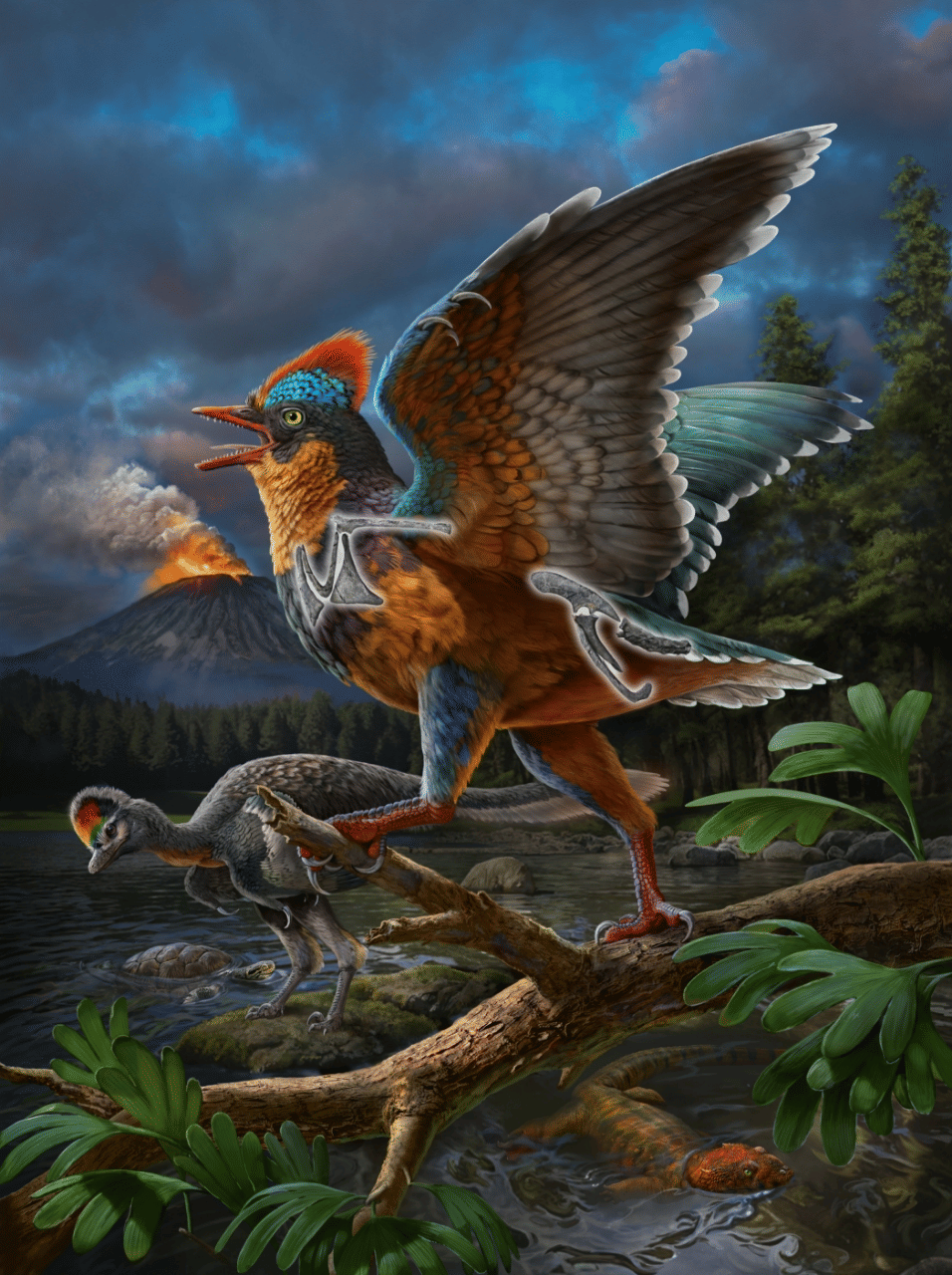
Life reconstruction of Baminornis zhenghensis. (Image Credit: Zhao Chuang).
However, the early evolutionary history of birds has remained unclear due to a highly fragmentary fossil record, with the Archaeopteryx being the only widely accepted Jurassic bird. Archaeopteryx possessed feathered wings, but retained a long reptilian tail, unlike the short-tailed form of modern and Cretaceous birds. Recent analyses have questioned its status of an avian, as against classifying it as a deinonychosaurian dinosaur, a sister group to birds, prompting debate over the existence of unambiguous Jurassic birds in the fossil record. The Baminornis zhenghensis fossil provides the evidence of a short-tailed Jurassic bird.
The earliest known short-tailed bird
The creature combines bird-like shoulder blades and pelvic girdles derived from ornithothoracine with a primitive hand structure similar to non-avian dinosaurs, and illustrates mosaic evolution in early birds. It has a short tail ending in a pygostyle, which is a compound bone seen in living birds. Previously, the oldest short-tailed birds dated to the Early Cretaceous. Baminornis zhenghensis is the only Jurassic and oldest shot-tailed bird discovered, advancing the origin of short-tailed birds by nearly 20 million years. The second fossil is an incomplete furcula, and was analysed using geometric morphometrics and phylogenetics, supporting its links to a diverse Cretaceous bird group known as Ornithuromorpha. Due to poor preservation, no new taxon was named, and its placement requires additional evidence.