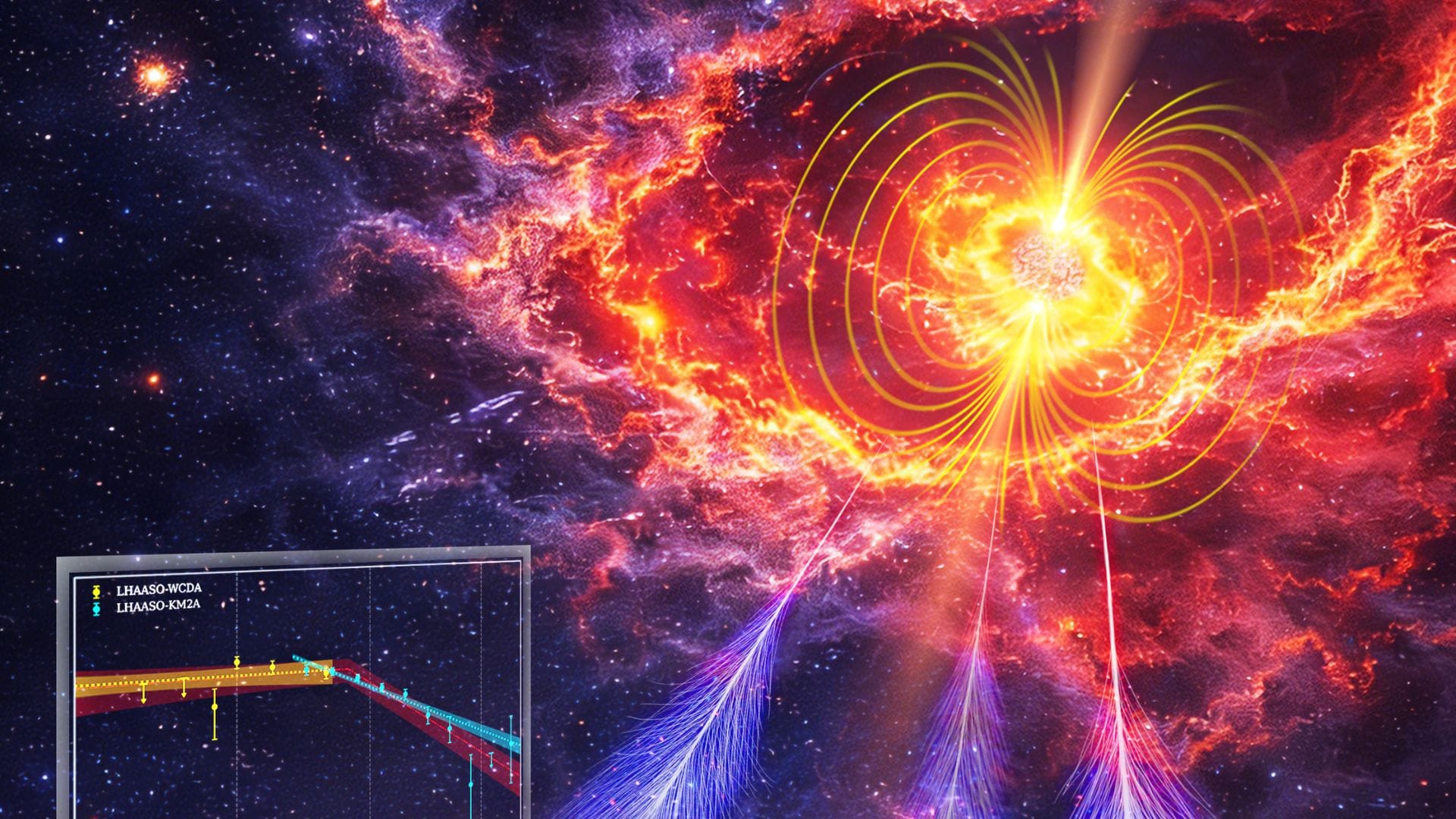
New Delhi: The Large High Altitude Air Shower Observatory (LHAASO) in China has detected energetic gamma-ray emission from a pulsar wind nebula, powered by a pulsar designated as PSR J1849-001 in the constellation of Aquila, which challenges the conventional theories on particle acceleration in Pulsar Wind Nebulae. The discovery is important because the calculated particle acceleration efficiency of the celestial structure approaches or even exceeds the theoretical limits allowed, even under ideal magnetohydrodynamic conditions. A paper describing the research has been published in Nature Astronomy.
A pulsar wind nebula is a spectacular, high-energy celestial structure formed when a pulsar, or a rapidly rotating, highly magnetised neutron star, expels a wind of charged particles moving at nearly the speed of light into the surrounding space, where it violently collides with the surrounding ambient medium. The Crab Nebula is among the most famous examples of a pulsar wind nebula, and is driven by the most luminous spin-down-powered pulsar in the Milky Way. This is a type of pulsar whose energy is derived from the slowing down of its rotation. Based on previous observations of gamma rays from the Crab Nebula, LHAASO determined that its particle acceleration efficiency is at least at 16 per cent of the theoretical limit, pushing the limits of existing acceleration models.
Natural Particle Accelerators
The current study focuses on another pulsar wind nebula system, that has a spin-down luminosity about 50 times lower than the pulsar in the Crab Nebula. Lower luminosity typically corresponds to a weaker radiation luminosity, but the Aquila Booster exceeds the limit up to 2 PeV, with a gamma-ray luminosity several times higher than that of the Crab Nebula. These observations suggest that the system is astonishing efficient at accelerating particles. The striking results challenge current theories of particle acceleration in pulsar wind nebula, and provides crucial inputs for refining the theoretical framework of pulsar wind nebulae.