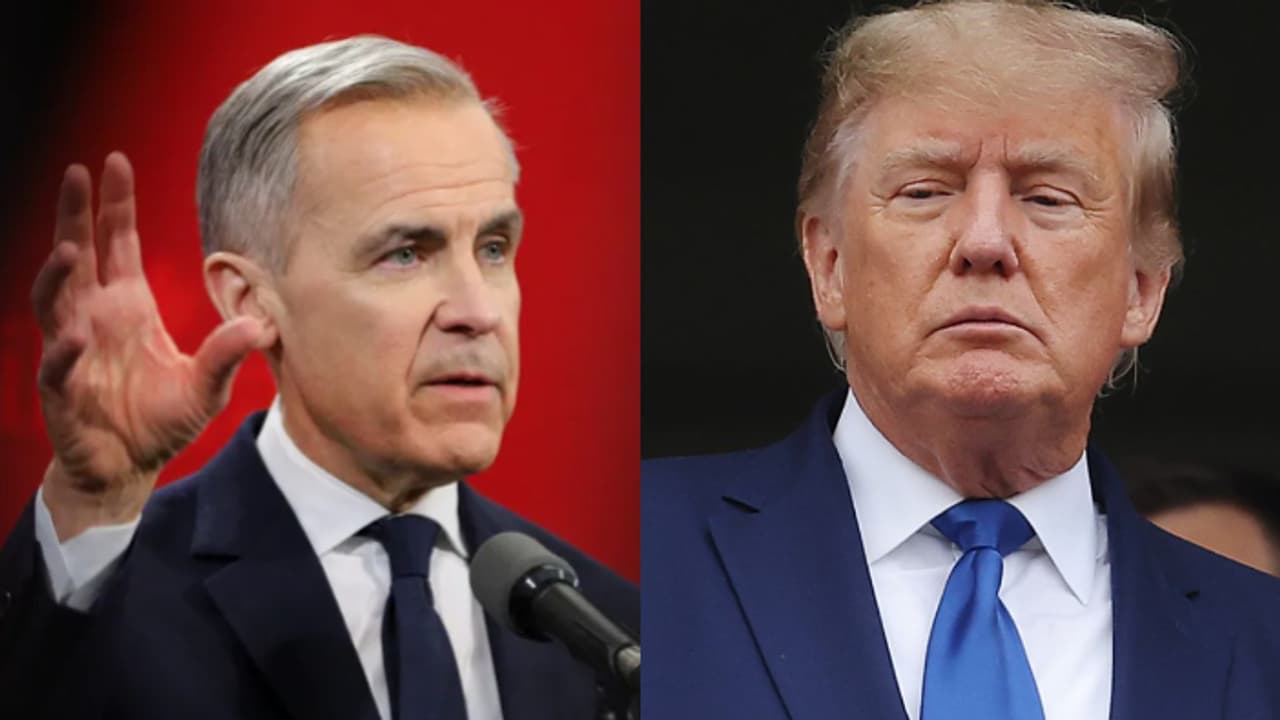
At the World Economic Forum, US President Trump criticized Canada for opposing the proposed “Golden Dome” missile defense system in Greenland. He accused Canada of aligning with China, particularly after Ottawa signed a new trade deal with Beijing.
At the World Economic Forum in Davos, US President Donald Trump launched an unusually combative attack on Canada, accusing its government of undermining North American security by opposing the proposed Golden Dome missile defence system in Greenland — and signalling broader strains in the long-standing alliance between Ottawa and Washington.
Trump’s criticism was posted on his social media platform Truth Social, where he said Canada was “against The Golden Dome being built over Greenland, even though The Golden Dome would protect Canada.”
He went further, asserting that Canada had sided with China, and warned that Beijing would “eat them up within the first year” because of deeper economic engagement between Ottawa and Beijing.
The Golden Dome project — Trump’s ambitious space-based missile defence concept — is framed by his administration as a comprehensive shield over North America designed to detect and intercept incoming threats early. Greenland’s strategic location in the Arctic makes it key to any high-latitude defence network. Trump’s supporters argue this system would significantly bolster continental security.
However, Canada’s political leadership, including Prime Minister Mark Carney, has expressed reservations about the plan. Officials have questioned its strategic value and cost, and some view it as an unnecessary militarisation of the Arctic. Canada’s ambassador to the United Nations previously called the idea a “protection racket,” reflecting deep scepticism in Ottawa about Washington’s motives and fairness of the proposal.
In his Davos address, Carney also criticised what he called the coercive tactics of larger powers and underscored the importance of respecting national sovereignty. These remarks, which didn’t name Trump but were widely interpreted as a critique of US foreign policy, reportedly triggered part of Trump’s reaction.
Tensions have further escalated because Canada recently struck a major trade agreement with China, aimed at opening new export markets valued at more than $7 billion for Canadian businesses and workers — a move Trump seized on to argue that Canada had chosen economic ties with Beijing over strategic alignment with Washington.
Carney, for his part, defended Canada’s independent path, saying the country “thrives because we are Canadian” and emphasizing that Ottawa seeks diversified global partnerships, not dependence on any single power. Canadian trade officials have said the deal with China included tariff reductions on agricultural products and a framework for electric vehicle imports, illustrating Ottawa’s attempt to balance economic opportunities with existing security partnerships.
Analysts note that this public spat marks a rare moment of open discord between two NATO allies, highlighting growing unease in Ottawa about US pressure and broader geopolitical shifts as China’s global influence expands.
Whether this rhetoric will translate into lasting policy divergence remains to be seen, but for now, diplomatic tensions between Ottawa and Washington are far more visible than usual.