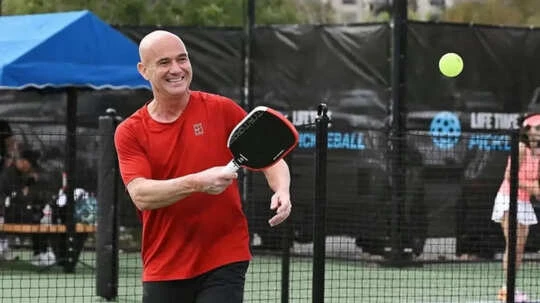
Tennis great Andre Agassi believes the next major leap for pickleball could come from China. Speaking during the China leg of the JOOLA Titans Tour 2026 last week, the eight-time Grand Slam champion pointed to the country’s infrastructure, scale, and sporting culture as key ingredients that could propel it into a dominant force in the fast-growing sport.
Agassi, who also owns an Olympic gold medal, did not hesitate in outlining why China stands out. “All the ingredients are right for this part of the world,” he said about China. “You’ve got space, you’ve got land, you’ve got weather, you’ve got facilities. You have a population where if you can get the paddle into young children’s hands, you’re going to start seeing a lot of them break through on a world stage.”
His assessment comes at a time when pickleball’s footprint in China is expanding at remarkable speed. According to Sun Wenbing, deputy secretary-general of the Chinese Tennis Association, the China Pickleball Tour has ballooned from 80 tournament stops in 2024 to more than 600 this year. The surge reflects not just growing interest, but also strong institutional backing – an approach that echoes China’s proven model in table tennis, where mass participation and early talent identification have historically produced world-beating athletes.
For Agassi, however, pickleball is more than just numbers and projections – it is deeply personal. His introduction to the sport began at home, alongside his wife, fellow tennis legend Steffi Graf, and their children. “What got us into it was us playing together as a family,” he said. “Something Steph and I have done our whole life, we were still able to do it with our children. Everybody was enjoying it. We loved that. That’s what got us into it.”
That early, casual engagement soon evolved into a more meaningful pursuit. Agassi described pickleball as offering a rare blend of physical exertion and mental sharpness, coupled with a constant opportunity to improve. “We had to unlearn many things from tennis,” he noted. “So there was a physical outlet, there was a mental challenge, and there was a nuance to it that made us feel every day from the first day that we can get better. And we haven’t stopped feeling that way.”
Now an active ambassador for the sport, Agassi is keen to play a role in shaping its future. He emphasised pickleball’s broader impact beyond competition, particularly its ability to foster community and enhance well-being. “I want to contribute to helping you grow, because I think it adds so much to people’s life health, physical, mental health, an outlet of community,” he said, while also outlining plans to help develop a World Series of Pickleball as a global competitive platform.
Also present at the event was world No. 1 Ben Johns, who addressed a common perception about the sport – that a tennis background is essential for success. “I think that you’ve seen most top players having a background in tennis or table tennis thus far,” Johns said. “But I don’t think it’s fully necessary if you are learning pickleball from a young age.”
That insight carries particular relevance for China, where a new generation could take up the sport without needing to adapt from other disciplines. Such a pathway, Agassi suggested, may unlock levels of performance yet to be seen in pickleball.
For now, the sport’s rise continues to gather pace – and Agassi, watching it unfold from close quarters, appears both unsurprised and optimistic. “It’s great to see how fast pickleball is growing,” he said. “And I’m just pleased and grateful to be part of it.”