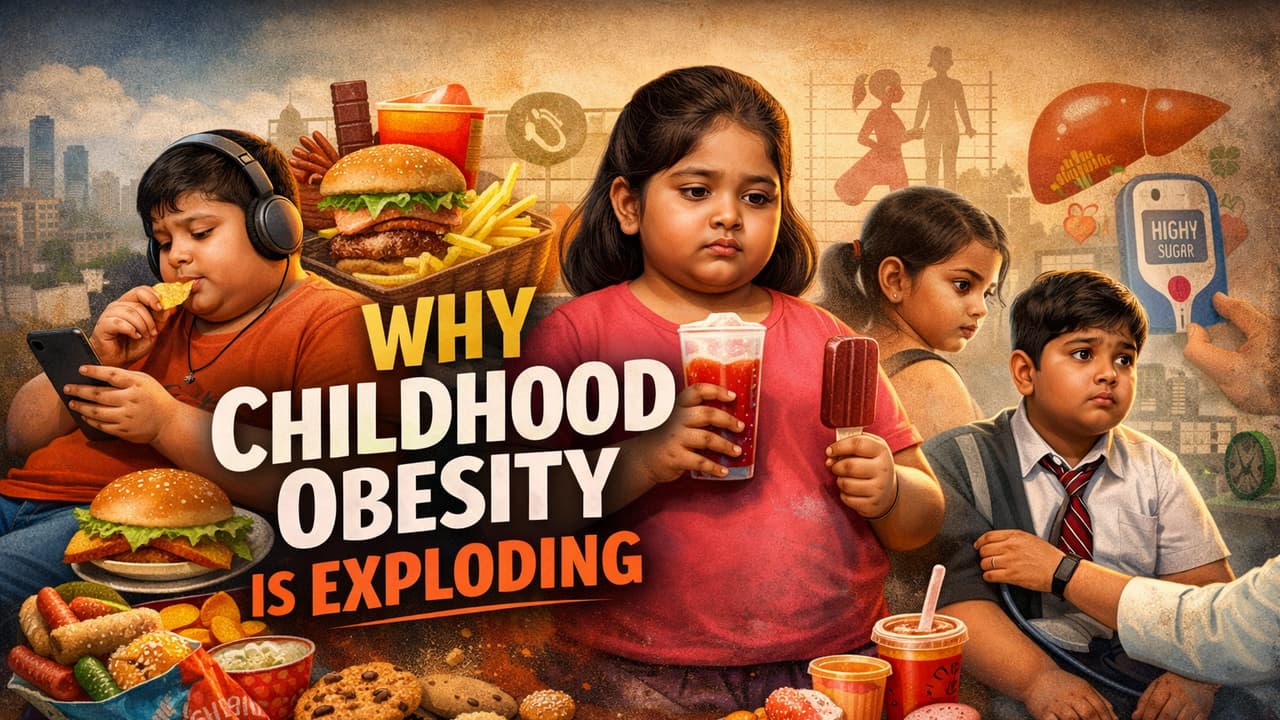
Childhood obesity is rising while kids remain nutritionally starved. From constant snacking to hidden sugar, modern diets are harming metabolism, hormones, and long-term health. Here’s why it’s happening and what families can change now.
There is a strange paradox unfolding in front of us. We are raising a generation of children who are bigger than ever before, and yet, more nutritionally starved than ever. Their stomachs are full, but their cells are empty. Their plates look colourful, but their bodies are quietly struggling.
Childhood obesity is not just a statistic anymore. It’s becoming the lived experience of families everywhere. In cities, small towns, schools, playgrounds, even homes where parents are consciously trying to “give the best” to their kids.
But what does “the best” even mean today?
Somewhere between convenience, packaging, advertising, and the pressure to keep children “fed and happy,” we have normalised something that should never have become normal.
This blog is not about blame. It’s about awareness and urgency because the crisis is not loud. It creeps in quietly, snack by snack, habit by habit, year by year until one day, a child’s body begins to show signs that something is deeply off .
THE SHIFT NO ONE NOTICED — UNTIL IT WAS TOO LATE
A generation ago, childhood looked different. Kids ran, played, scraped their knees, came home hungry, and ate whatever was cooked. Meals were meals. Snacks were occasional. Sweets were treats, not daily habits.
Today, childhood has been redesigned. A snack for the car ride, a snack between online classes, a snack while doing homework, a snack while watching TV, a snack before bed. Food is everywhere but ironically, nutrition is nowhere. Doctors across India report an alarming rise in:
- Childhood obesity
- Early puberty
- PCOS and PCOD in girls as young as 9–10
- Type 2 diabetes appearing in children
- Fatty liver and hypertension in teenagers
These used to be adult diseases but now they’re appearing in school health checkups. The truly frightening part? Most of this isn’t genetic. It’s environmental, it’s food-driven and it’s preventable.
THE REAL REASON KIDS ARE GAINING WEIGHT AND LOSING HEALTH
Children today are eating more calories, but less nutrition than any generation in history. It’s not overeating. It’s undernourishment in the middle of overconsumption.
- The Rise of Package-Based Childhood
Open any school tiffi n box and you will see a new “normal”. Biscuits, chips, flavoured yogurts, juice, energy bars, fries, instant noodles.
Even foods marketed as “healthy” are loaded with sugar, chemicals, refi ned oils and fl avour enhancers that overpower a child’s natural satiety signals. These foods don’t nourish. They stimulate, confuse and addict. They make children want more, need more, and eat more, while giving their bodies almost nothing of value.
2. Snacking Culture Has Broken Hunger
Children today eat 7–10 times a day. Not because of hunger, but because of habit.
When insulin stays elevated all day due to constant snacking, the body gets stuck in fat-storage mode. It never gets a chance to reset or restore. This is why we see young kids:
- Gaining weight rapidly
- Feeling tired easily
- Experiencing mood swings
- Struggling with focus
- Craving sugar constantly
Their metabolic machinery is stressed long before adulthood arrives.
3. Sugar Is No Longer a Treat, It’s a Lifestyle
The average child today consumes sugar not just through sweets, but through:
- Cereals
- Juices
- Milkshakes
- Ketchup
- Bread
- Packaged snacks
- “Fruit-fl avoured” drinks
- Hidden sugars in “healthy foods”
Excess sugar in childhood does more than cause weight gain. It disrupts hormones, speeds up puberty, affects sleep, weakens immunity, and contributes to insulin resistance. The body may look chubby, but inside, it is struggling to find minerals, vitamins and amino acids necessary for growth.
THE MOST SILENT DANGER: OBESE BUT MALNOURISHED
A chubby child is not necessarily a nourished child. This is the hardest truth for parents to accept because we often associate weight with health. But modern childhood obesity is diff erent. It comes from foods that are high in calories but low in micronutrients.
So the child grows but not in the way they should. They grow outward, but not upward in immunity, strength, cognitive health or hormonal balance. This internal starvation has long-term consequences:
- Early Puberty
In many girls, puberty now starts 2–3 years earlier than before. Excess fat tissue increases estrogen production, triggering early breast development, mood swings, acne, and eventually PCOS symptoms.
2. PCOS & PCOD in Childhood
We are now seeing PCOS in 11–12-year-olds. Something that was practically unheard of two decades ago.
Most cases stem from:
- High sugar intake
- Processed food consumption
- Obesity
- Insulin resistance
These factors disturb the delicate hormonal dance that a young girl’s body is supposed to perform.
3. Type 2 Diabetes in Children
“Adult-onset diabetes” is no longer an adult. It’s aff ecting children who:
- Snack frequently
- Live a sedentary lifestyle
- Consume sugary drinks regularly
- Eat mostly packaged foods
Insulin resistance begins quietly, long before diagnosis.
4. Hypertension, Fatty Liver & Metabolic Syndrome
These “adult diseases” are now paediatric diagnoses. A child who drinks fruit juice regularly is at higher risk of fatty liver than a child who eats occasional sweets.
Why? Because fructose, especially the processed kind, gets stored directly in the liver.
WHY WE CANNOT SAY “IT’S JUST BABY FAT” ANYMORE
The biggest myth in Indian households is:
“Kids will lose weight as they grow.” But science tells a diff erent story. 80% of overweight children continue to be overweight adults because childhood obesity:
- Rewires appetite hormones
- Weakens metabolic flexibility
- Alters fat-storage pathways
- Creates lifelong insulin resistance
By the time these children reach their twenties, the foundation for chronic disease is already laid. We are not losing them at 40 or 50. We are losing them in childhood.
SO WHAT CAN WE DO? SMALL CHANGES CREATE BIG FUTURES
Parents don’t need perfection. Children don’t need diets. They need better routines, not stricter rules.
Here’s where real change begins:
- Return to Real Food
Instead of:
- Cereal → give eggs or homemade dosa/idli
- Packaged snacks → nuts, fruits, boiled corn
- Juices → water, coconut water, buttermilk
- Packaged tiffin → roti sabji, rice dal, poha, upma
2. Reduce Snacking
Three meals + 1 snack is enough for most children. Their stomach needs breaks. Their hormones need rhythm. Their metabolism needs rest.
3. Prioritise Movement Over Exercise
Children don’t need gyms. They need freedom to move.
- Outdoor play
- Cycling
- Skipping
- Sports
- Dancing
Movement is medicine for metabolism.
4. Create a Supportive Home Environment
Kids eat what is available. The simplest truth is this:
If junk is at home, junk will be eaten. If fruits are cut and visible, that’s what they will reach for. Children follow what they see, not what they are told.
5. Lead by Example
A child’s health mirrors the household’s atmosphere. Not the rules.
When parents:
- Eat mindfully
- Avoid emotional eating
- Prioritise real food
- Keep screens away during meals
- Make movement part of life
Children absorb these patterns naturally.
THE REAL CRISIS ISN’T OBESITY. IT’S WHAT OBESITY IS DOING TO CHILDHOOD.
Childhood should be a time of energy, curiosity, play, messy eating, discovery, and growth. But for many children today, childhood is becoming a cycle of tiredness, cravings, mood swings, weight anxiety, hormonal issues, doctor visits.
We owe our children more than that. We owe them a childhood where their bodies feel light, energetic, capable, nourished and alive.
Childhood obesity is not a weight issue. It’s a nourishment issue. A hormone issue. A food environment issue. A cultural shift issue. And the good news? Small family-level changes can reverse this trend faster than we think.
We cannot wait for schools, governments or policies to rescue our children. The rescue begins at home. In the kitchen. On the playground. In the choices we make daily. The crisis is silent but our response does not have to be.