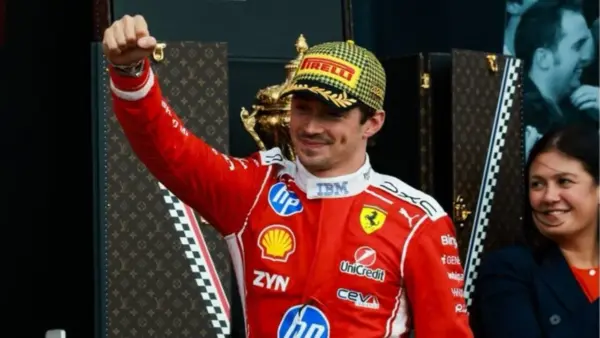
Charles Leclerc believes subtle changes to Ferrari’s approach helped end his difficult run of form after claiming victory at the British Grand Prix, with Lewis Hamilton’s setup direction emerging as a key part of the Scuderia’s progress.
Leclerc’s win at Silverstone was his first in Formula 1 in more than 20 months and came after a spell that included two retirements and two crashes in the previous three races. While Hamilton had been growing increasingly comfortable inside Ferrari following his breakthrough victory in Spain, Leclerc admitted he had been battling both on-track struggles and external criticism.
Charles Leclerc explains how Ferrari solved his recent struggles
Leclerc revealed that Ferrari’s turnaround began after he studied telemetry following Friday’s Sprint sessions at Silverstone and realised aspects of the car no longer suited his natural driving style.
“Just a few things I saw on the data on Friday night, and I was like, OK, that might be things that just don’t fit with my driving style.”
Rather than overhauling the way he drives, Leclerc said he chose to adapt the Ferrari around his strengths.
“I went towards the second route, which was to stick with what I know worked in the past and try to find a way around with the car and with the tools I have available inside the car.”
According to analysis by The Race, Leclerc’s qualifying telemetry showed a noticeably different approach compared to Sprint qualifying. He carried more speed through Silverstone’s high-speed sections, matched Hamilton’s gear usage more closely and appeared significantly more confident on throttle application through several key corners. *The Race* also noted that Ferrari’s setup changes appeared to give Leclerc greater rear stability, allowing him to attack corner exits more aggressively.
Those improvements translated into a front-row start before Leclerc converted pole contention into a long-awaited race victory.
Lewis Hamilton’s Ferrari setup direction influenced Leclerc
Hamilton later suggested Ferrari’s development direction also played a role in his teammate’s resurgence.
The seven-time world champion explained that Ferrari’s simulator had pointed both drivers towards one setup direction before the weekend, but he chose to follow a different path based on experience.
“Charles started at where the sim would say to go. The direction I was taking was ultimately the right one, and he migrated that way.”
According to The Race, Ferrari has already introduced several changes that align with Hamilton’s preferences, including the use of Carbon Industrie brake materials and adjustments to the front suspension. Those developments have gradually become team-wide solutions rather than upgrades tailored exclusively to Hamilton.
Team principal Fred Vasseur has previously suggested Leclerc’s inconsistent performances were partly a consequence of adapting to those changes before rediscovering confidence behind the wheel.
Charles Leclerc says blocking out outside criticism helped
Away from the technical changes, Leclerc admitted he also needed to distance himself from the growing scrutiny surrounding his performances.
“Obviously there’s a lot of negativity around me in general with narratives being created, and it’s never a nice environment to work in.”
The Monegasque driver explained that stepping away from social media helped him regain perspective.
“I didn’t become a bad driver from one day to the other.”
That mindset, combined with Ferrari’s evolving setup, allowed Leclerc to halt Hamilton’s recent momentum and reassert himself inside the team.
What Charles Leclerc’s Silverstone win means for Ferrari
Leclerc’s victory represents more than just a return to the top step of the podium.
After Hamilton claimed Ferrari’s first victory of the 2026 season in Spain, attention had increasingly shifted towards the Briton’s growing influence within the team. Silverstone suggested Ferrari may now have found a setup philosophy capable of extracting the best from both drivers, even if each ultimately arrived there through different routes.
Hamilton admitted he compromised his own race by reducing front-end grip before the Grand Prix, leaving him with excessive understeer during the opening stint while Leclerc controlled the race from the front.
For Ferrari, the result offers encouragement that both drivers are moving in the same technical direction. For Leclerc, however, the bigger challenge begins now.
Having ended one of the longest winless spells of his Formula 1 career, the focus will shift to whether the breakthrough at Silverstone marks a lasting turning point rather than a one-off result.