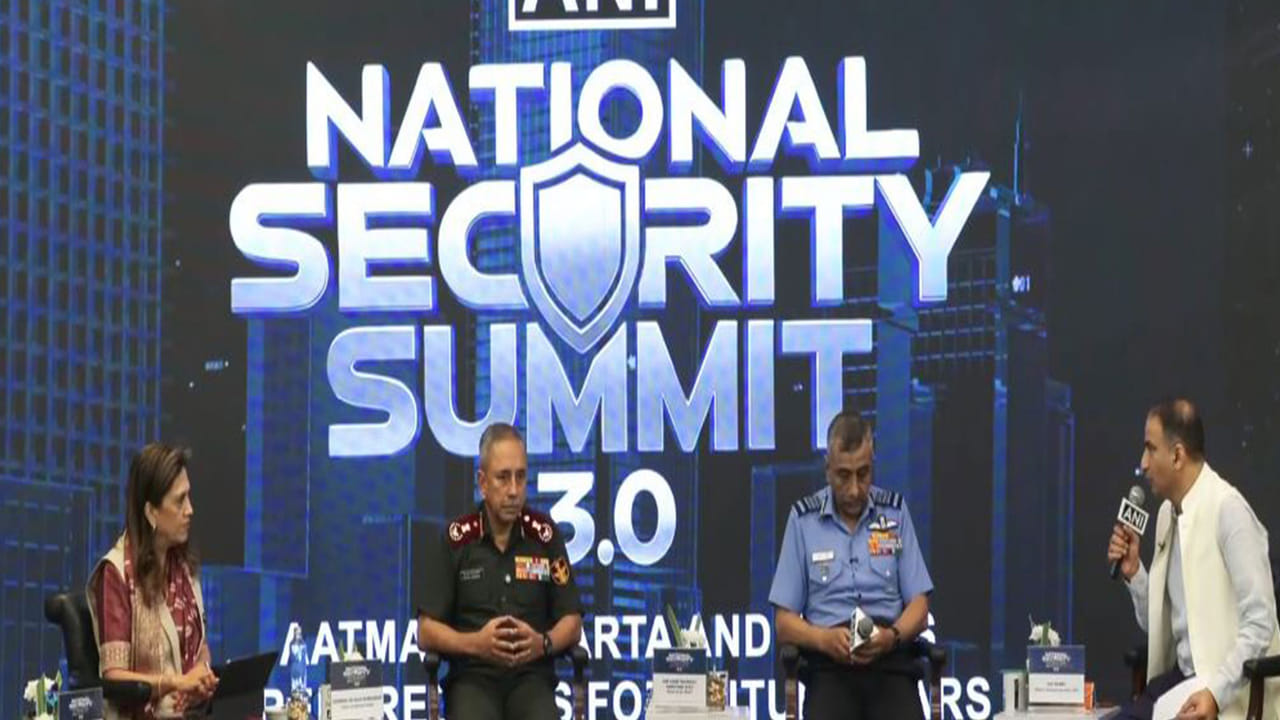
CDS Gen NS Raja Subramani asserts that Integrated Theatre Commands are an operational imperative for modern multi-domain warfare, with military leadership confirming consensus and progress toward implementation in the coming months.
CDS Affirms Integrated Theatre Commands are an Operational Imperative
New Delhi [India], November 16 (ANI): Asserting that modern multi-domain warfare leaves no room for siloed operations, Chief of Defence Staff (CDS) General NS Raja Subramani on Monday declared that the creation of Integrated Theatre Commands (ITCs) is an “operational imperative” rather than a mere administrative reform, expressing confidence that India will already be well on its way to implementing them before the next edition of the ANI National Security Summit.
Speaking at the ANI National Security Summit 3.0 in New Delhi, General Subramani was joined by Chief of the Air Staff, Air Chief Marshal Ashutosh Dixit, who dispelled perceptions of institutional resistance by describing air power as “the glue” that will bind jointness, integration, and theatreisation together.
“All I can say is that hopefully we’ll not have to discuss it in the fourth summit,” General Subramani said regarding the long-awaited rollout of theatre commands. “I have made this point before also in talks. Theatre Commands are not an administrative requirement; they are an operational imperative. Operation Sindoor has aptly proved that multi-domain operations are the need of the hour.”
Explaining why integrated command structures are indispensable for future conflicts, the CDS pointed out that warfare has expanded far beyond traditional boundaries. “We are not only going to fight on land, air and sea, but also sub-sea, cyber, electronic warfare, spectrum, space spectrum as well as the cognitive spectrum,” General Subramani said. He noted that these domains are not exclusive to any single branch of the military, meaning actions created by one service directly impact the others. “I hope to come to the next summit and proudly say that we are already there on our way,” he added.
Addressing longstanding debates over how limited air assets will be apportioned under joint commands, Air Chief Marshal Ashutosh Dixit stressed that the Indian Air Force (IAF) is fully aligned with the restructuring. “Air power is a constant thread in all three services in all domains. It is available to everybody. So people think that because the Air Force’s main job is air power, they will be negating this concept—that is why people think like that,” Dixit said. “But air power is the glue which will keep and put all this integration, jointness and theatreisation together.”
Defining theatreisation as “a single commander operating, exercising all the domains together to get an effect,” the Air Chief highlighted the IAF’s unique adaptability: “The Air Force is the most flexible service or most responsive service, and it transcends time and space.”
Confirming that consensus has been achieved across the military brass, Dixit noted that the final nitty-gritty is being ironed out. “I have seen all three services very closely, and everybody is on board. You see, it is a transformational change. You cannot roll it back. So we have to get it right. We have worked out all the details. A few details are left, which we will work out,” he said, adding, “Like sir has rightly said, maybe next ANI summit we will be discussing how it is helping us. Maybe that may be the topic. It’s only a few months away, sir.”
Efforts to modernise the Indian Armed Forces centre on restructuring existing single-service commands into Integrated Theatre Commands (ITCs) and Integrated Battle Groups (IBGs) to unify Army, Navy, and Air Force capabilities by geography and function. Studies at the Service Headquarters level are actively refining models for dedicated Theatre Commands covering Land Borders, Maritime security, and Joint/Integrated Air Defence to maximise synergy and combat effectiveness. Former CDS General Anil Chauhan had previously emphasised that jointness and integration are essential prerequisites for ITCs, which will cleanly separate operational warfighting roles from administrative Raise-Train-Sustain (RTS) functions—freeing theatre commanders to focus exclusively on security and operations. Beyond structural reorganisation, ITCs mark the foundation for wider multi-domain reforms, integrating space and cyberspace with conventional domains while advancing digitisation and data-centric warfare. (ANI)