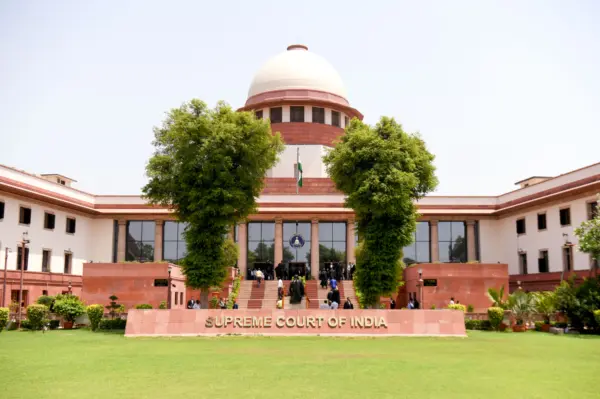
The Supreme Court on Thursday (August 20) asked the Centre, NCERT and the Central Board of Secondary Education (CBSE) to reconsider parts of the board’s three-language policy and address concerns surrounding its implementation.
It also directed CBSE to examine whether pupils already enrolled in Class 6 could get an exemption from the revised language requirement.
A bench led by Chief Justice of India Surya Kant, along with Justices Joymalya Bagchi and V Mohana, heard petitions challenging CBSE circulars introducing the language framework from the 2026-27 academic session. The judges stopped short of cancelling the policy and instead sought a fresh assessment of its practical application.
Court questions classification of English
Justice Joymalya Bagchi questioned the description of English as a “non-native” language under the proposed framework. He also objected to CBSE’s use of the word “native” in the language scheme formulated under the National Education Policy 2020.
“To what extent can English be considered a non-indigenous language? I have reservations about the expression ‘native’ because of its colonial origin. It should be ‘indigenous’. The framers of the National Education Policy 2020 should have been conscious of the use of the word ‘native’, he said
The bench said it would consider whether English should constitutionally be regarded as an indigenous or non-indigenous language in India.
“Whether English can be termed indigenous or non-indigenous, we have to see its constitutionality”, Justice Bagchi added.
He also questioned the basis for treating English as foreign or non-indigenous given its long association with India and its status as an official language in several states.
The proposed system requires pupils in Classes 5 to 9 to study two Indian “native” languages alongside a third language. Petitioners have raised concerns about the availability of suitable textbooks, trained educators and other facilities required to support the scheme.
Bench flags teacher and resource gaps
The judges also sought clarity on whether schools have adequate administrative and academic infrastructure to introduce the arrangement. Justice Bagchi specifically questioned the availability of qualified Sanskrit teachers.
“How many Sanskrit teachers are B.Ed. qualified in our schools?”, Justice Bagchi asked.
Chief Justice Surya Kant said the issues highlighted during the proceedings could warrant a review of the framework.
“These doubts – you may revisit. How to streamline the policy? Yours is an expert body”, the CJI said.
The bench separately asked CBSE to assess whether children currently in Class 6 could remain outside the revised structure. Justice Bagchi indicated that those who have already chosen their languages could be given relief, with the new arrangement introduced for the subsequent Class 6 batch.
The court also sought clarity on whether schools can provide adequate teachers and study materials for all 23 proposed languages. It observed that presenting students with language options alone would not guarantee access to proper instruction. Schools would need trained educators, textbooks and supporting resources for students to pursue their chosen languages.