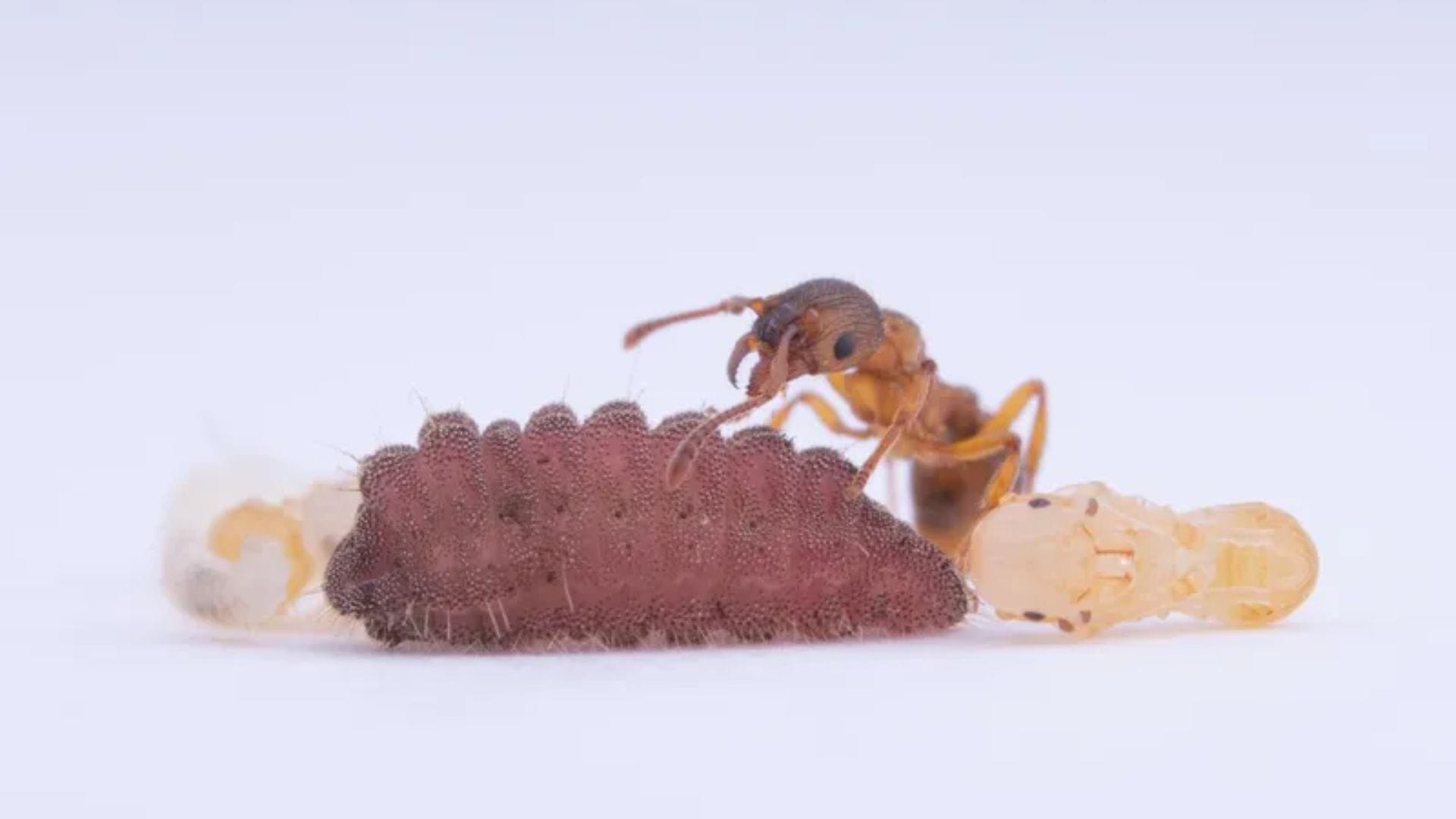
New Delhi: Scientists have discovered that caterpillars use sophisticated rhythmic signals to communicate with ants, helping them gain protection, food and access to ant nests. So butterflies rely on ants for survival in the early stages of their lives, which can be a symbiotic or parasitic relationship. The ants essentially treat the baby caterpillars as members of the colony, carrying them into nests, protecting them from predators and feeding them. Some caterpillars provide the ants with a sugary secretion, while others just mimic the behaviour of the ants to fit in.
For a long time, scientists believed that these relationships were underpinned y only chemical mimicry. New research indicates that the the caterpillars also use precisely timed vibrational rhythms to attract and appease their ant hosts. The caterpillars are essentially speaking in the same language as the ants, to convince them that they are not imposters. The researchers examined vibroacoustic signals from two ant species and nine caterpillar species with varying levels of myrmecophily, or the strength of the relationship the caterpillars have with the ants. The researchers analysed a number of rhythmic features including tempo, interval timing and the regularity of the patterns.
Rhythm as a fundamental feature of communication
The caterpillars with the highest degree of myrmecophily produced signals with highly regular timing, and complex rhythmic patterns, similar to music with alternating strong and weak beats. These rhythms closely matched the rhythms used by the ants themselves. The species with weaker or no associations produced simpler or more irregular rhythms. The caterpillars that were highly dependent on ants shared two rhythmic traits, isochrony, or evenly spaced pulses that create a steady beat, and a double metre, a complex pattern of alternating long and short intervals. This combination was only observed in the ants and the most ant-dependent caterpillar species.
The findings challenge the idea that rhythm is limited to humans or animals with large brains, and that it may be a fundamental feature of communication across the animal kingdom. A paper describing the research has been published in the Annals of the New York Academy of Sciences.