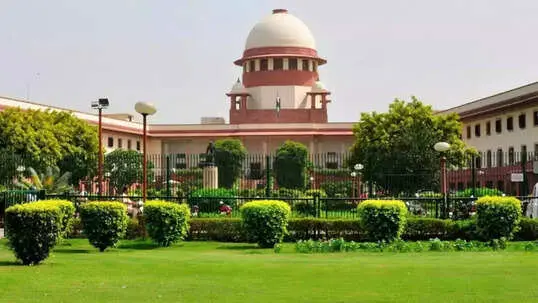
New Delhi: The Supreme Court on Thursday (August 19) observed that a casteist slur inside an enclosed space without public access is not an offence under the .The top court made this observation while quashing a case registered under the SC/ST Act against a school manager.
A bench of Justice Vikram Nath and Justice Sandeep Mehta held that if a casteist slur was made inside a closed room with no public access, it does not satisfy the essential ingredients of the offence under the Scheduled Castes and the Scheduled Tribes (Prevention of Atrocities) Act, 1989. The appellant was Ramkrishna Chauhan, a manager of the school where the complainant’s sons studied.
The bench gave this ruling while hearing an appeal against a judgment passed by the Allahabad High Court, which had dismissed the appellant’s appeal. The top court, while hearing Chauhan’s appeal, raised the condition about “public view”.
Chauhan’s lawyer said the alleged incident happened inside a closed room, and witness statements did not prove the presence of any member of the public in the room or that anyone outside heard what was said.
The SC Bench concluded that the alleged casteist slur was made inside a closed room, and on top of that the prosecution could not establish, even prima facie, that the incident happened in a place where people could see or hear it.
Reiterating principles laid down in earlier judgements, the bench said a location where members of the public are present and can see or hear the words spoken by the accused to the victim can be considered “within public view.”
About The Case:
Following a quarrel between two students, the complainant’s son approached Chauhan who allegedly abused and assaulted him along with the school staff, and used caste-based abuse against him.
Following the complaint, Chauhan was booked under A chargesheet was filed against him, and the Special Judge took cognisance.
Chauhan then challenged the special court’s summons order in the Allahabad High Court, which declined to grant relief, saying that the proceedings could not be quashed merely on the ground that the case was filed out of vendetta. HC held that a prima facie case was valid.