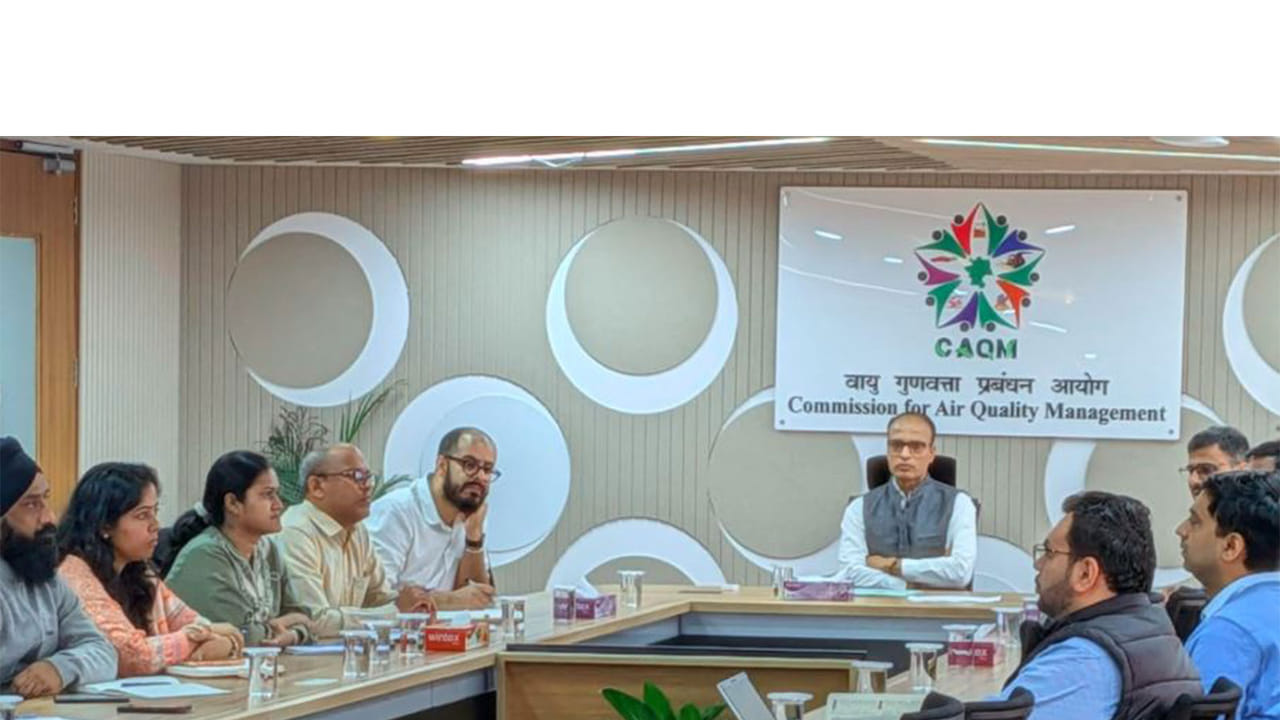
CAQM Member Secretary Tarun Kumar Pithode reviewed winter pollution control measures across Delhi-NCR, emphasizing District Action Plans 2027 to achieve a 15-20% reduction in pollution while holding officials accountable for targets.
CAQM Reviews District Plans to Curb Delhi NCR Winter Air Pollution
New Delhi [India], November 23 (ANI): Commission for Air Quality Management (CAQM) Member Secretary Tarun Kumar Pithode held a review meeting with Deputy Commissioners (DCs) and District Magistrates (DMs) across the Delhi-National Capital Region (NCR) and adjoining areas to assess ongoing winter pollution control measures and District Action Plans 2027. To ensure strict enforcement and accountability on the ground, designated officers have been assigned direct responsibility for meeting the stipulated emission-reduction targets. Commission for Air Quality, in a post on X, stated that the meeting emphasised District Action Plans 2027 to reduce pollution. “CAQM Member Secretary Shri Tarun Kumar Pithode held a meeting with DCs/DMs across Delhi-NCR & adjoining areas to review winter pollution measures and District Action Plans 2027, targeting 15–20% pollution reduction, with designated officers responsible for the targets,” the post read.
On Monday morning, Delhi continued to grapple with poor air quality, with the national capital recording an overall Air Quality Index (AQI) of 249 at 8 am, while Punjabi Bagh emerged as the most polluted among the listed monitoring stations with an AQI of 282, according to the Central Pollution Control Board (CPCB). According to the CPCB, Punjabi Bagh recorded the highest AQI among the listed monitoring stations at 282, followed by Bawana at 273 and Chandni Chowk at 271, all falling in the ‘poor’ category.
Earlier, on Saturday, the Commission for Air Quality Management (CAQM) began assessing and ranking Delhi and neighbouring states on their performance in implementing measures to combat air pollution, with its 2026 report card covering progress up to October and highlighting significant gaps across several key areas, including industrial inspections, waste management, public transport and pollution-monitoring infrastructure.
According to the State Action Plan-2026 report card, none of the four states and Delhi have established the targeted number of green crematoriums. Against a combined target of 421 green crematoriums across Delhi, Haryana, Rajasthan and Uttar Pradesh, the achievement stood at zero as of October 31. The report card has been prepared based on progress recorded up to October 2026. The final report card for the year is scheduled to be released in January 2027, giving the states and the Delhi government an opportunity to improve their performance by accelerating the implementation of pollution-control measures during the remaining period of the year.