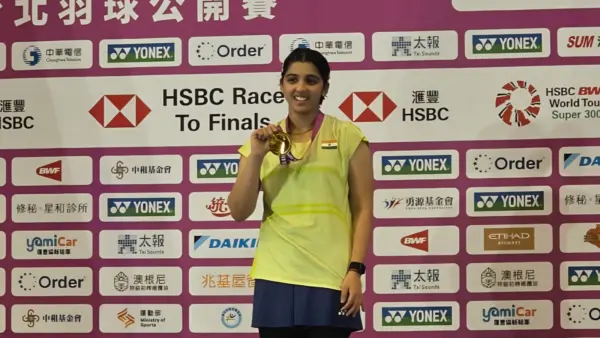
Tanvi Sharma became the youngest ever to win the Taipei Open, and followed Saina Nehwal, PV Sindhu and Devika Sihag to win a BWF Super 300 title.
The 17-year-old from Hoshiarpur broke former World No 1 and Tokyo Olympics silver medallist Tai Tzu-ying’s record at the age of 18 years and 85 days. In a chat with The Indian Express, Tanvi spoke about her thoughts on the feat, training under coach Park Tae-Sang, injecting patience into her game, learning from Sindhu and more.
What were your first thoughts on becoming only the fourth Indian to win a BWF Super 300 title?
Prior to the Taipei Open I was struggling a lot. I was sick for a long time and was not able to find my rhythm back. But then as I started training, my mind would shift towards early training under my mother and coach Meena Sharma and sister Radhika at the four wooden courts at the indoor stadium in Hoshiarpur. How I would wake up early in the morning and would first watch my sister train before my mother trained me. And how I showed patience at that time waiting for my turn, and how my mother worked on my slow drop as well as slices. So when I won the title, my first thought was those early mornings as well as late evenings at that indoor hall.
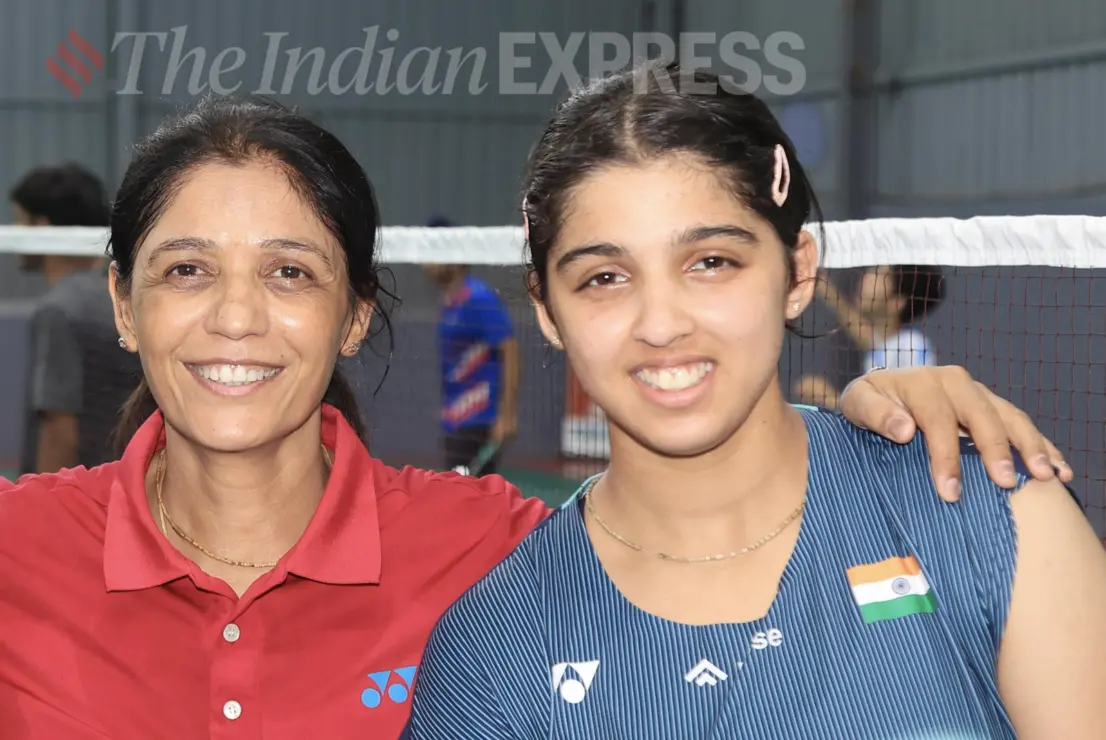 Tanvi Sharma with her mother and coach Meena Sharma at Zirakpur (Express photo by Jasbir Malhi)
You also became the youngest player to win the Taipei Open since Tai Tzu-ying won the title. How do you see that feat?
To be frank, I did not know it. It was only when some reporters told me post the final win that I realised the feat. I am happy that I broke the record held by Tai Tzu-ying. Later I also met Paris and Tokyo Olympics doubles champion Lee Yang, who was also watching the final. My coach Park Tae-Sang was with me when we met him and to get a pat on the back from a player like him is also special. I have always seen Tai as somebody to look up to and took a lot of learnings from her game. The way she played her deceptive strokes, she was a legend in that. And also her patience in big matches. She was very patient when it came to crucial points and I still rewatch almost every match of her’s. There are so many things to learn.
What was your mindset in the tournament? You had wins against world number 27 Supanida Katethong in the quarters before you won against world number 25 Thuy Ling Nhuyen. In the final, we also saw you excelling with smashes but your net play saw errors creeping in. How do you see that?
I went with the mindset of taking it one game at a time and one point at a time. The quarter-final against a player like Katethong was a bit tricky. She is a player who is very attacking and aggressive and I knew I have to be good with my defence. I was ready with my defence and patience was the key to grab my chances to make her make errors or play my attacking strokes. And in the final, I knew if I can show the same patience, I can win the title. Yes, I have to improve my net play and if I have to aim big in Super 750 and Super 1000, I cannot just rely solely on my smashes.
You have been training under coach Park Tae-Sang at NCOE Guwahati since the last one and half years. Tell us about training under him and what was your first conversation with him and what areas has he focussed on, in your game?
When I was moving to Guwahati, I just told coach Park Tae-Sang that I am joining. He was happy that I was going to train under him. The first conversation I remember was him telling me to be more patient and he laid emphasis on being stronger in mentality and he told me that you have to be more confident and more stronger mentally. I think that’s the main focus. Over the last one and half years, he has worked on my smash particularly and also the deceptive strokes. I understand that I need to improve more and coach Park Tae-Sang has been teaching me the most important virtue: Patience. We have been watching a lot of videos too and he also makes me watch An Se-young ‘s videos. She is very calm and composed in her games and she has that unbreakable defence. It’s very tough to break her defence and that’s what Sang sir too tells me that defence is also the form of attack. And we have been working on that.
Your views on your women’s singles competitors in India.
Well, of course I idolise PV Sindhu didi. I have been a fan of her smashes and the way she utilises her height to take the shuttle from us and smash. I know I am a short player but then I have understood that I have to add and rely on more power. At present there are 10 Indian women singles players in the top 50 in the world and I see the competition among each one of us as good. Each one of us learns things from the other and playing against each other at the international level as well whatever domestic competitions we can play only benefits us. Most of them are senior or very senior to me but then I learn from each one of them. Devika didi’s games I watch and learnt to be more calm.
The win meant that you are now ranked 29th in world rankings. When the cut-off for the world championships ended in April, you were fourth among Indians with two spots available. Are you missing the chance?
Well, I hoped I could have won the title earlier. Of course, I wanted to play in the World Championships at home but then I understand that there will be many more chances in the future. But then I would be watching it from Guwahati between my training.I will be keenly following Sindhu didi and An Se-young matches during the World Championship. I will be going to compete in the China Masters next month before the Asian Games. In 2024, I was part of the title-winning women’s team in the Asian Championships. Even though I did not play a match, just that experience and the emotions will also motivate me in Asian Games.
Lastly, what do you like to do when not playing badminton?
I like to watch cartoons a lot, especially Doremon, and also like listening to Punjabi songs by Karan Aujla. I have not been to Japan yet and perhaps post the Asian Games, I could pick some merchandise from Doremon too apart from giving my best.