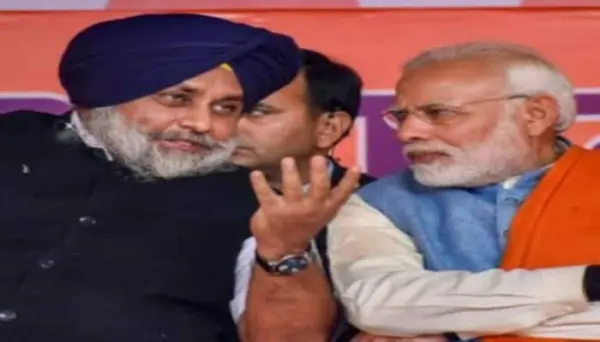
New Delhi: Punjab is inching closer to the 2027 Assembly election, with political parties working on strategies and possible alliances.
One of the biggest talking points is the possibility of the Bharatiya Janata Party (BJP) and the Shiromani Akali Dal (SAD) coming together again after years apart.
The speculation gained ground after Prime Minister Narendra Modi met SAD leader Sukhbir Singh Badal. Neither party has so far made an official announcement about an alliance, but their past election record gives enough numbers to understand why the possibility matters.
The BJP and the SAD were political partners for nearly two decades. They parted ways in 2020 over three controversial farm laws that were rolled back after over a year of protest. Before that, the two parties had fought several elections together and formed governments in Punjab.
The two parties first contested the 1997 Assembly election together after the Akali Dal’s Moga Declaration in 1996. The two parties had different strengths. The SAD had a stronger base among rural and Sikh voters, while the BJP had greater support in urban areas and among Hindu voters. Punjab’s Hindu population accounts for around 38.5 per cent, and the BJP has traditionally targeted seats with a large Hindu population.
What the Assembly numbers show
The 1997 election gave the alliance its biggest early success. The SAD won 75 of Punjab’s 117 Assembly seats, while the BJP won 18. The two together bagged 93 seats. The Akali Dal polled 37.64 per cent of the vote and the BJP 8.33 per cent. The Congress won 14 seats with a 26.59 per cent vote share.
The alliance lost ground in 2002, when the Congress returned to power with 62 seats. The Akali Dal won 41 and the BJP only three. It gave the alliance 44 seats.
The BJP-Akali Dal recovered in 2007. The latter won 48 seats and the former 19, taking the alliances total to 67 seats. The Congress finished with 44 seats. In 2012, the alliance again formed the government, with the Akali Dal winning 56 seats and the BJP 12.
The picture changed in 2017 when the Congress won 77 seats, while the Aam Aadmi Party (AAP) entered the Assembly as a major force with 20 seats. The SAD fell to 15 seats and the BJP to three. The vote shares were 38.77 per cent for the Congress, 25.42 per cent for the Akali Dal, 23.88 per cent for the AAP and 5.43 per cent for the BJP.
The 2022 election brought an even bigger change. The AAP won 92 seats with a 42.31 per cent vote share. The Congress bagged 18 seats, the Akali Dal three and the BJP two. Their vote shares were 23.15 per cent for the Congress, 18.52 per cent for the Akali Dal and 6.65 per cent for the BJP.
These numbers show how far the two former allies have fallen since their strongest years. It also explains why their combined vote could matter in a close contest.
Lok Sabha results tell a similar story
The alliance also had several strong performances in Punjab’s Lok Sabha elections.
In 1998, the Akali Dal won eight of Punjab’s 13 seats and the BJP won three, giving the alliance 11 seats. The Congress returned strongly in 1999 and won eight seats, while the Akali Dal and the BJP won two and one respectively.
The alliance again performed well in 2004 by winning 11 seats between them, with eight going to the SAD and three to the BJP. The Congress won two.
In 2009, the Congress won eight seats, while the SAD won four and the BJP one. The 2014 election saw the AAP enter Punjab’s Lok Sabha contest and win four seats. The SAD also won four, the Congress three and the BJP two.
In 2019, the Congress won eight seats with a vote share of around 40.58 per cent. The BJP-SAD won four seats between them, two each. Their combined vote share was around 37.5 per cent.
The two parties fought separately in 2024. The SAD won just one seat, while the BJP failed to open its account despite securing 18.56 per cent of the vote. The Congress won seven seats and the AAP three.
What the 2024 numbers reveal
The 2024 Lok Sabha results provide some clues about what a BJP-Akali alliance could mean in individual constituencies.
In Gurdaspur, Congress candidate Sukhjinder Singh Randhawa won with 3,64,043 votes. BJP’s Dinesh Singh Babbu finished second with 2,81,182 votes, while AAP’s Amansher Singh received 2,77,252. Akali Dal candidate Daljit Singh Cheema got 85,500 votes.
The BJP’s vote share was around 26.17 per cent and the Akali Dal’s 7.96 per cent. They together accounted for about 34.13 per cent, compared with Congress’s 33.88 per cent.
Jalandhar tells a similar story. Congress’s Charanjit Singh Channi won with 3,90,053 votes. BJP’s Sushil Kumar Rinku received 2,14,060 votes and AAP’s Pawan Kumar Tinu 2,08,889. Akali Dal candidate Mohinder Singh Kaypee got 67,911 votes.
The BJP-Akali Dal had around 28.65 per cent of the vote, while the Congress had 39.62 per cent.
Ludhiana was another close contest. Congress’s Amarinder Singh Raja Warring won with 3,22,224 votes, while BJP’s Ravneet Singh Bittu received 3,01,282. AAP’s Ashok Parashar Pappi got 2,37,077 votes and Akali Dal’s Ranjit Singh Dhillon 90,220.
The BJP-Akali Dal polled around 37.14 per cent, compared with Congress’s winning vote share of around 30.55 per cent.
The vote share does not mean the alliance would have won these seats. Vote transfer between parties does not always happen completely. They show how the electoral arithmetic could change when two parties combine their support.
The 2022 Assembly numbers offer more clues
The 2022 Assembly results also show several seats where the combined BJP-Akali vote could have produced a much closer contest.
The BJP finished second in Balluana, Fazilka, Ludhiana Central, Ludhiana North, Ludhiana South, Rajpura and Sujanpur. In Ludhiana Central, for example, the party polled 28.63 per cent and the Akali Dal 8.41 per cent. Their combined share was 37.04 per cent, above the winner’s 33.55 per cent.
In Sujanpur, the BJP secured 32.89 per cent and the Akali Dal 6.22 per cent, giving them a combined 39.11 per cent against the winner’s 36.50 per cent.
The numbers from constituencies where the Akali Dal finished second show a similar pattern. In Balachaur, the SAD polled 30.71 per cent and the BJP 4.87 per cent. Their combined share of 35.58 per cent was slightly higher than the winner’s 34.68 per cent.
In Dera Baba Nanak, the Akali Dal had 36.36 per cent and the BJP 1.34 per cent, giving them a combined 37.70 per cent against the winner’s 36.69 per cent.
Gurdaspur also produced a close contest. The Akali Dal polled 29.49 per cent and the BJP 7.95 per cent. Together, their vote share reached 37.44 per cent, compared with 35.43 per cent for the winning candidate.
Other seats such as Raja Sansi, Shahkot, Talwandi Sabo, Tarn Taran, Guru Har Sahai and Lambi also had numbers that could have produced much tighter contests if the two parties had fought together.
The arithmetic has a limitation. Simply adding two parties’ vote shares does not guarantee the same voters will support a common candidate. Local candidates, caste equations, alliances and voter preferences can change the outcome. Still, the numbers show that a combined BJP-Akali vote could change the contest in several seats.
Akali Dal needs more than a BJP alliance
The possible BJP alliance is only one part of the challenge for the Akali Dal. The party also needs to rebuild support among two traditional groups such as Panthic and Jat voters.
It once had a strong connection with both groups. The party’s support among Panthic voters suffered after the 2015 sacrilege of the Guru Granth Sahib and the Behbal Kalan police firing. Its vote share fell to 25.24 per cent in the 2017 Assembly election, when it won 15 seats. In 2022, its vote share dropped further to 18.38 per cent and it won only three seats.
Around 58 per cent of Punjab’s population is Sikh, and an estimated 20 to 25 per cent of voters are described as Panthic voters who give greater weight to religious issues when choosing candidates. A section of this support has moved towards the AAP, the Waris Punjab De and the Shiromani Akali Dal (Amritsar).
The Jat vote has also become more divided. The community accounts for an estimated 35 to 40 per cent of Punjab’s population and has a strong presence across the state, particularly in agriculture. This group was once a core part of the Akali Dal’s support base.
The BJP-Akali alliance could therefore change the electoral calculations in the state, especially in seats where their separate vote shares were close to the winning numbers. The larger question for the Akali Dal is whether it can rebuild its traditional support at the same time. The BJP will need to turn its urban and Hindu voter base into seats through an alliance with a party that still has a rural and Sikh support network.
With the 2027 Assembly election approaching, the old partnership has a familiar electoral formula. The numbers from recent elections show where that formula could work. The final impact will depend on how much support each party can transfer to the other and how successfully the Akali Dal can rebuild its own base.