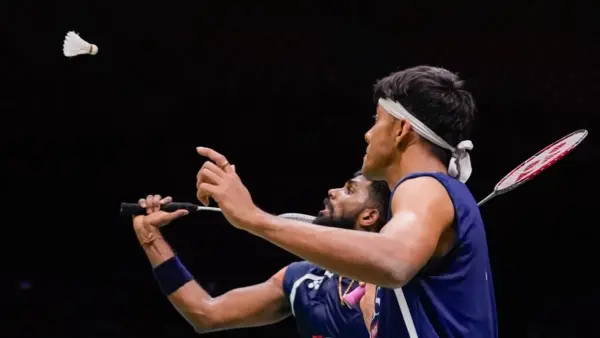
New Delhi, August 20: Satwiksairaj Rankireddy and Chirag Shetty began their BWF World Championships campaign on home soil with a hard-fought 21-23, 21-19, 21-17 win over Malaysia’s Junaidi Arif and Yap Roy King, surviving a stern test in their first competitive match since winning the Singapore Open final on Thursday (August 20).
The World No. 5 Indian pair had received byes in the opening two rounds, meaning their third-round contest was their first appearance at the World Championships held at home. It was also their first competitive outing since their Singapore Open triumph and came after a lengthy break from competitive badminton.
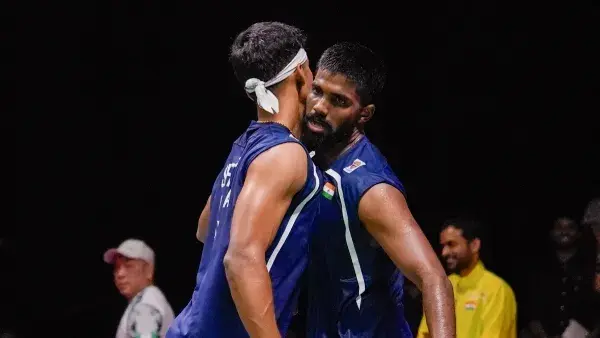
The lack of match practice was visible at times, with the top-seeded Indians admitting they were not at their best. But they found a way to recover after losing the opening game and eventually prevailed after 122 points and three closely fought games at Indira Gandhi Indoor Arena.
For Satwik, the biggest concern going into the match was not tactical but physical as the gruelling game lasted for one hour and 22 minutes.
“It’s been a while we played. I don’t know how the body will respond. In practice, it was 100% good, but it’s very different. You get more tense in the shoulder,” Satwik said after the match.
That concern eased as the contest progressed. After dropping the first game 23-21, the ‘Brothers of Destruction’ won the second 21-19 and then completed the comeback with a 21-17 deciding-game victory.
Game 1: Malaysians dictate the early exchanges
The opening game was a sign of what was to come tactically. Arif and Yap were aggressive in trying to control the front court and prevent Satwik from getting into the kind of attacking rhythm that makes the Indian pair so dangerous.
The Malaysian pair edged a closely contested game 23-21, despite both teams winning just three points in their longest consecutive sequences.
The game’s progression showed how little separated the pairs. Neither side managed a sustained run, and the Indians were unable to create the decisive advantage needed to close it out.
For Satwik and Chirag, it was also about getting used to the conditions after arriving at the tournament late because of their byes.
Chirag acknowledged that the circumstances were unusual. “We knew that it won’t be easy. Thoda court conditions bhi different rahega (The court conditions would also be slightly different). And we were ready for it. And we weren’t playing at our best,” he said.
The answer, according to Chirag, was not to force the game but to simplify it. “We just try to tell each other that eventually, things will turn into your favour. Just keep it simple, keep it inside the court, and don’t really complicate things,” the Maharashtra-born shuttler added.
Game 2: Satwik-Chirag find their rhythm
The second game followed a similar pattern but with the Indians gradually becoming more comfortable. The Malaysians continued to look for opportunities at the net, while Satwik and Chirag tried to prevent them from dictating the first two or three shots of the rally.
The score remained close, but the Indians were able to stay ahead when it mattered and closed out the game 21-19.
Satwik had spoken about the importance of the first game in particular, explaining that the pair needed time to get a feel for the court.
“I was just wondering we’ll just open up and play in the first few rallies so that we get the length of the court, we get the feel of the court,” the Andhra Pradesh athlete state.
The Indians had also been observing other matches during the first two rounds to understand how the court was playing. “We were watching all the time… watching how court is there. So, a little bit, it took us time to play, but I think it’s always important for a good start,” Satwik added.
Game 3: Indians crack the Malaysian net game
The decider was where Satwik and Chirag finally began to solve the biggest tactical problem posed by their opponents. The Malaysians were particularly effective in the short exchanges. With the shuttle playing relatively slowly, Arif and Yap were reluctant to lift repeatedly and give Satwik the opportunity to unleash his powerful attack.
Instead, they looked to engage the Indians in flat exchanges and dominate around the net.
“They usually prefer playing and dominating the net, and they knew the shuttles were quite slow, and they didn’t want to lift as many smashes to us,” Chirag explained.
That meant the Indians had to be prepared for a match that was less about outright smash-and-finish badminton and more about winning the first few exchanges.
“They were the first ones to try to create opportunities for themselves, and likewise for us, we knew that that would be coming, and the net exchanges and also the flat drives would be coming,” Chirag said.
The crucial difference was that Satwik and Chirag eventually became more comfortable in those exchanges. “In the very end, I think we were able to crack that quite well,” Chirag said.
The Indians broke away from the Malaysians in the closing stages and finished the decider 21-17. The match statistics underline the closeness of the contest: the Malaysians won 59 points, while Satwik and Chirag won 63. The Indians also produced their best consecutive run of the match in the decider, putting together a four-point sequence.
‘Eventually, things will turn into your favour’
The victory was as much about solving problems as it was about playing their best badminton. Chirag repeatedly stressed the importance of not overthinking after the first-game setback. “Just keep it simple. Because if you keep it simple inside the court, points aayenge (will come),” he said.
That mindset helped the Indians navigate a match in which they were clearly not at their sharpest.
Satwik, meanwhile, was relieved that his body responded well after the long competitive break. “I was more worried about my health rather than the strategy-wise,” he said.
The Indian admitted he was particularly pleased with how his body held up in the third game. “I was very happy in the third game that there is no bad signals, like it was all positive, I can hold myself,” he said.
Asked directly about any discomfort, Satwik simply replied: “No, all good.”
Focus now shifts to a familiar rivalry
The victory sends Satwik and Chirag into the quarterfinals, where they will face Liang Wei Keng and Wang Chang, a pair they have encountered several times before.
But the Indians know they cannot afford another slow start. ” (We’ll) Just go out there, prepare tactically well, and see how it goes, just give your everything on court,” Chirag said when asked about their approach.
For a pair returning to competitive action after a lengthy gap, the opening match was never going to be just about the result. It was about rediscovering their competitive rhythm, testing Satwik’s shoulder, adjusting to the home conditions and finding solutions against an opponent that refused to give them easy attacking opportunities.
They did not produce their cleanest badminton.
But after losing the opening game by the narrowest of margins, Satwik and Chirag stayed patient, simplified their approach and gradually worked their way into the contest.
Their first World Championships match at home, therefore, ended with exactly what they needed most: a win, a three-game test under their belt and the confidence that their bodies and tactical game can hold up as the tournament gets tougher.