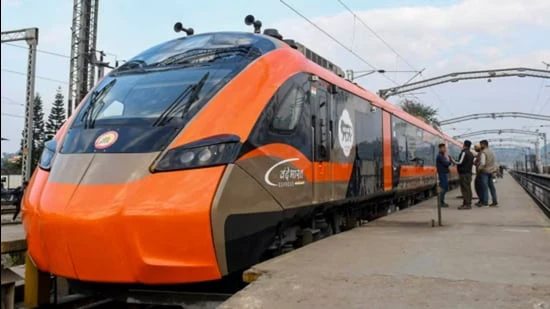
“…to promote environmentally sustainable passenger systems, we will develop seven high-speed rail corridors between cities as growth connectors… Mumbai to Pune, Pune to Hyderabad, Hyderabad to Bengaluru, Hyderabad to Chennai, Chennai to Bengaluru, Delhi to Varanasi, Varanasi to Siliguri,” she said in her budget speech.
She announced a new dedicated freight corridor between Dankuni in West Bengal and Surat in Gujarat to promote environmentally sustainable movement of cargo.
Work on one high-speed corridor between Ahmedabad and Mumbai is in progress. Two dedicated freight corridors, Eastern and Western, are operational.
Railways minister Ashwini Vaishnaw said that there is a lot of focus on safety. ” ₹1,20,000 crores will be invested in safety. 95% accidents have been reduced, there is more focus on track maintenance, loco maintenance, wagon maintenance, coach maintenance, rapid installation of coverage, installation of CCTV cameras, upgrading the overhead electrical system, and construction of stations. Safety will be improved. Customer care and customer facilities will be improved.”
Vaishnaw said the world is noticing the progress of Ahmedabad and Mumbai high-speed corridors. “It is being done at a fast pace, keeping the quality of the work high. After the seven new high-speed corridors that have been announced, the transportation sector in the country will be completely transformed and changed,” he said.
“Chennai-Bengaluru-Hyderabad will be a south high-speed triangle or south high-speed diamond, which will prove to be a great boon for the south Indian states Karnataka, Telangana, Andhra, Tamil Nadu, Kerala, and Puducherry.”
Vaishnaw said the projects would significantly reduce travel time. He added that Chennai-Bengaluru travel would come down to 1 hour 13 minutes, Bengaluru-Hyderabad to two hours, and Chennai-Hyderabad to 2 hours 55 minutes.
“Chennai-Bengaluru-Hyderabad are three big economies and big hubs of IT. By making this high-speed diamond, a major multiplier of growth will come to the southern Indian states, which is good for the country and for all the residents,” he said. “The corridor from Mumbai to Ahmedabad is being made. Next, the corridor from Mumbai to Pune will be made. From the Mumbai-Pune corridor, Mumbai and Pune will practically merge, and the travel time between the two cities will be 48 minutes,” he said, adding that Pune to Hyderabad will be covered in 1 hour and 55 minutes.
In north India, the Delhi-Varanasi corridor will enable travel in just 3 hours and 50 minutes, the minister said. “The seven new corridors span about 4,000 km and will involve an investment of nearly ₹16 lakh crores,” Vaishnaw said.
“India has to be developed by 2047; so work on these seven corridors will have to be simultaneous… the capacity of the industry and the team has increased, there is a lot of learning.. we have already climbed the learning curve in the country… We will move fast.”
Referring to the dedicated freight corridors, Vaishnaw said, “…there is a very significant progress of the Western Freight Corridor and the Eastern Freight Corridor…we have already reached the saturation level as 400 trains per day are already travelling in these corridors.” He added Eastern Corridor, Western Corridor and the East-West Freight Corridor of 2052 km and seven high-speed corridors together will give a new energy to the railways.