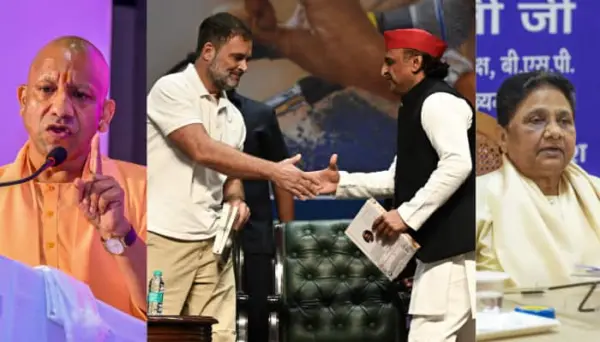
Uttar Pradeshs 2027 Assembly election may still be months away, but the battle lines are already beginning to take shape. And if the latest signals from the Samajwadi Party are any indication, Akhilesh Yadavs party is looking at the next election through a familiar but increasingly important lens: keep the Congress partnership intact, consolidate the opposition vote and prevent the BSP from cutting into its social base.
The Samajwadi Partys message on the Congress has become particularly relevant in the latest political developments.
Reportedly, Congress MPs from Uttar Pradesh have now urged their central leadership to finalise an alliance with the Samajwadi Party at the earliest, arguing that a coordinated opposition challenge would be crucial against the BJP in 2027. The push, however, comes amid some resistance from sections of the Congresss state organisation.
This makes the Samajwadis assessment of the BSP even more significant.
In an exclusive interview to Zee News, Samajwadi Party national spokesperson Dr MH Khan left little ambiguity about where his party believes the principal contest lies.
The Samajwadi Party is going to form a government in 2027. And Akhilesh Yadavji is going to become the Chief Minister. Thats it. These people have no place. If they get even one seat, then tell me.
Khan was referring to the Bahujan Samaj Party (BSP) and its prospects in the coming Assembly election.
BSP has nothing left, will get zero seats
Samajwadi National spokesperson Dr MH Khan said, Every day she removes someone or someone gets in. She removed her co-father-in-law (Samdhi) then called him again. Sometimes she threatens Akash Anand.. Sometimes she will remove Dalitswhat is she left withwhy are there discussions around Mayawatishe was a four-time CM, but she has nothing left now.
His arguments were in line with BSPs repeated changes in its leadership structure and the departures and returns of prominent leaders, including developments involving BSP supremo Mayawatis nephew Akash Anand, which had weakened the party considerably.
BSP chief Mayawati on 2nd August expelled former MP Ashok Siddharth, father-in-law of her nephew Akash Anand and senior leader Randhir Singh Beniwal over gross indiscipline and anti-party activities. Reinstated once before, Siddharth has now been permanently barred from the party.
MH Khan also pointed to Mayawatis declining electoral footprint, arguing that the four-time former chief minister now has nothing left.
The BSPs latest setback gives that argument fresh political ammunition. Umashankar Singh, the partys lone MLA in Uttar Pradesh, from Rasra constituency in Ballia district died this week, leaving the BSP without representation in the state Assembly. Mayawati, while mourning Singh, she described him as someone who remained loyal to her when many others had left.
Khans assessment, however, remains a political claim rather than the final word on the BSPs electoral relevance.
Mayawati has been actively preparing for the 2027 contest. The party has also been pursuing outreach among Dalits, OBCs, Brahmins and Muslims. Mayawati has said the BSP intends to fight the election on its own and has set her sights on returning to power for a fifth time.
The 2024 lesson: Can SP-Congress repeat the formula?
For the Samajwadi Party, the strongest argument for retaining the Congress alliance comes from the 2024 Lok Sabha election.
The SP emerged as the single largest party in Uttar Pradesh with 37 Lok Sabha seats, while the Congress won six. Together, the two parties significantly disrupted the BJPs electoral calculations in the state.
The result demonstrated what coordinated campaigning and a broader social coalition could achieve. The SPs PDA strategy Pasmanda, Dalit and Adivasi outreach alongside its traditional OBC and minority support was complemented by the Congresss campaign, with Rahul Gandhi and Akhilesh Yadav increasingly appearing together.
The chemistry between the two leaders has again been visible, reinforcing the perception that the alliance could form the backbone of the opposition campaign in 2027.
But there is a warning from history.
The 2017 SP-Congress alliance failed to convert its high-profile campaign into electoral success. And the subsequent SP-BSP alliance in 2019, despite bringing together two major opposition forces, won only 15 Lok Sabha seats between them.
For Akhilesh Yadav, therefore, the challenge is not merely to reproduce an alliance; it is to ensure that the arithmetic translates into votes across constituencies.
The minority vote remains a crucial piece of the puzzle
That calculation becomes particularly important because of Uttar Pradeshs substantial Muslim electorate.
Muslims account for roughly one-fifth of the states population, but their electoral influence is concentrated in a much larger number of constituencies. Muslims form a substantial share of voters across dozens of Assembly segments.
This is why the oppositions ability to avoid a division of minority votes could become critical.
For the SP, the ideal scenario would be a consolidated Muslim vote combined with its OBC base, sections of Dalits and other groups brought into the PDA framework, while the Congress adds to the coalition without creating friction over seats.
The BSP, meanwhile, remains the wildcard
Even a reduced BSP vote share could have an impact if it is concentrated in constituencies where the SP-BJP contest is closely fought. That is precisely why the SP has a political incentive to portray Mayawatis party as electorally marginal, even as the BSP works to rebuild itself on the ground.
BJP under attack over jobs, exams and infrastructure
Dr Khans attack on the BJP, meanwhile, was centred less on grand ideological battles and more on issues that opposition parties hope will resonate with voters in their everyday lives.
He cited unemployment among young people, examination paper leaks, inflation and alleged shortages of fertiliser as core issues that could shape the public mood in February 2027.
The employment and examination question has already generated visible political pressure. In May, hundreds of competitive-exam aspirants protested in Prayagraj over alleged irregularities in recruitment examinations, paper leaks and unemployment.
On the national level, the ruling NDA faced recent criticism over the NEET-UG paper leak and subsequent protest at the Jantar Mantar.
Infrastructure has also handed the opposition a fresh talking point.
Khan recalled the controversy surrounding the Lucknow-Kanpur Expressway and contrasted it with the Agra-Lucknow Expressway constructed during Akhilesh Yadavs tenure.
From Lucknow to Kanpur, an expressway was made. And Mr. Gadkari said that we are making a better road than America. And after 8 days, that 1 km road got stuck. They made a better road than America. No expressway has been made that hasn’t got stuck. And an Agra expressway has been made by Akhilesh Yadavji. To date, there hasn’t been a dent in it, argued Khan.
The Lucknow-Kanpur Expressway developed visible damage after the monsoon rains, with a portion of the road caving in just 12 days after its July 13 inauguration. The incident triggered questions over construction quality and project execution. The developments have made that comparison particularly politically potent.
For the opposition, the fallout offers a ready-made campaign question: does the states infrastructure story match the political claims being made about it?
Law and order could become another battlefield
Khan also sought to make law and order a central part of the 2027 conversation.
He referred to National Crime Records Bureau (NCRB) figures while alleging that Uttar Pradesh continues to face serious concerns over crimes against women. He alleged that
Murder is happening every day. Robbery is happening every day. Three rapes are happening in Uttar Pradesh in a day.
Although the claims are deeply political, the opposition is likely to make womens safety, crime, recruitment, inflation and employment central to its campaign narrative.
Ram Temple donation theft adds another dimension
Then there is Ayodhya. Khan questioned the state-appointed investigation into alleged irregularities involving donations at the Ram Temple and demanded a probe by a sitting Supreme Court judge, arguing that those responsible should face decisive action.
An inquiry should be conducted by a sitting judge of the Supreme Court. And all the people involved should be punished, argued Dr Khan.
During the conversation, Samajwadi spokesperson also confirmed Pawan Pandey as the party’s pick for the Ayodhya assembly seat.
Mr. Pawan Pandey is the candidate from Ayodhya. He has been given the responsibility there. His ticket has also been filed, said Dr Khan.
The Supreme Court has directed the Uttar Pradesh government to include a forensic auditor in the SIT investigating allegations of embezzlement of donations received by the Ram Temple Trust and has sought a status report on the probe.
The developments do not establish the allegations as proven. But politically, the issue gives the opposition another line of attack in a state where Ayodhya has been one of the BJPs most powerful political symbols.
The real contest may be over the vote that gets divided
The central question, however, remains: Can the opposition prevent the anti-BJP vote from fragmenting?
The SP believes it has found a workable formula with the Congress. The Congress, for its part, is pushing for an early alliance agreement. The BSP insists it can rebuild under Mayawati and is continuing its organisational and social outreach.
The BJP, meanwhile, enters the contest as the incumbent force with the advantage of government machinery, an established organisation and a strong political narrative around development, infrastructure and law and order.
The SPs confidence is unmistakable. Khan is already predicting an Akhilesh Yadav government.
However in Uttar Pradesh elections, good numbers and strong alliances are only part of the battle.
In 2027, the bigger question will be whether the SP-Congress combine can keep its coalition together. Whether the BSP can recover enough ground to alter constituency-level equations, and whether the BJP can turn its governance record into another electoral mandate.