Before the muscular Love & War posters, and before the grim hardness of Gangubai Kathiawadi, watching a Sanjay Leela Bhansali film felt like walking through a luminous exhibition of things you could never afford and places you could never visit, but just had to admire. There was Bachchan’s wardrobe in Hum Dil De Chuke Sanam, and there was the lustre of Devdas. You could almost smell the freshly painted henna on the hands, feel the heat of the diyas and the weight of the jewellery.
That’s the promise of a Bhansali film: Grandeur, sweeping camerawork, and an opulence so hypnotic that you might gloss over the flaws in the storytelling.
In 2013, he released Goliyon Ki Rasleela Ram-Leela, and this time the aesthetics came with a trail of blood. Starring and Deepika Padukone, it is one of many loose retellings of Romeo and Juliet: two warring clans, two besotted lovers, torn apart. Ranveer was still fairly new then, climbing with a mix of hits and misses. Deepika, who had debuted three years before him, had already proven herself as a leading actress.
It was also a time when on-screen chemistry still meant something in Bollywood, built with glances, eyebrow raises and twisted smiles that could be the language of banter.
A Verona made of colour and gunpowder
Bhansali moves Shakespeare’s Verona to Ranjaar, a fictional Gujarati town where the Rajadi and Saneda clans have traded bullets for 500 years. Guns are sold as casually as vegetables, and the film opens on that absurdity with a cheeky, almost comic energy. Ram is a Rajadi who sells videos and preaches love over violence. Leela is the Saneda daughter kept under the watch of her formidable mother. The two are flawed, raw, brazen adults, as they must be, born into a world of guns and blood. And yet, they can’t stay away from each other.
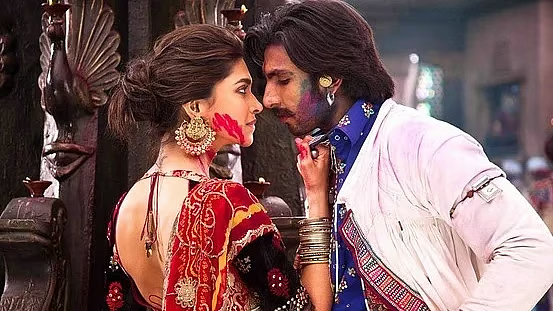
It’s a Bhansali film and you’re just living in it: Ravi Varman’s camera lingers on crimson walls, mirror-work, rain-soaked courtyards and the Holi-drenched beauty of Lahu Munh Lag Gaya, the song where Ram and Leela first set eyes on each other, surrounded by clouds of colour.
The film announces its ending in its very first romance:Tthe same shade that smears their faces in celebration will later lead to their own deaths.
The relationship begins instantly, with no courtship to speak of, only hunger. The speed is the point. In a town where every bond is dictated by clan, choosing someone in a single glance is the most rebellious thing either of them can do. But the film is also honest about what that choice costs. Ram turns out to be far more abrasive than we first imagine: impulsive, possessive, quick to turn a slight into a showdown. By the time blood is spilled on both sides and the two run away together, you may already be asking, Leela, is he really worth it?
Bhansali never fully answers the question. The love is real to them, enough for them to burn down their lives for it. The rush between them is so intense that even their families can’t pull them apart, even when they are apart.
Leela refuses to part with the ring that binds her to Ram, and her mother resorts to the most gruesome method to separate her from it. And yet, in all the pain, Leela still dances in the next scene to Nagada Sang Dhol, encountering Ram again, but is unable to look at him again.
But, she keeps dancing.
Where it falls apart
For all its glow, the cracks show. The first half is adrenaline, but the second half sags badly. Once the lovers are separated and each is thrust into leading their clan, the film turns into a slow, repetitive study of power, ceasefires and betrayal. The idea itself is rich: Two people who fled their families’ violence now have to manage it. But Bhansali doesn’t dig into it. Instead of showing how leadership changes Ram and Leela, or how they try to use their power to end the feud, the story circles the same beats of suspicion, provocation and reprisal.
The tonal shifts only make it harder to settle in. The film moves from bawdy comedy to gruesome violence to operatic tragedy with very little connecting tissue. A scene of sly flirtation can be followed by a mutilation, then by a lavish song, as though each mood belongs to a different film. Priyanka Chopra’s Ram Chahe Leela is the clearest example: an item number dropped into the tense stretch of the story; it’s a pause in a narrative that badly needs momentum.
Moreover, in such a tale, frames are so crowded with beauty that emotion has to fight for space, and characters sometimes feel posed within the image rather than living in it.
Even the climax, where the lovers turn their guns on each other rather than let their families win, feels rather staged. The choice is meant to be their final act of defiance, love claiming the one freedom the clans cannot take. Yet it arrives so carefully composed, so soaked in slow motion and symbolism, that the grief feels choreographed. After a second half that kept them apart for so long, the film hasn’t given their love enough room to breathe, so its ending lands as a tableau. You admire it more than you feel it.
Why it still endures
More than a decade later, Ram-Leela is easy to pick apart. It is overstuffed, uneven and at times exhausting. And yet it belongs to an era where you could enjoy the film, criticise it, and not completely forget about it.
Mainstream Hindi cinema has increasingly settled into a few familiar moulds: The chest-thumping patriotic drama, the grim revenge saga built on determination and body count, or the hastily assembled film that seems to exist only for a release date. Many of these films look alike and feel alike, and they leave very little behind once the credits roll. Ram-Leela came from a different instinct. It was a director taking a big, risky swing, and even where it missed, the miss was fun.
Perhaps, that is what makes a flawed film worth remembering. You can argue with Ram-Leela. You can question whether Ram deserved Leela, whether her rebellion was freedom or just another kind of captivity, whether its violence was critique or indulgence, and whether its ending was tragic or merely beautiful. It gives you something to wrestle with, and that is more than many cleaner, safer films manage.
And, it had music. The music you remember, and the songs you still sing years later. Lahu Munh Lag Gaya held the thrill and danger of first love in a single riot of colour. Nagada Sang Dhol turned longing into celebration, and Ang Laga De gave desire a kind of sorrowful tenderness.
And above all, there was Ranveer and Deepika. Chemistry like theirs, that effortless, crackling pull between two people on screen, has become strangely rare. In Ram-Leela, it was the thing that held the whole extravagant structure together. Whenever the story wobbled, they steadied it.
So yes, Ram-Leela is flawed and glamorous, and sometimes too much of both. But it felt like the time that you willingly wandered into an exhibition, admired it, sometimes covering your eyes because it could just be that illustrious. Yet, you walked out, telling yourself that you would be back for the next.