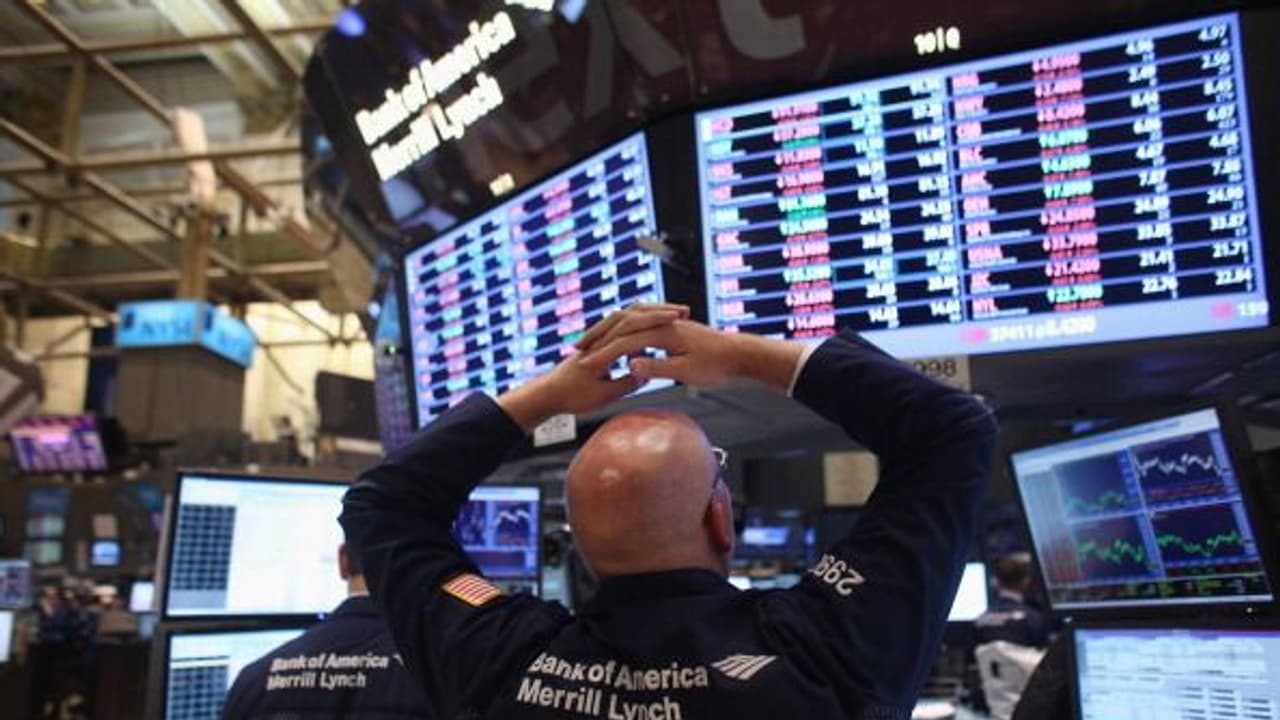
U.S. stock futures rose early Monday despite social media fears of a repeat of the 1987 Black Monday crash, while the Nasdaq had just recorded its worst week since June.
- Oil near $110 a barrel could keep inflation and Treasury yields in focus, with energy prices shaping expectations for the Federal Reserve’s next move.
- The semiconductor sell-off faces a key test as investors weigh stretched valuations, earnings expectations and the outlook for AI-related demand.
- The S&P 500’s headline performance may obscure a wider divide between sectors.
Calls for a “Black Monday” crash spread across social media over the weekend, but U.S. stock futures were pointing higher early Monday, the 39th anniversary of the 1987 market crash.
S&P 500 futures were up about 0.53% in pre-market trade, while Nasdaq futures were up more than 1%. Dow futures traded flat.
The fear was not baseless. The Nasdaq had its worst week since June, South Korea’s Kospi fell more than 16% in a month, and the 10-year Treasury yield stayed above 5%.
The potential calm does not end the debate. Retail traders on Stocktwits were bearish on the SPDR S&P 500 ETF Trust (SPY) even as futures rose. A poll on the platform of more than 13,000 respondents found 47% expect the index to gain more than 1% this week while 30% expect a drop of more than 1%.
The Federal Reserve sits at the center of these concerns. The central bank raised its benchmark rate in September to a range of 3.75% to 4.00%, its first increase in three years. Two hot inflation reports last week revived speculation about another hike. Chair Kevin Warsh declined on Friday to signal the next move, while Goldman Sachs put the odds of a December hike in focus.
The Fed is scheduled to meet next week, a couple of days before the midterm elections. Three charts show how oil, AI-related stocks and the broader market’s sector rotation are shaping the outlook for the week.
Energy Is the One Part of the Market That Loves $110 Oil
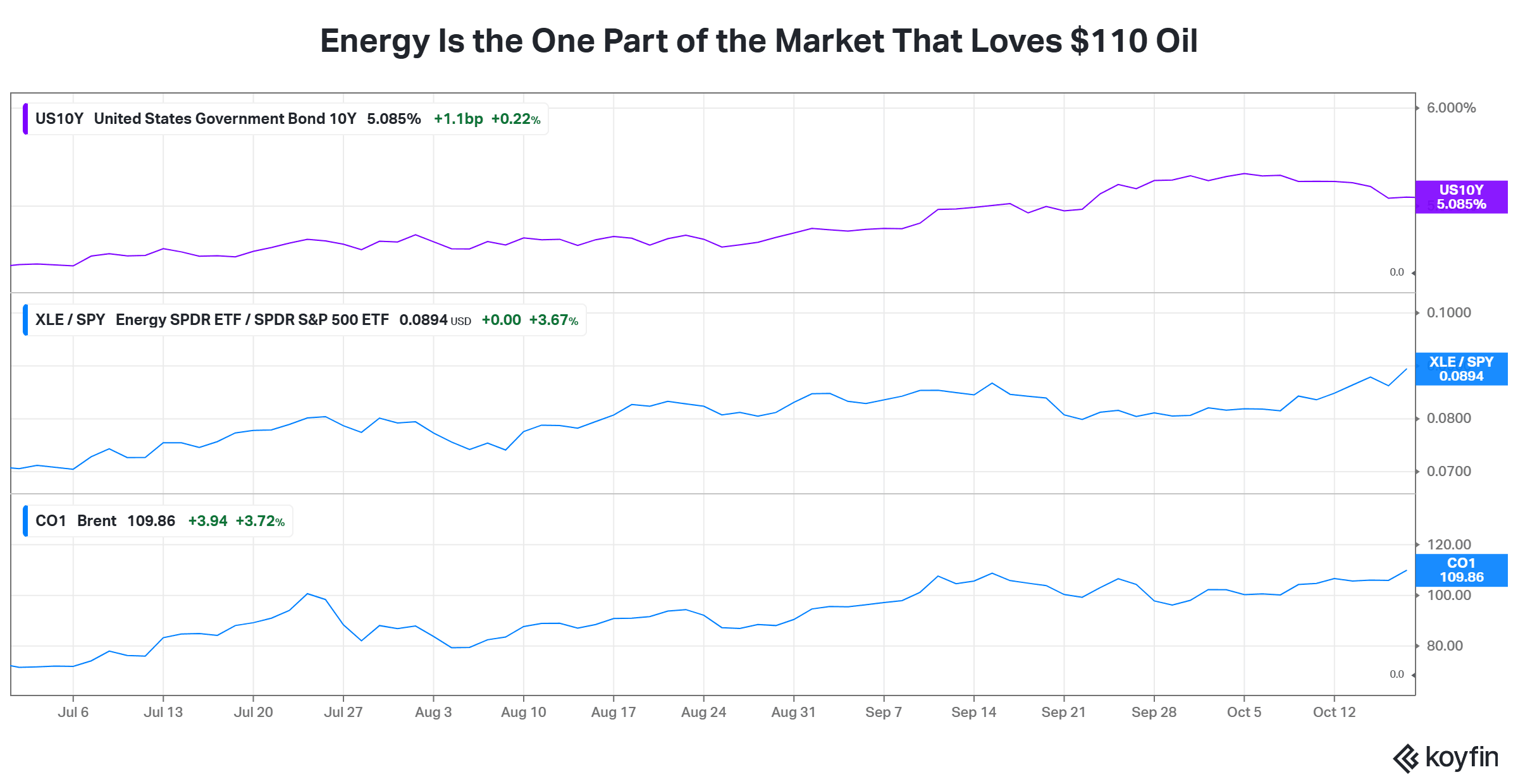
Brent crude settled at $109.86 on Friday, its highest close since May 19, after rising 3.7% in a single session. Brent gained 4.9% for the week, while U.S. crude advanced 10.4%. Since early July, energy stocks have outperformed the S&P 500 by roughly 25 percentage points, according to Koyfin data.
Attacks on commercial ships near the Strait of Hormuz, Houthi missile strikes on Saudi Arabia and Ukraine’s strike on a Russian refinery have heightened concerns about fuel supplies. Government efforts to contain prices include planned fuel releases and changes to U.S. sanctions on Russian fuel.
For markets, the risk extends beyond energy stocks. September consumer prices rose 3.7% year over year, up from 3.4%, while the 10-year Treasury yield reached 5.36% earlier this month before easing to 5.085% Friday. Further supply disruptions could keep oil elevated, complicating the Federal Reserve’s next move ahead of its Oct. 27-28 meeting.
The AI Boom’s Hottest Corner Is Cracking
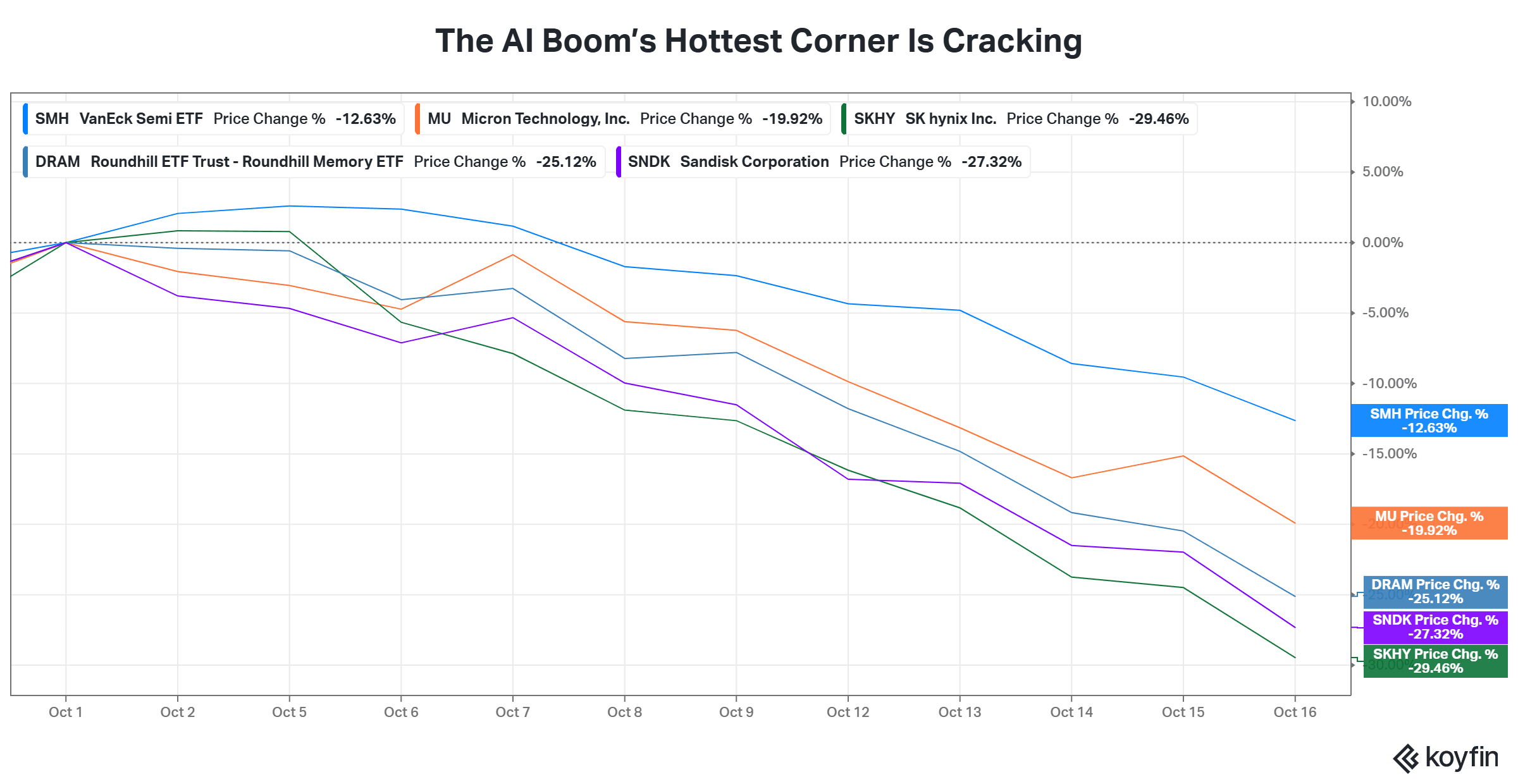
Memory and storage stocks have been among the hardest-hit parts of the technology market. So far this month, SK Hynix (SKHY) has fallen 29.5%, SanDisk (SNDK) has dropped 27.3%, the Roundhill Memory ETF (DRAM) has declined 25.1% and Micron Technology (MU) has lost 19.9%. The VanEck Semiconductor ETF (SMH), which tracks a broader group of chip companies, has fallen 12.6%.
The sell-off comes after enormous gains earlier this year and reflects concerns about Chinese competition, AI companies’ revenue growth and higher financing costs. Yet demand indicators remain strong. Taiwan Semiconductor Manufacturing (TSM) raised its 2026 growth outlook to about 44%, Samsung forecast a sharp increase in quarterly operating profit, and TrendForce expects memory prices to rise in the fourth quarter.
This week, investors will look for clues from Tesla (TSLA), Meta Platforms (META), Texas Instruments (TXN) and Western Digital (WDC). Their results and outlooks could help determine whether Monday’s pre-market chip rebound has staying power. SK Hynix reports next week, ahead of the Fed decision.
A Flat S&P 500 Masks A Sharp Rotation Across Sectors
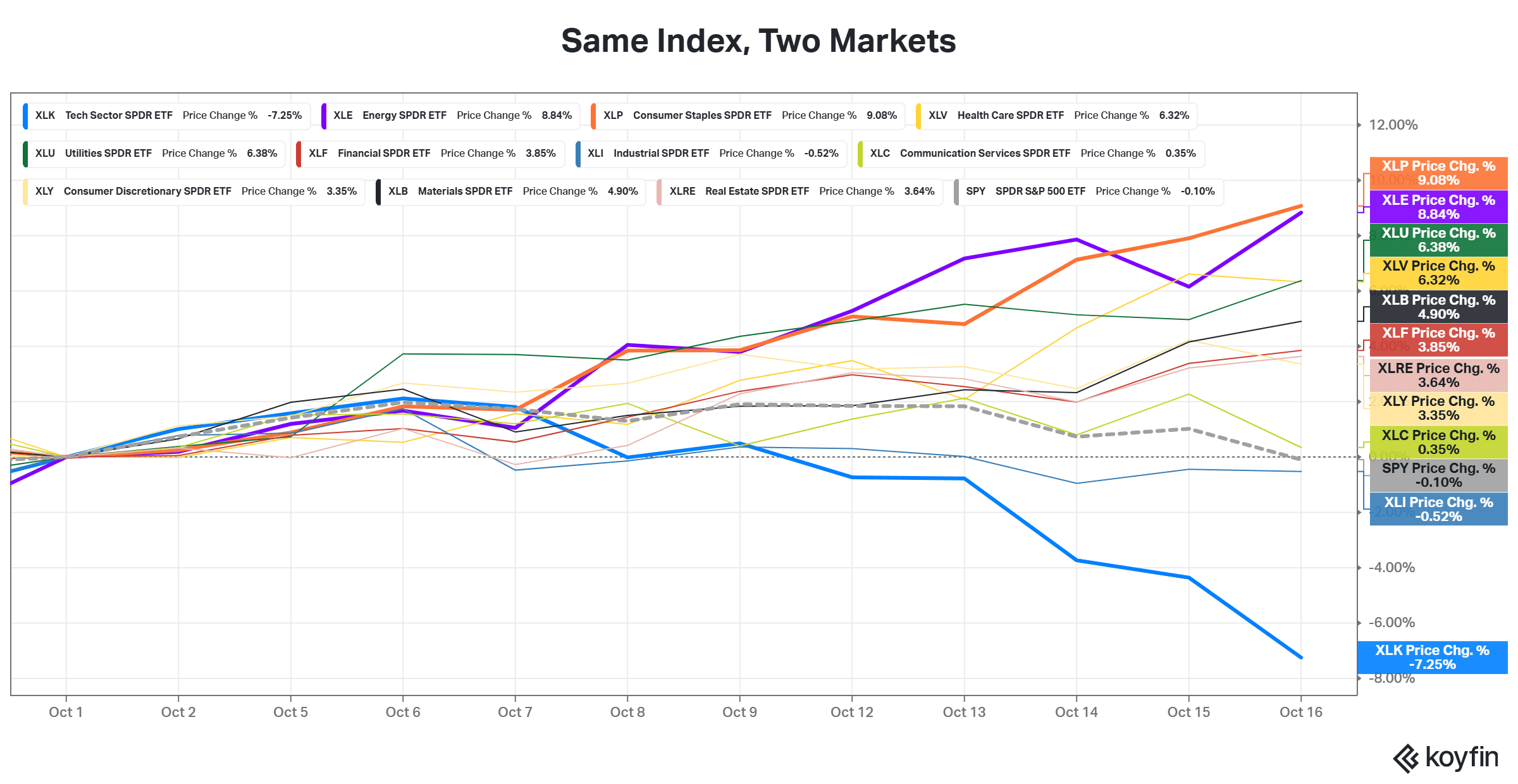
The S&P 500 has barely moved since the start of October, but that headline figure masks a sharp divide across sectors. The index closed Friday at 7,659.44, down 0.1% for the month. Technology fell 7.25% over the period, while industrials slipped 0.5%. Nine of the 11 S&P 500 sectors were higher.
The strongest gains came from defensive groups and energy. Consumer staples rose 9.1%, energy gained 8.8%, utilities advanced 6.4% and health care climbed 6.3%. Technology’s large weighting in the S&P 500 means its losses have offset gains elsewhere.
The rotation suggests investors are favoring defensive businesses and energy exposure while reassessing expensive technology stocks. Procter & Gamble (PG) and Philip Morris International (PM) report this week, giving investors a fresh look at demand for consumer staples.
The key question is whether chip stocks can recover without defensive sectors surrendering their gains. Oil prices, earnings and Treasury yields will help decide whether the market broadens out or the pressure on technology deepens.
Read also: Elon Musk’s Roadster, Nvidia’s Space AI Push, Nadella’s Security Warning: Mag 7 Voices This Week
For updates and corrections, email newsroom[at]stocktwits[dot]com.<