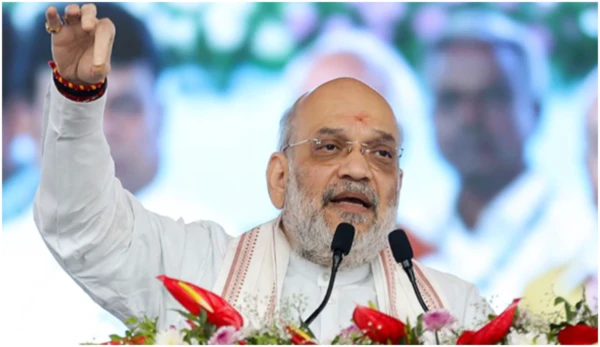
After his historic victory in West Bengal, Union Home Minister Amit Shah is now engaged in strategising for Uttar Pradesh, where assembly elections are scheduled to take place next year.
In line with that, he is expected to begin his Uttar Pradesh tour in June.
Between June and September, he will attempt to gauge the state’s political pulse so that he can formulate an election strategy based on that information.
Bundelkhand first
The elections are likely to be held in February next year. While Amit Shah’s visit to Uttar Pradesh hasn’t been finalised yet, high-ranking sources, cited by jagran.com, indicate that he is planning to visit two regions in June.
He will initially visit Bundelkhand and the Braj region. During this period, he will discuss local issues and social dynamics with local leaders and workers, and also review the state of the organisation from the district to the booth level.
Following this, he plans to visit the remaining four regions similarly in July, August, and September.
The BJP has organisationally divided Uttar Pradesh into Western Uttar Pradesh, Kashi, Bundelkhand, Braj, Awadh, and Gorakhpur. After completing visits to all regions, work will begin in October on a strategy to boost the BJP’s standing at the booth level.
What is BJP’s strategy?
The Jagran.com report cited highly placed sources, suggesting that the party believes the UP Assembly elections will not be easy, given the BJP’s significant seat loss in the 2024 Lok Sabha elections.
The BJP, which won 71 seats in 2014 and 62 in 2019, was reduced to 32 seats in 2024. Similarly, in the 403-member Assembly, the BJP alone won 312 seats in 2017 and 255 in 2022.
To replicate its past performance in 2027, West Bengal’s electoral strategy could be replicated in Uttar Pradesh.
The state has been divided into five regions similar to West Bengal. As part of the Bengal campaign, Amit Shah divided West Bengal into five regions, assigning these responsibilities to five organisational secretaries and five senior leaders. Previously, this strategy was successful in achieving historic victories in the Bihar and Maharashtra Assembly elections.