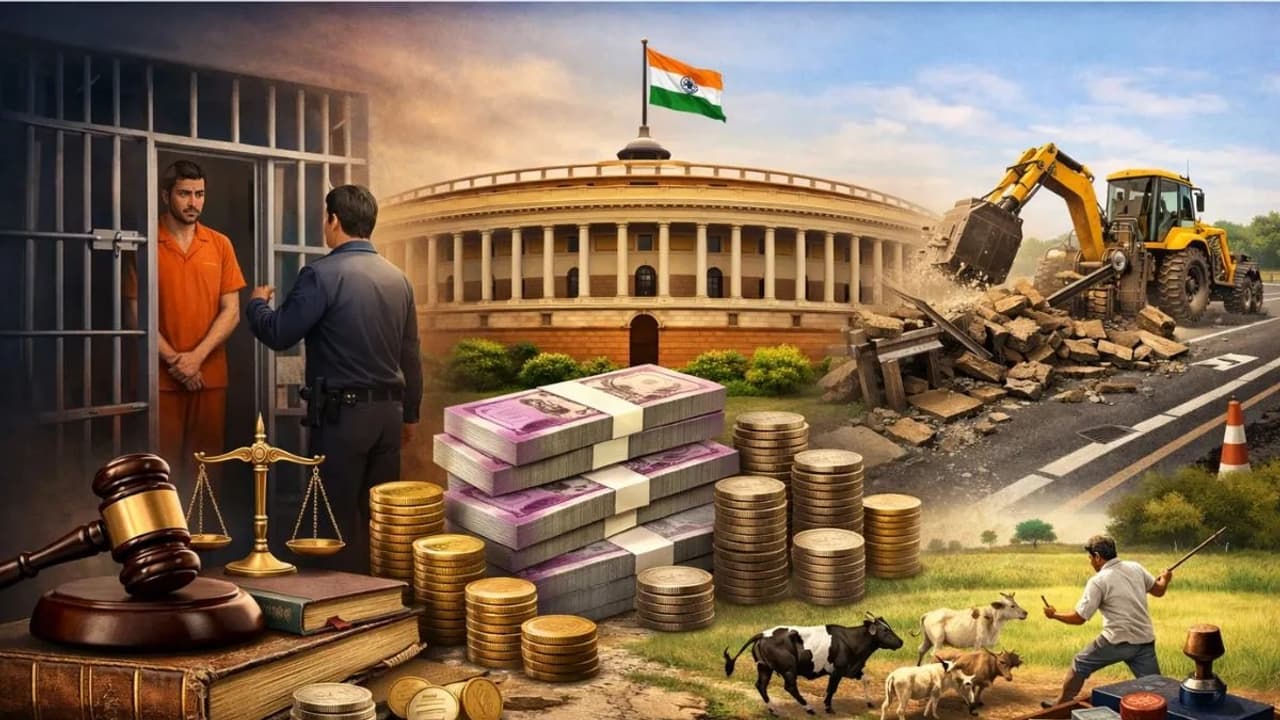
Parliament has passed the Jan Vishwas Bill 2026 to reduce criminal penalties for minor offences and improve ease of doing business. The law amends 80 Acts and removes jail terms in many cases, replacing them with fines. It also introduces graded penalties and compliance measures.
Parliament on Thursday approved the Jan Vishwas (Amendment of Provisions) Bill, 2026, a major law aimed at reducing criminal penalties for minor offences and making rules easier for businesses and citizens. The Rajya Sabha passed the Bill by a voice vote after a discussion. The Lok Sabha had already cleared it a day earlier. Commerce and Industry Minister Piyush Goyal said the changes will reduce compliance burden and help both citizens and small businesses.
Wide scope covering many laws
The Bill was introduced in the Lok Sabha on March 27, 2026. It replaces an earlier version brought in August 2025, which covered only 17 laws.
A Select Committee led by Tejasvi Surya reviewed that version and suggested expanding the scope. Its report, submitted on March 13, 2026, recommended changes to many more laws.
The earlier Bill was withdrawn on March 17, and the new version was brought in with wider coverage.
In total, the new law amends 80 central Acts and covers 784 provisions across 79 laws handled by 23 ministries. These include sectors like coal, transport, shipping, commerce, and urban development.
Out of these, 717 provisions remove criminal liability for minor offences, while 67 aim to improve “ease of living”.
Shift from jail terms to fines
One of the biggest changes is replacing jail sentences with civil penalties for many minor violations.
For example, under the Drugs and Cosmetics Act, earlier offences related to cosmetics could lead to up to one year in jail or a fine of ₹20,000. Now, such violations will attract a civil penalty of ₹1 lakh or three times the value of seized goods, whichever is higher.
Similarly, under the National Highways Act, actions that make highways unsafe, which earlier could lead to up to five years in prison, will now result in fines between ₹10 lakh and ₹1 crore.
Some offences removed completely
The Bill also removes certain offences entirely. These include giving a false fire alarm under the Delhi Police Act, not reporting births and deaths under the Delhi Municipal Corporation Act, and incorrect entries in copyright registers under the Copyright Act.
In other cases, jail terms have been removed and replaced with higher fines. This includes laws like the Indian Succession Act and the Electricity Act.
Regular increase in penalties
The Bill also updates penalty amounts. It introduces a rule that minimum fines will increase by 10 percent every three years.
This is meant to keep penalties effective over time.
Graded approach to enforcement
A new system has been introduced to handle violations in a more balanced way.
For some offences, first-time violations will lead to an advisory. A second offence may result in a warning. Only after repeated violations will financial penalties be imposed.
For example, under the Apprentices Act, issues like not providing required information will first attract softer action.
The Bill also introduces “improvement notices” under the Legal Metrology Act. This allows businesses to fix problems within a set time before facing penalties.
Changes in dispute handling
To make enforcement faster and clearer, the Bill allows for adjudicating officers to decide penalties. There will also be appellate authorities where people can challenge decisions.
Municipal reforms included
The Bill also makes changes to the New Delhi Municipal Council Act. It restructures property tax into separate parts for buildings and vacant land.
It also sets up a Municipal Valuation Committee and a Hardship and Anomaly Committee to address complaints.
Another change is the removal of provisions related to advertisement tax.
Focus on ease of doing business
The government says the Bill is part of a larger effort to improve ease of doing business and reduce unnecessary legal pressure.
By removing jail terms for minor issues and focusing on fines instead, the law aims to make compliance simpler and less stressful.
The Jan Vishwas Bill marks a major shift in India’s legal system for minor offences. It focuses on trust, ease, and fairness, rather than punishment.
Officials believe it will help businesses grow while also making everyday rules easier for people to follow.