India’s safest bank
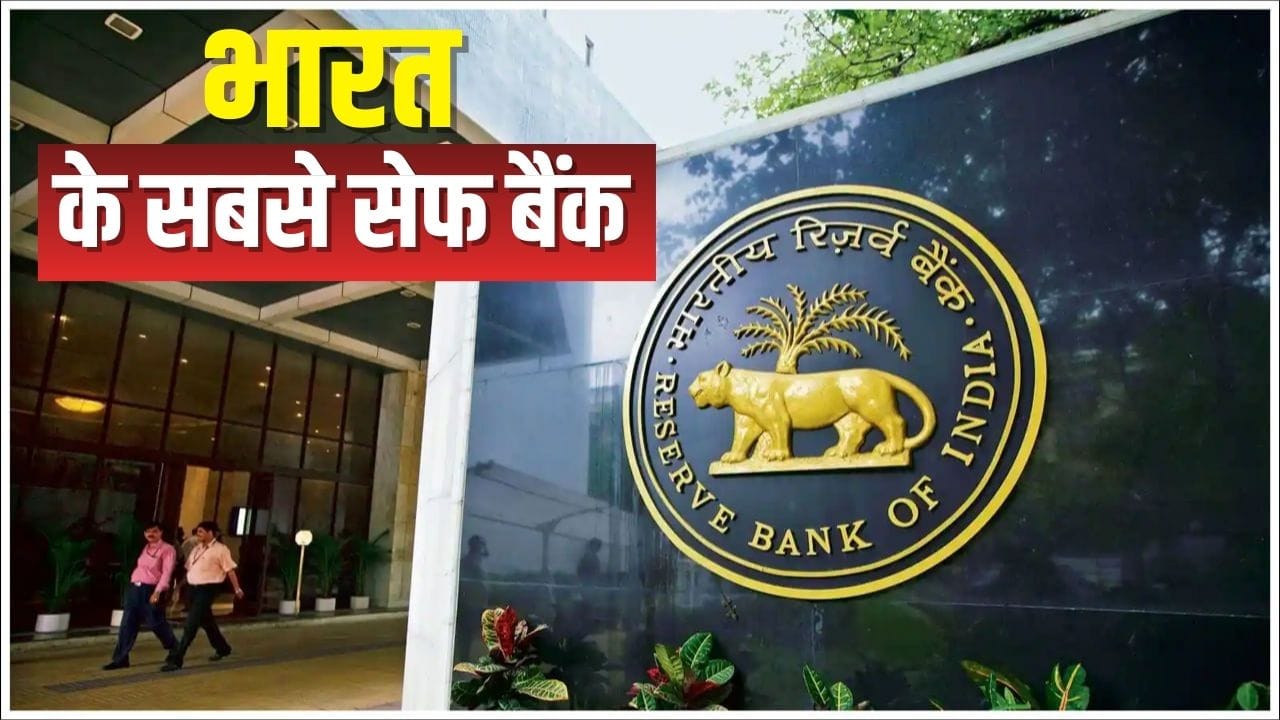
India safest bank list: Every person has only one question in his mind while depositing his hard-earned money in the bank, “Is my money safe?” If your account is in State Bank of India (SBI), HDFC Bank or ICICI Bank, then there is very good news for you from the Reserve Bank of India (RBI). The Central Bank has made it clear that these three banks are the pillars of the Indian economy, which will not be allowed to sink under any circumstances.
rbi Has retained these three banks in the category of safest banks of the country. In banking terminology these are called ‘Domestic Systemically Important Banks’ (D-SIBs). If understood in simple language, they are ‘Too Big To Fail’ i.e. they are so huge that their failure can put the entire economic system of the country in danger.
Why are these three banks VIP?
Often people consider government banks to be safer than private banks, but this list of RBI breaks this myth also. In this list there is one government (SBI) and two private (HDFC and ICICI) banks. Their getting the status of D-SIBs means that the supervision of the Reserve Bank on them is more strict than that of normal banks.
The functioning of these banks is so widespread and their contribution to the country’s GDP is so high that if even a small problem occurs in them, its impact will be visible from the stock market to the pockets of the common man. This is the reason why RBI and the Government of India have ensured that if ever there is any financial crisis on these banks in future, the government itself will come forward and handle them. That is, your money deposited in these can be considered completely safe.
Know who got the place when
RBI started the concept of this security cover i.e. D-SIB in the year 2014, so that the banking system could be strengthened. Subsequently, banks were added in a phased manner based on their capacity and performance:
- 2015: The country’s largest government bank, SBI, first became a part of this list.
- 2016: Private sector giant ICICI Bank was included in this elite club.
- 2017: After this, HDFC Bank was also given the status of Systemically Important Bank of the country.
From then till today, these three banks have continuously remained in this list, which is a proof of their financial strength.
Price to be paid for security guarantee
With this special status of security comes great responsibilities. According to RBI rules, these three banks have to maintain more cash reserves or capital than normal banks. In technical language it is called ‘Common Equity Tier 1′ (CET1). This is a kind of ’emergency fund’, which saves the bank from sinking in bad times. RBI has placed these banks in different ‘buckets’ or categories according to their size. The higher the risk of a bank, the more extra capital it will have to maintain:
- SBI (Bucket 4): It will have to maintain maximum additional tier-1 capital of 0.80%.
- HDFC Bank (Bucket 2): It will have to maintain an additional buffer of 0.40% of its total assets.
- ICICI Bank (Bucket 1): It will have to maintain 0.20% additional capital.
These new and strict rules will be fully implemented from April 1, 2027, due to which the foundation of these banks will become even stronger like stone.
How safe is your money?
When RBI declares a bank as D-SIB, it is indirectly guaranteeing that the bank has enough surplus money (buffer) that it can withstand even the biggest economic shocks. If you are a customer of these banks, then you do not need to worry about the bank’s closure or bankruptcy.