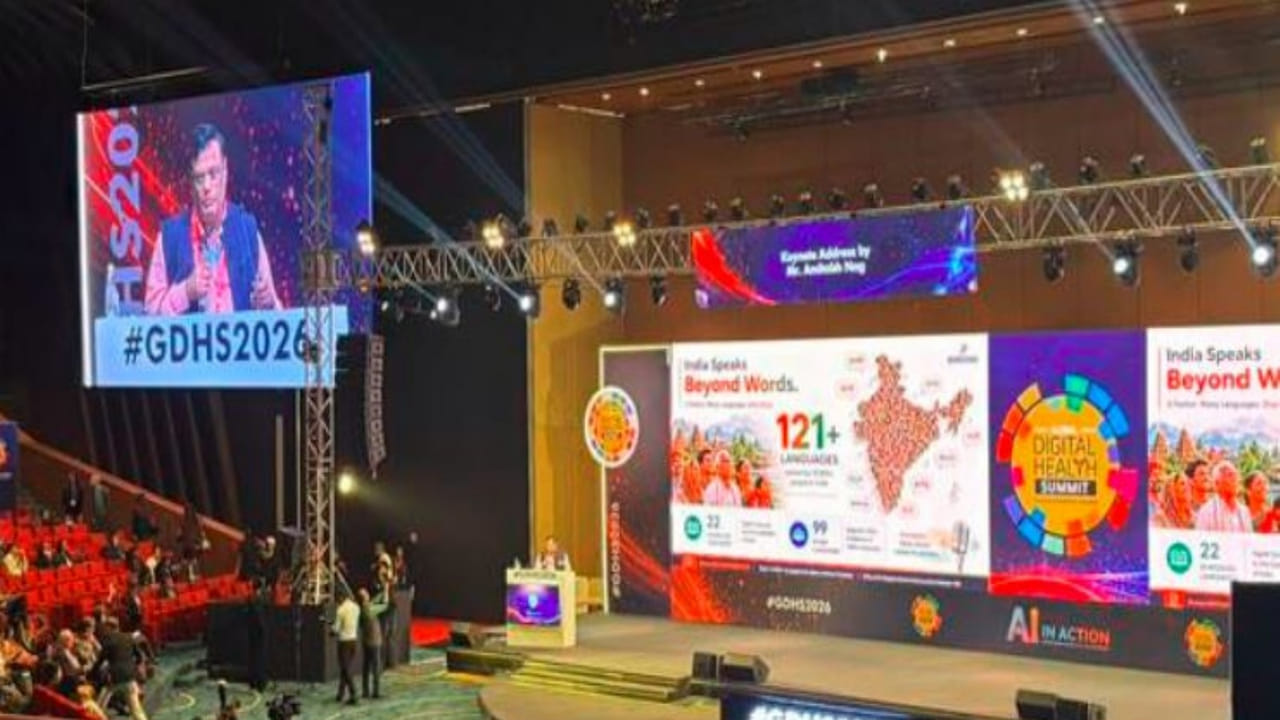
At GDHS 2026, the Digital India BHASHINI Division demonstrated how its multilingual AI ecosystem enhances healthcare by breaking language barriers and streamlining clinical workflows for a more inclusive, patient-centric medical experience.
The Digital India BHASHINI Division (DIBD), under the Digital India Corporation (DIC), Ministry of Electronics and Information Technology (MeitY) concluded its participation at the Global Digital Health Summit (GDHS) 2026, held at Bharat Mandapam, New Delhi, on November 20-21. According to a release from the Ministry of Electronics & IT, across the two-day summit, BHASHINI showcased its multilingual Artificial Intelligence (AI) ecosystem and demonstrated how language technologies can strengthen healthcare delivery, facilitate clinical workflows and enable more accessible, inclusive and patient-centric healthcare experiences.
On the concluding day of the summit, Amitabh Nag, CEO, Digital India BHASHINI Division, delivered a keynote address titled “Breaking Language Barriers in Healthcare Through AI: Sharing BHASHINI’s Model of Removing Linguistic Barriers Using AI.” The address highlighted the need to integrate language intelligence into digital healthcare infrastructure, ensuring that patients can understand, communicate and access healthcare services in their preferred languages. Emphasising that language is a critical yet often overlooked layer of digital healthcare, the keynote explored how multilingual AI can support communication between doctors and patients, simplify clinical documentation and improve access to medical information.
It also highlighted the importance of empathy in healthcare, recognising that healing extends beyond diagnosis and medication to the human connection between doctors, caregivers and patients, the release said. The ability to express care, reassurance and understanding in a language that patients relate to can foster comfort, trust and a stronger connection with healthcare professionals. Through BHASHINI’s language technologies, such interactions can become more inclusive and compassionate, helping ensure that patients feel heard and understood.
The keynote also highlighted BhashaDaan for Health, reflecting the importance of community-driven contributions in developing language resources for healthcare and strengthening multilingual AI capabilities for medical and public health applications. Data Daan for Health was highlighted as an initiative to build multilingual healthcare datasets by capturing colloquial expressions used by people to describe symptoms and health conditions, alongside their corresponding medical terminology. The focus is on documenting how people naturally communicate health concerns in their everyday language, including regional phrases and commonly used expressions that may not directly correspond to formal medical vocabulary.
For instance, a phrase such as “per me paani bhar gaya hai” can be mapped to the medical term Oedema. By capturing such expressions across Indian languages and mapping them to standard medical terminology, the initiative aims to help AI systems better understand how people describe their symptoms, recognise health-related concerns and facilitate more effective communication between patients and healthcare professionals. At the BHASHINI exhibition stall, demonstrations continued across healthcare-focused applications and multilingual AI capabilities. The exhibition featured use cases from the All India Institute of Medical Sciences (AIIMS), Jawaharlal Institute of Postgraduate Medical Education and Research (JIPMER), and the Directorate General of Medical Services, Indian Army, showcasing the application of speech and language technologies in clinical settings, the release said.
At JIPMER, the integration of e-BHASHINI with the e-Sushrut Hospital Management Information System (HMIS) enables voice-based documentation of clinical histories, IPD notes and discharge instructions. At AIIMS, demonstrations highlighted speech technologies supporting doctor-patient conversations across languages, alongside the integration of BHASHINI’s speech-to-text facility with NIC’s eHospital prescription module. The Directorate General of Medical Services (Army) showcased the use of BHASHINI’s capabilities in i- Dhanwantri, where doctors’ spoken clinical notes are converted into typed text to support medical documentation. The stall also featured demonstrations highlighting multilingual conversations between doctors and patients, showcasing how BHASHINI’s speech and language technologies can facilitate communication across languages, support patient understanding and make healthcare interactions more accessible and inclusive.
An interactive AI-powered healthcare persona was also demonstrated at the BHASHINI stall, illustrating how conversational and voice-enabled AI can facilitate more accessible interactions and make technology-based healthcare experiences more engaging and intuitive. Other demonstrations included the BHASHINI mobile application, showcasing its translation and voice-based capabilities; Shrutlekh, supporting real-time multilingual transcription and translation; Data Daan for Health, a community-driven initiative to build medical language datasets by capturing colloquial expressions used to describe symptoms and health conditions, alongside their corresponding medical terminology; and Granthika, BHASHINI’s guided platform for collecting and digitising written and oral language resources, the release said. Through its participation at GDHS 2026, BHASHINI highlighted how multilingual AI can extend beyond language translation to become an enabling layer across healthcare systems. By bringing together institutional use cases, speech technologies, medical language resources and community-led contributions, the exhibition and keynote reinforced the importance of making healthcare more accessible, efficient, empathetic and responsive to India’s linguistic diversity.