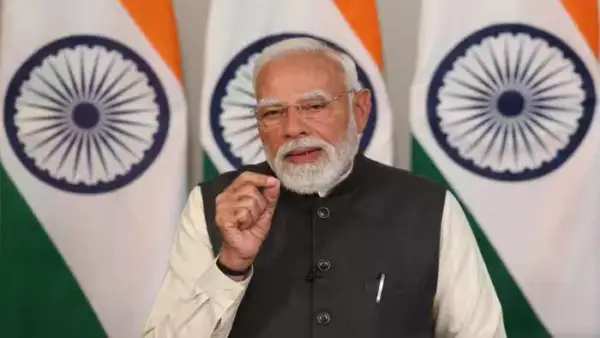
Prime Minister Narendra Modi in Bharat Renewable Energy Summit and Expo said that India targets adding 500 GW of new non-fossil energy capacity in the next 10-11 years.
The country has achieved 300 GW of non-fossil energy capacity so far, PM Modi added.
Despite multiple global crises, from COVID-19 to the West Asia crisis, PM Modi said that India’s economic growth remained strong, with over 140 crore Indians being proud of the economy.
India ranks top three nations in rewenable energy
Describing India’s 12-year clean energy journey as one defined by Promises, Passion, and Performance exemplified by its COP-26 commitment to achieve 500 Gigawatts of non-fossil capacity by 2030, the Prime Minister highlighted that the nation fulfilled its Paris pledge of sourcing half its installed power capacity from non-fossil sources in 2025, five years ahead of schedule.
Noting that India now ranks among the top three nations in solar and renewable energy with over 50 percent non-fossil installed capacity and nearly 300 Gigawatts already achieved toward the 500-Gigawatt target, he announced an ambitious goal to add another 500 Gigawatts of new non-fossil capacity over the next 10 to 11 years. “This target is somewhat difficult, but I have faith in the capability of my country; therefore I say, We will do it!” affirmed PM Modi.
Detailing the rapid progress of the PM Surya Ghar Muft Bijli Yojana launched in February 2024 to install rooftop solar panels in one crore homes, the Prime Minister noted that over 65 lakh households have joined the movement within 24 to 25 months at a pace of one lakh new homes every six days, cutting electricity bills by roughly 76 percent according to a study and reducing bills to zero for lakhs of families who now earn money by selling surplus power to the grid. “This scheme of India can give great strength to energy security in many countries,” observed PM Modi.
Highlighting efforts over the past 12 years to integrate solar power into daily life, industry, and agriculture, the Prime Minister pointed out that connecting over 44,000 government buildings with solar energy is saving nearly 700 crore rupees annually, while the KUSUM scheme has provided solar irrigation to over 30 lakh farmers and saved each solar pump beneficiary nearly one lakh rupees every year.
He also cited the PM Surya Sarovar Yojana, which installs solar panels over reservoirs, ponds, and lakes to optimize water bodies and save land acquisition costs. “India is making solar power a part of the lives of its citizens,” noted Shri Modi.
The Prime Minister said India’s single-frequency national grid is being supported by dedicated green energy corridors to improve renewable power distribution. He added that the government has recently approved investment of Rs 2 lakh crore for this effort.
India has also sharply increased its domestic solar manufacturing capacity. Solar module production capacity has risen from about 2 gigawatts a decade ago to more than 200 gigawatts, while solar cell manufacturing capacity has reached around 40 gigawatts.
Modi said the renewable energy sector has attracted more than Rs 15 lakh crore, or about USD 164 billion, in investment over the past decade. Since the ReInvest summit in 2024, investments of around Rs 6 lakh crore, or over USD 63 billion, have been recorded in just two years.
He added that the sector could see investment opportunities worth more than Rs 20 lakh crore, or around USD 220 billion, by the end of the decade.
The Bharat Renewable Energy Summit & Expo 2026 was held alongside the 9th Assembly of the International Solar Alliance and the 4th International Green Hydrogen Conference. Modi also reiterated India’s proposal for a USD 200 million Africa Solar Facility aimed at supporting technology and finance for developing economies.