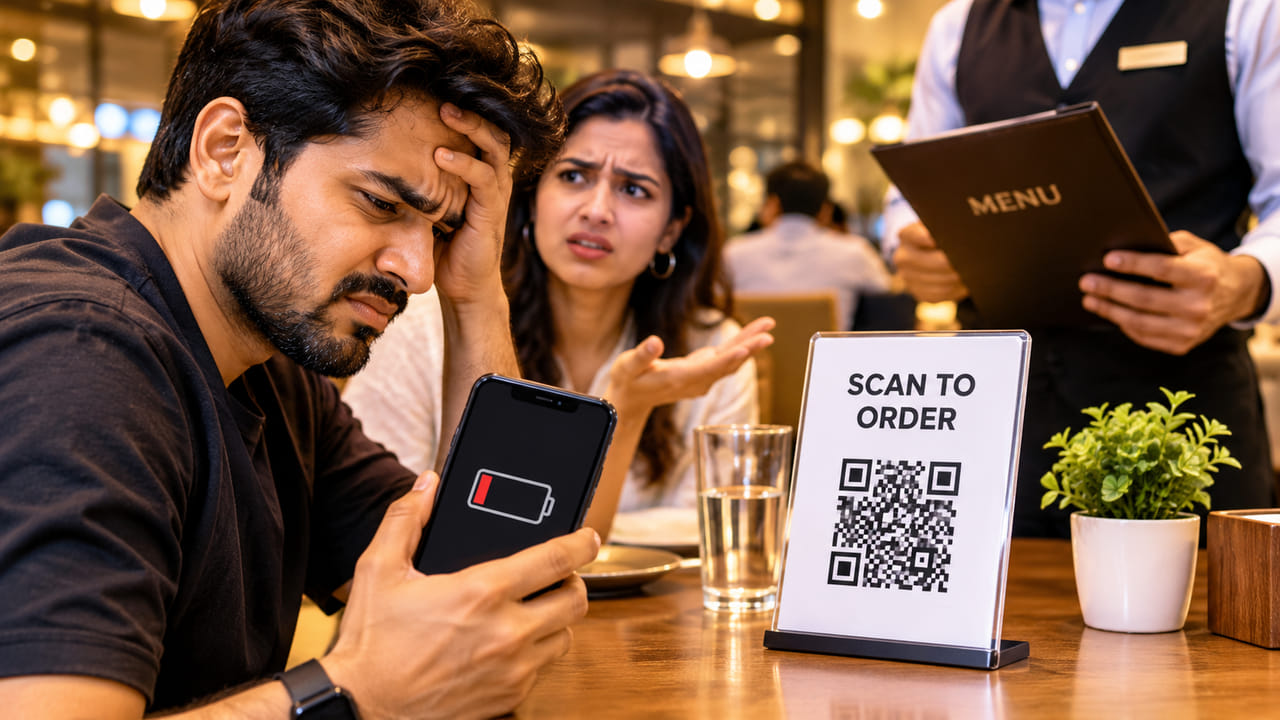
A restaurant in Bengaluru allegedly insisted that customers scan a QR code to access its menu and place orders online, even when their phones were running out of battery.
A restaurant in Bengaluru allegedly insisted that customers scan a QR code to access its menu and place orders online, even when their phones were running out of battery. Laalit Lobo, a brand-led growth consultant, took to LinkedIn to share his frustrating experience, calling out restaurants that increasingly depend on technology for even the simplest aspects of dining out.
According to Lobo, he had visited a popular restobar near Brigade Road in Bengaluru with his wife and son the previous Friday. When he asked the waiter for a menu, he was instructed to scan a QR code. His phone had completely run out of battery, while his wife’s device was left with just 6% charge.
“I said can’t you just get me a physical menu. The one phone we have won’t likely survive the evening,” Lobo wrote.
Although the waiter agreed to provide a physical menu, he informed the customer that placing the order online was still mandatory.
“What!!” Lobo wrote, describing his disbelief at the restaurant’s insistence.
Lobo revealed that the restaurant’s ordering webpage reset four times during the meal, forcing the couple to log in repeatedly. On each occasion, the waiter had to provide an OTP linked to their table.
Questioning the growing obsession with digitalisation in restaurants, Lobo criticised establishments for shifting the responsibility of ordering onto customers’ personal devices.
“Bangalore restaurateurs, like your peers in the tech industry, I know you pretend you are living in 2067 and you want to digitise everything because someone told you data is the new oil. But guys get a grip on reality,” he wrote.
Lobo argued that restaurants looking to streamline operations through technology should invest in their own devices instead of expecting customers to arrive with fully charged smartphones and reliable internet connections.
“Don’t be a cheapskate and expect people to bring their own phones, charged and with good network,” he wrote, suggesting that restaurants could instead place tablets on every table to make ordering easier.
Taking a sarcastic dig at the growing dependence on automation, he also suggested that restaurants could go a step further by deploying robots to serve food, particularly if reducing staff requirements was the ultimate objective.
Lobo also cited his experiences at sushi restaurants overseas, where customers could place orders through tablets and receive their food on conveyor belts. However, despite the advanced ordering systems, customers still had the option of paying cash at the counter.
“We are spending our money to have a good time. To chill after a long week. Don’t make it stressful with your half baked tech integrations,” he wrote.
Several social media users shared similar frustrations over QR-based ordering systems.
One user pointed out that such arrangements become particularly inconvenient at restaurants with poor mobile connectivity or no Wi-Fi. Another praised Lobo and his family for managing to enjoy their meal without depending on their personal phones.
A third user suggested that restaurants should provide their own devices for customers who cannot or prefer not to order through personal smartphones. They also argued that charging points at every table should be a basic facility if establishments insist on phone-based ordering.