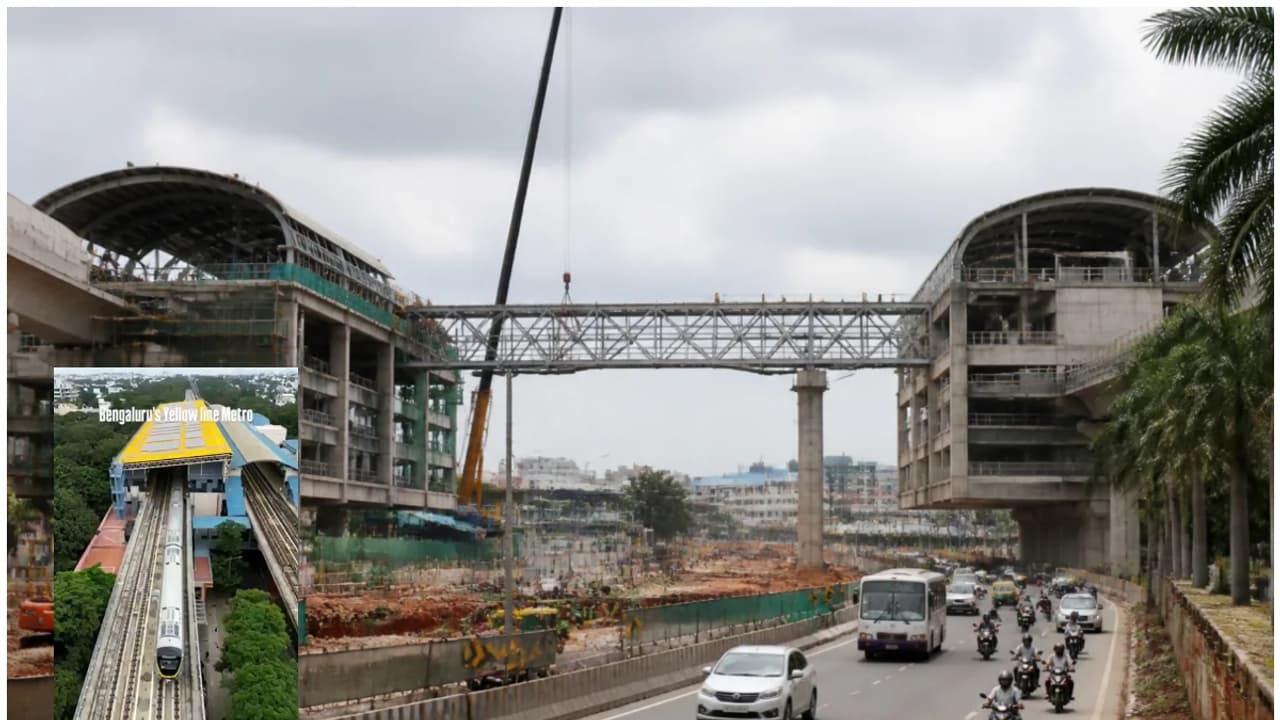
Bengaluru Metro will get its first travelator at Central Silk Board under a ₹55.48 crore project awarded to Milan Road Buildtech LLP. The 250-metre elevated skywalk will connect the Yellow and Blue Line stations with a moving walkway.
Namma Metro commuters can look forward to a more convenient interchange at Bengaluru’s Central Silk Board junction, where the Bangalore Metro Rail Corporation Limited (BMRCL) is developing the city’s first travelator to connect the Yellow and Blue Line stations. The project aims to make transfers easier and safer at one of the city’s busiest traffic junctions, where the two elevated stations are separated by the Outer Ring Road (ORR).
BMRCL has awarded a contract worth ₹55.48 crore to Milan Road Buildtech LLP to construct a 250-metre elevated skywalk equipped with an automated moving walkway and an adjacent pedestrian pathway.
A High-Tech Solution for the Busy Silk Board Junction
The Yellow and Blue Line stations at Central Silk Board are located on opposite sides of the busy Outer Ring Road. The Yellow Line, which runs from RV Road to Bommasandra, is operational, while work on the Blue Line, which will connect Bengaluru to Kempegowda International Airport, is progressing.
Without a dedicated interchange facility, commuters transferring between the two lines would have to descend from one station, cross the busy road and climb up to the other station. The proposed 250-metre elevated skywalk, featuring a travelator, is designed to eliminate this inconvenience and provide a more convenient interchange experience.
Airport-Style Moving Walkways for Metro Commuters
BMRCL is introducing technology commonly found at major airports, shopping malls and large railway stations to Bengaluru’s metro network. A travelator allows passengers to stand or walk on a continuously moving, flat platform, helping them cover longer distances with less effort.
For commuters who prefer to walk, a dedicated pedestrian pathway will run alongside the travelator. BMRCL Chief Public Relations Officer Yashavanth Chavan explained that the facility is necessary because the two stations are located a considerable distance apart, with a major road separating them.
The facility is expected to improve passenger convenience and make transfers between the Yellow and Blue lines easier, particularly during peak hours.
How Is the Silk Board Interchange Different From Other Metro Stations?
The interchange arrangement at Central Silk Board differs from those at other major Namma Metro stations.
At Nadaprabhu Kempegowda Station, Majestic, the Purple and Green lines connect within the same interchange complex. At RV Road, the Green and Yellow Line stations are located close to each other, making transfers more convenient. At MG Road, the elevated Purple Line connects with the underground Pink Line at a separate station.
At Silk Board, however, the two elevated stations are separated by the Outer Ring Road, making a dedicated elevated connection necessary. The proposed skywalk and travelator are intended to bridge this gap, improve pedestrian movement and add a modern feature to the junction’s transport infrastructure.
When Will the Silk Board Travelator Open?
The travelator is expected to open to commuters once the Blue Line station at Central Silk Board becomes operational. Until then, services on the Yellow Line will continue as usual.
The facility is being developed as part of the interchange infrastructure connecting the two metro corridors. The construction timeline will determine when commuters can start using the moving walkway and the adjoining pedestrian pathway.
What Exactly Is a Travelator?
A travelator, also known as a moving walkway, is a mechanised platform that transports people horizontally or along a gentle incline from one point to another. Unlike an escalator, which uses moving steps to carry passengers between different levels, a travelator has a flat, continuously moving surface similar to a conveyor belt.
Travelators are commonly installed at airports, railway stations and other large public facilities to help people cover long distances more comfortably. At Central Silk Board, the facility is intended to reduce the effort required to transfer between the Yellow and Blue metro lines and improve the overall commuting experience.