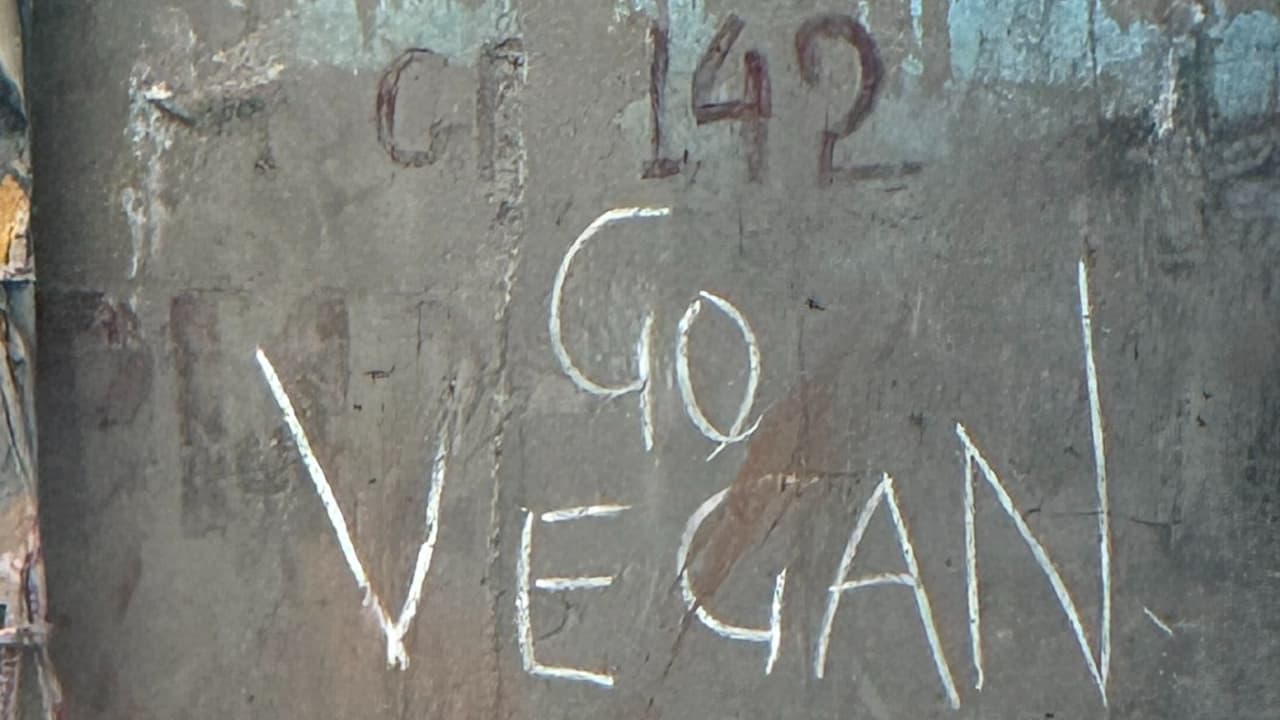
Graffiti with messages like “Go Vegan, Save Cow” and “Save Hasu” has appeared across Bengaluru, irritating residents and triggering a social media debate on whether this chalk activism is meaningful awareness or simple vandalism.
In a curious yet increasingly frustrating trend across Bengaluru, the slogan “Go Vegan, Save Cow” along with phrases such as “Save Hasu” has been appearing repeatedly on walls, metro pillars, ATMs, garbage pile enclosures and almost any flat surface available. Many residents have started questioning the civic sense behind this sudden wave of graffiti. Several have pointed out that the message is plastered all over the city, particularly in South Bengaluru. The growing number of these chalk writings has sparked a lively debate online, especially on Reddit, where users are divided on whether this is meaningful activism or simply vandalism.
City Residents Question the Sudden Surge in Graffiti
Several Bengaluru residents noted that the graffiti is visible in dozens of locations, creating visual clutter in an already crowded urban landscape. While many acknowledged that raising awareness about veganism and animal welfare is a meaningful cause, they argued that defacing public and private property is not the right approach.
Some users suggested that activists could have opted for murals, awareness events or community engagement instead of writing everywhere without permission. Others expressed frustration at the lack of civic responsibility.
One resident remarked that if the same people had written “Fix potholes” everywhere, the city would have welcomed it because the message would highlight a real and practical concern.
South Bengaluru Sees More Graffiti
Multiple posts mentioned that South Bengaluru appears to have the highest concentration of this graffiti. Although many appreciate the intent behind promoting veganism, they insist that the method is inappropriate.
As one user wrote, “Veganism is nice but defacing my city is not!”
This reflects the sentiment of many citizens who feel that the city is already dealing with waste management issues, pollution and infrastructural challenges, and additional graffiti only adds to the overall deterioration of the civic environment.
Scroll to load tweet…
How Did Social Media Users React?
Reddit discussions on the topic became heated, with strong support, criticism and personal experiences being shared.
One user commented: “The dairy industry repeatedly impregnates cows, takes away their calves and sends them to slaughter once they stop giving milk or just abandon them on the roads where they spend the rest of their lives eating trash and plastic. So this person is using chalktivism to urge people to go vegan and choose plant based to reduce their suffering.”
Another user commented: “You do not see these daily posts about the banners and graffiti all over the place that glorify people’s favourite actors and politicians. But the moment someone uses easily washable chalk to raise awareness about an important social issue, people lose their minds.”
A third user commented: “I myself have stopped consuming milk when I realised that it causes acid reflux. Trust me, after stopping milk consumption, my acid reflux has reduced drastically. Also, many children nowadays have stopped drinking milk compared to the 90s. Many children from birth are lactose intolerant or naturally reject milk. Many parents also do not encourage their kids to drink milk considering the level of adulteration and its health impact.”
A fourth user commented: “Going vegan to save cows is not a sustainable solution. We should vouch for better management of farming techniques so that animals are managed carefully and with less cruelty.”
Other users added: “The problem is not milk or eggs themselves, it is the unethical practices. Instead of forcing everyone to go vegan, the real solution is regulating and improving animal welfare standards. Humanity has consumed dairy and eggs for thousands of years and the issue is the modern industrial system, not the food. We should push for stricter laws, cruelty free farming, transparency in production and sustainable practices.”
And finally: “It is just chalk and it will probably wash off in the rain. I do not see the point in all this outrage. Seems harmless.”
A Divided Public: Activism or Vandalism?
The debate highlights a larger question about where the line should be drawn between activism and public nuisance. Many Bengaluru residents agree that animal welfare and veganism are important topics but insist that the method must be responsible and respectful of public spaces.
Supporters of the chalk messages argue that the writings are temporary, non destructive and a tool to draw attention to the suffering within the dairy industry. Critics, however, maintain that any unauthorised marking of public property, temporary or not, is still vandalism.
The viral “Save Hasu, Go Vegan” graffiti trend has revealed a deep divide in how Bengaluru residents perceive public activism. For some, it represents a necessary push towards cruelty free living. For others, it is yet another example of poor civic behaviour in a city already struggling to maintain cleanliness.
Whether this chalk activism continues or fades once the rains arrive, the discussions it has sparked have opened up fresh conversations on veganism, civic responsibility and the right way to advocate for a cause.