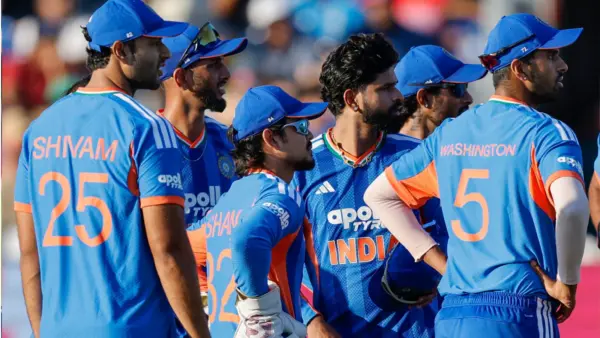
Four months ago, Suryakumar Yadav lifted a T20 World Cup trophy in Ahmedabad. On Saturday, he will watch from outside the XI as India try to salvage pride at Southampton, having already lost this series, their second straight defeat in a fortnight after a three-year run without one ended in a shock whitewash to Ireland.
A loss here also costs India the world No. 1 T20I ranking they’ve held since 2022. In between, he lost the captaincy, then his place in the team altogether. Nothing about his batting changed. What changed is that India, having won a tournament playing one way, discovered it does not know how to play any other way, and needed someone to blame for that first.
The clearest proof came at Trent Bridge, where India folded for 76, their second-lowest total in T20I history. Five wickets went down inside the powerplay alone, 54 for 5, the earliest India have ever lost five in a men’s T20I. Abhishek Sharma mistimed a top edge to point. Vaibhav Sooryavanshi gloved an Archer bouncer behind. Ishan Kishan and Shreyas Iyer both picked out the same fielder at deep backward square leg in successive balls. Axar Patel edged behind trying to counter-attack. Five different shots, five different ways of failing, but the same instinct behind all of them: commit to the attack and trust the pace and bounce not to punish it. “When you’re chasing 200, you need to pace up your innings, have a set pattern for how you’re going to go about it,” Shreyas Iyer said afterward. “We fell a bit short in terms of that. Execution was awful.”
For years, India batted cautiously in T20Is despite being home to the IPL, T20’s most aggressive league. Only from the 2023 ODI World Cup was that caution shed for good, and two T20 World Cups followed. It still works against attacks that let the ball come on. It stops working the moment the pitch fights back, because the method leaves no room for a batter to slow down mid-innings without the whole thing stalling.
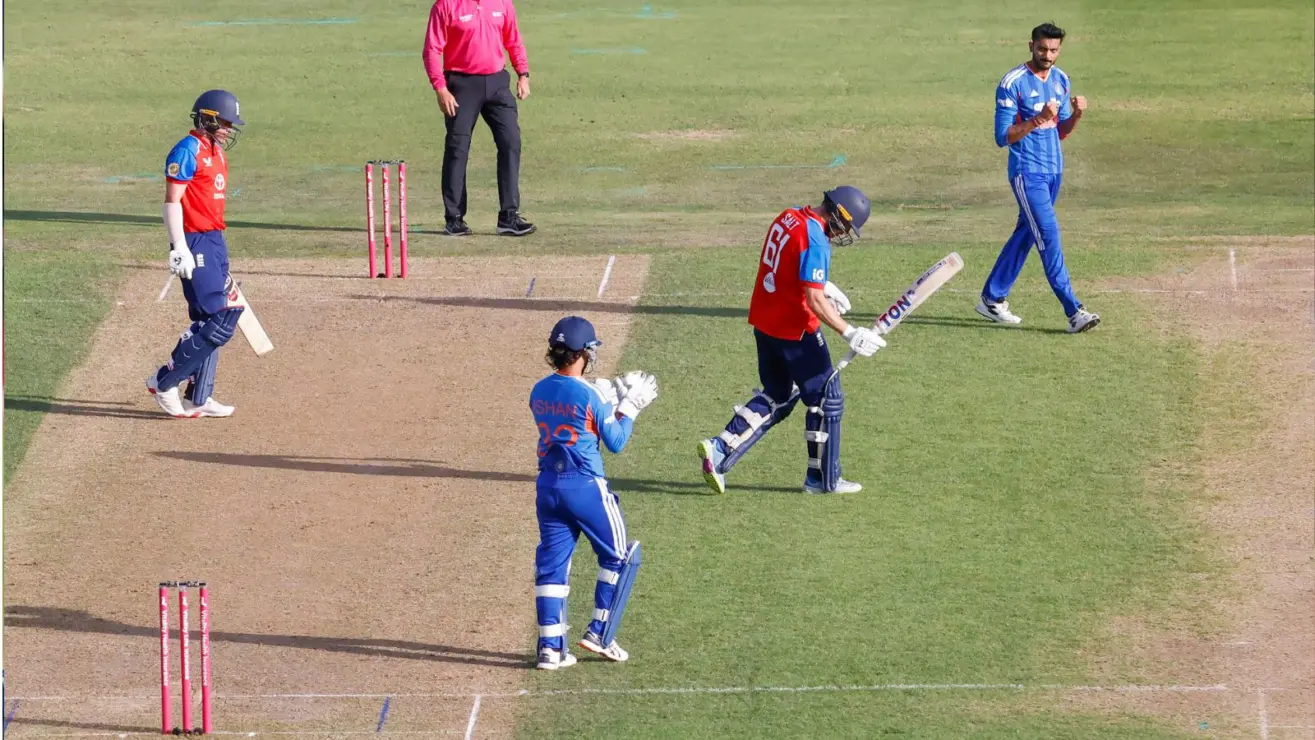 Axar Patel picks the wicket of Phil Salt. (Deepak Malik / CREIMAS for BCCI)
England’s own batters faced the same conditions and found them workable, not hostile, just demanding a few adjustments and a willingness to find the straighter parts of the ground rather than the leg-side arc India defaults to. Assistant coach Ryan ten Doeschate put it plainly: preparation for different conditions matters, and being mentally ready to shift approach matters just as much. India have shown neither.
The personnel excuse only stretches so far. Of the squad that won in Ahmedabad, only Suryakumar was actually removed. Bumrah and Pandya, the two players who featured in every match of that tournament, were rested, not injured or dropped, and their absence is the one personnel gap India can genuinely point to. Kuldeep Yadav, Rinku Singh and Siraj were also missing, though none played every game in March either. This is a weakened side, not an unrecognisable one, and swapping in more experienced batters would not by itself fix a unit built for one gear.
Whether India arrived with the right personnel for a reset is its own question. Shubman Gill’s name came up in selection meetings, but stayed just that, talk, alongside Sudharsan, Padikkal and the reinvented KL Rahul, whose 174.41 strike rate in this year’s IPL beat Prabhsimran Singh’s 168.87. It is Prabhsimran, not any of them, travelling to Zimbabwe next. India will keep hopping between venues like this for the foreseeable future, which makes the refusal to adapt look less like a one-series problem than a recurring one.
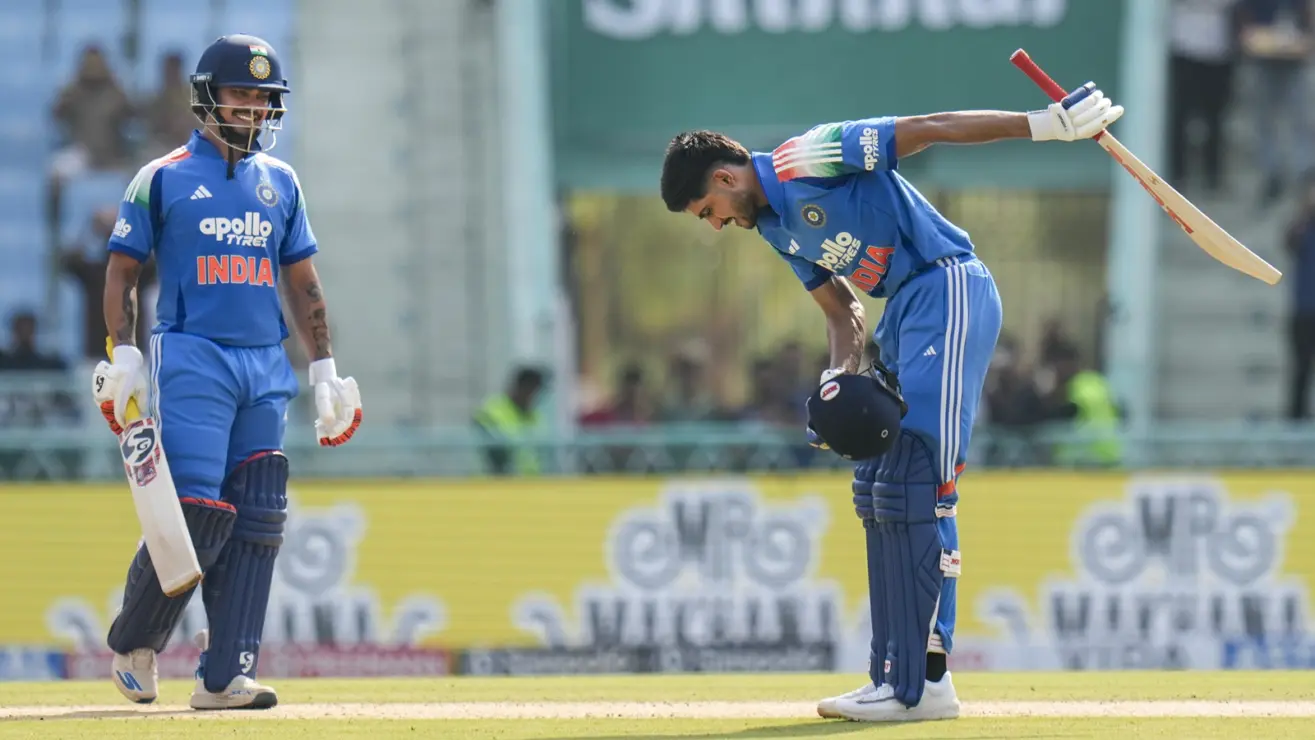 Shubman Gill in action. (FILE photo)
Underneath all of it sits something harder to coach out: fear. Suryakumar went from trophy to XI omission inside four months, and Sanju Samson was dropped without a clear public explanation. Both send the same message to the dressing room: no place is secure, no matter what you have won. High-risk batting cannot survive that atmosphere. Fluency is the first thing fear removes, and there is already talk inside the batting group, unofficially, about exactly that.
The board’s own reading is calmer than the dressing room’s. BCCI secretary Devajit Saikia called the results “not something abnormal,” a “purely bad phase,” and confirmed a review once the ODI series against England ends on July 19, “strictly about the performance of the team… Nothing else will be discussed.” That last line does more work than it means to. A board rarely needs to specify what won’t be discussed unless it already knows what everyone assumes will be.
Saturday’s match at Southampton won’t undo the series defeat already sealed in Bristol. Win, and India salvage some pride and keep the ranking they’ve defended since 2022. Lose, and they hand over the ranking too, on top of a series already gone. Either way, the review due after July 19 will have to answer a harder question than form: whether the side that discovered one ferocious gear in Ahmedabad has any idea how to find a second one, not back toward the caution they buried in 2023, but toward genuine range, batters who can shift down and still hold an innings together. Calling it a bad phase assumes the method is sound and the execution slipped. Trent Bridge suggests the opposite.