Nepal’s govt formation has begun with the submission of the poll report to the President. Rapper and former Kathmandu mayor Balen Shah is set to be the next PM, with his Rastriya Swatantra Party securing a near two-thirds majority in parliament.
The government formation process has formally begun in Nepal with the Election Commission submitting the poll report to President Ram Chandra Paudel on Thursday. Structural engineer, rapper, and former Mayor of Kathmandu, Balendra ‘Balen’ Shah, is poised to become the next Prime Minister of the Himalayan nation.
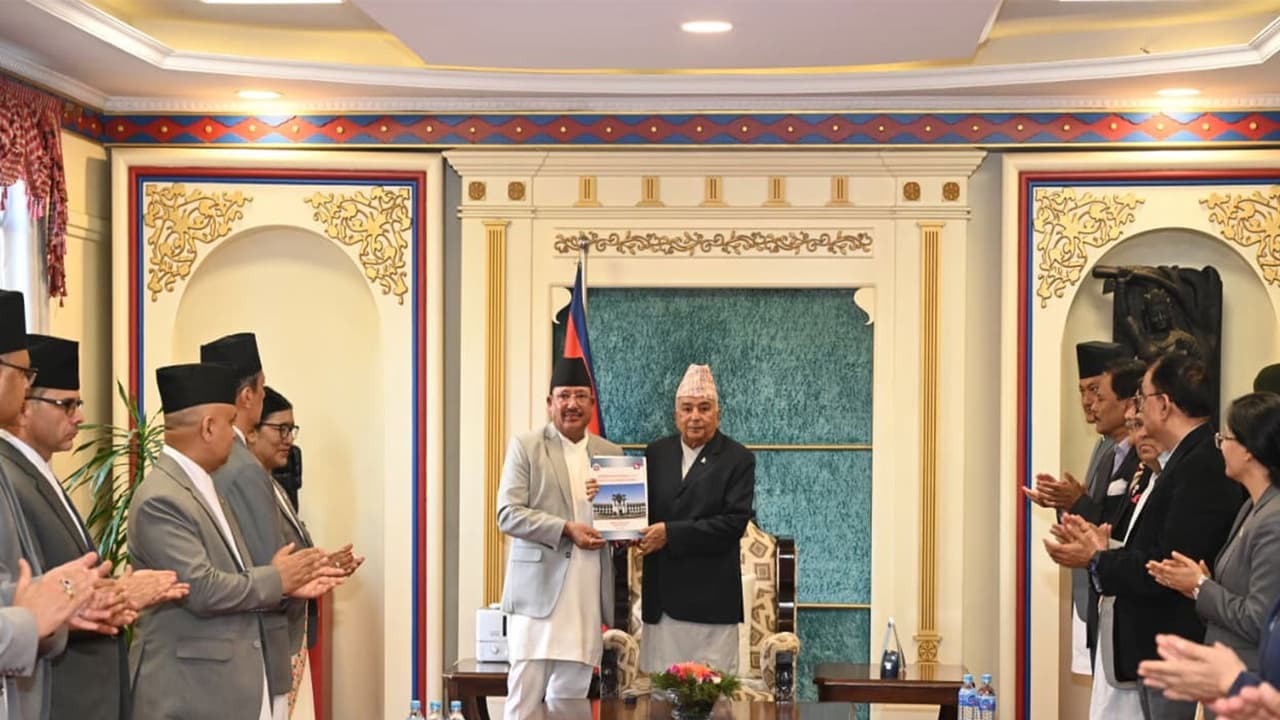
Ram Prasad Bhandari, officiating Chief Election Commissioner, presented the report to the President during a special ceremony at the Office of the President, Shital Niwas.
Election Commission Submits Final Report
During the event, President Paudel expressed satisfaction over the successful conclusion of the polls, noting that they were conducted with dedication and integrity despite “difficult and complex circumstances.”
The EC report includes the final names of the 275 members elected under both the First-Past-the-Post (FPTP) and Proportional Representation (PR) systems. The submission marks the formal conclusion of the general elections, clearing the way for the President to initiate the process of government formation.
Earlier in the morning, the electoral body also distributed certificates to lawmakers elected under the PR system in the recent House of Representatives elections. A total of 110 lawmakers were elected through the PR system. Officiating Chief Election Commissioner Bhandari, along with Commissioners Janaki Kumari Tuladhar and Sagun Shumsher JB Rana, welcomed them with Tika and garlands. Election Commission Secretary and PR election officer Krishna Bahadur Raut distributed the certificates.
“We have so much to tackle, from the most basic things of justice, security, and safety to more complex problems related to development. We’ve got so much to address, but we are very confident that the team we have will be able to handle all issues, from foundational to growth-related ones. For me personally,” Anushka Shrestha, Miss Nepal 2019 and newly elected MP, said.
Final Seat Distribution
Under the PR system, 57 lawmakers were elected from the Rastriya Swatantra Party (RSP), 20 from the Nepali Congress (NC), 16 from the CPN (UML), nine from the Nepali Communist Party (NCP), and four each from the Shram Sanskriti Party and the Rastriya Prajatantra Party (RPP). The Election Commission had announced the PR election results on March 16.
Under the FPTP system, the RSP secured 125 seats, followed by the NC with 19, UML with nine, NCP with eight, Shram Sanskriti Party with three, RPP with one, and one independent candidate.
“Just the locations where we were standing have changed. On September 8, we were at the Maitighar Mandala protesting, and next we’ll be in Parliament addressing the sessions. Only the place where we stand has changed, not the nature. We will remain vocal in Parliament, as we were on September 8. If the ruling party makes any mistakes, we will raise our voice and be very vocal about it,” said Purushottam Yadav, September 8 protest organiser and newly elected MP.
Path to New Government
With the distribution of certificates to elected representatives and the submission of the final poll report, the President will now call for government formation under Article 76 of the Constitution of Nepal. Clause (1) states that the President shall appoint the leader of the parliamentary party commanding a majority in the House of Representatives as Prime Minister.
As per constitutional provisions, the House of Representatives, the lower house of the Federal Parliament, consists of 275 members, including 165 elected through FPTP and 110 through PR.
Balen Shah to be Prime Minister
The RSP had projected its senior leader, Balen Shah, as its prime ministerial candidate. As per constitutional requirements, the Prime Minister must be a member of the House of Representatives and the leader of the parliamentary party. The party is preparing to appoint Shah as its parliamentary leader, though the formal announcement is unlikely before the weekend.
With the RSP alone holding a near two-thirds majority in Parliament, its parliamentary leader will be appointed Prime Minister under Article 76(1). This marks the first time since the promulgation of the Constitution that a single party with a clear majority will form a government under this provision.
According to constitutional provisions, the President must convene a session of the Federal Parliament within 30 days of the announcement of final results, as stipulated in Article 93(1). The first meeting of the House of Representatives will be chaired by the senior-most member, during which the process to elect the Speaker and Deputy Speaker will begin within seven days.
The Federal Parliament Secretariat has scheduled the oath-taking ceremony for newly elected lawmakers on March 26. As per legal provisions, the Election Commission must submit its report to the President within seven days of the publication of the final results.
Upcoming parliamentary sessions are expected to be held at the newly constructed Parliament building in Singha Durbar. (ANI)
(Except for the headline, this story has not been edited by Asianet Newsable English staff and is published from a syndicated feed.)