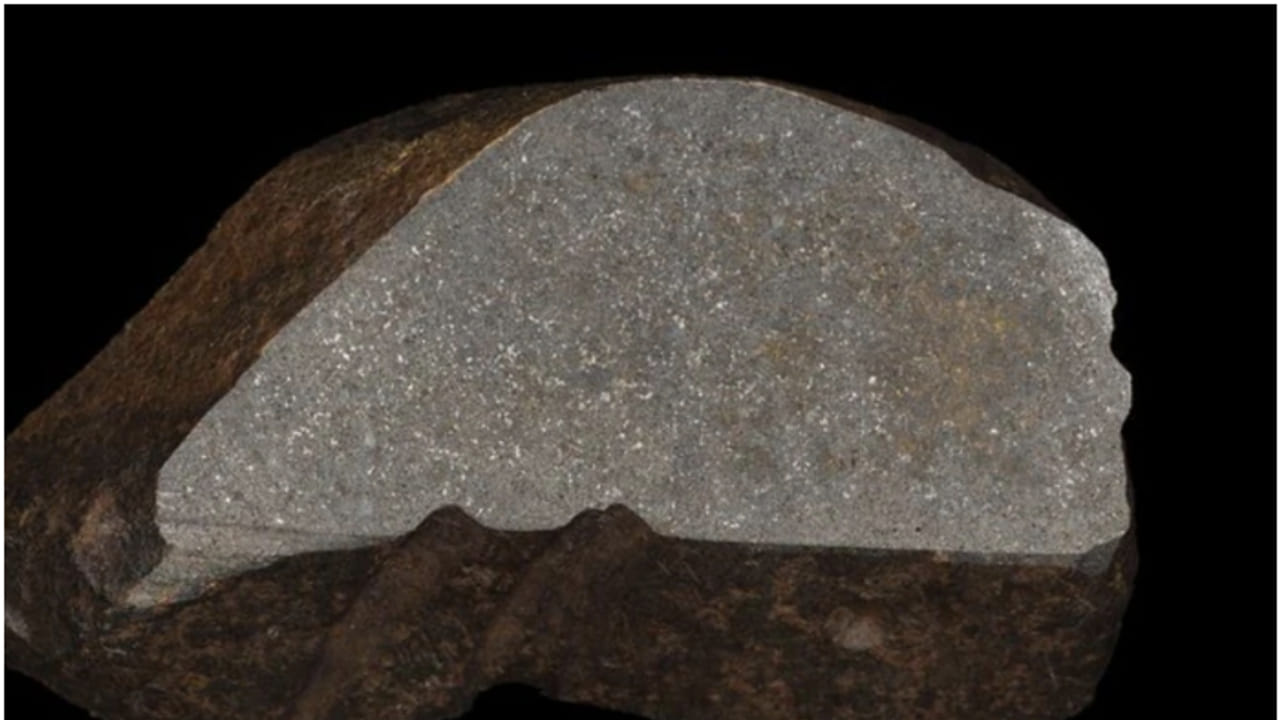
An Australian man who spent years trying to crack open a rock hoping to find gold was in for a surprise when scientists discovered that his 17-kg find was actually a rare meteorite dating back 4.6 billion years
An unusual discovery in Australia’s Victoria region has turned into a fascinating scientific story after a man unknowingly kept a rare meteorite for years, believing it could contain gold.
David Hole came across the heavy, reddish-coloured rock in 2015 while searching for gold using a metal detector at Maryborough Regional Park in central Victoria. The area is part of Australia’s historic Goldfields region, which witnessed a major gold rush during the 19th century.
Given the location and the unusual appearance of the object, Hole suspected that it might contain a valuable gold nugget. He took it home and repeatedly attempted to break it open to see what was inside.
However, the rock refused to crack despite his efforts. Hole reportedly tried a rock saw, an angle grinder, a drill, acid and even a sledgehammer. Eventually, he decided to take the mysterious object to the Melbourne Museum for examination.
Scientists identify 17-kg rock as a rare meteorite
The examination revealed that Hole’s discovery was far more unusual than an ordinary gold-bearing rock. Geologists at the Melbourne Museum noticed distinctive surface features that indicated the object could have originated beyond Earth.
Geologist Dermot Henry explained that the rock had a sculpted appearance with several dimples. Such features can develop when a meteorite enters Earth’s atmosphere, causing its outer surface to melt and become shaped by atmospheric forces.
After further investigation, researchers confirmed that the specimen was indeed a meteorite. They named it the Maryborough meteorite, after the town near the location where it was discovered.
The space rock weighs approximately 17 kilograms and is estimated to be around 4.6 billion years old. According to researchers, it belongs to a category known as H5 ordinary chondrites, which contain a significant amount of iron.
Scientists used a diamond saw to remove a small section of the specimen for closer examination. The cut revealed tiny crystallised droplets of silicate minerals, known as chondrules, providing further evidence of its extraterrestrial origins.
Where did the meteorite come from and why is it important?
Scientists believe the Maryborough meteorite most likely originated in the asteroid belt located between Mars and Jupiter. Collisions between asteroids could have dislodged the space rock from its original position, eventually sending it towards Earth.
Although its exact arrival date remains unknown, carbon dating suggests that the meteorite has been on Earth for less than 1,000 years.
The discovery is particularly significant because meteorites preserve material from the earliest stages of the Solar System. Studying them allows researchers to investigate how planets formed and understand the chemical composition of the objects that existed billions of years ago.
According to Henry, meteorites offer scientists an opportunity to study the history of the Solar System without travelling into space. Some specimens even contain stardust older than the Solar System, while others have organic compounds such as amino acids, which are considered building blocks of life.
The findings on the Maryborough meteorite were published in the Proceedings of the Royal Society of Victoria. What began as an ordinary search for gold ultimately led to the discovery of an ancient object that could offer valuable insights into the history of our cosmic neighbourhood.