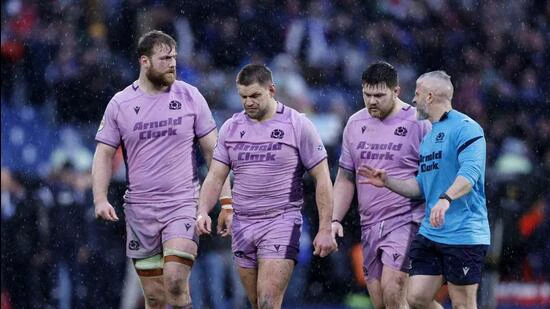
Kolkata: On Saturday, England and Scotland are meeting for a T20 World Cup match at Eden Gardens in erstwhile Calcutta. Fittingly, 8000 km away at Edinburgh’s Murrayfield Stadium, England face Scotland in a Six Nations match for rugby’s oldest international prize, the Calcutta Cup, in a rivalry that dates back to 1879. There are rivalries, and then there is England versus Scotland-a fixture that carries the weight of history, identity and generations of needle.
In rugby, football or in cricket, it is never just another game.
“Yeah, England playing Scotland in cricket and in the Six Nations, the Calcutta Cup and we’re playing in Kolkata-so that’s quite a coincidence,” said Scotland fast bowler Brad Wheal on Friday. “I mean, obviously for everyone, we just want to go out there and do our country proud. So it’s a big day for Scottish sport and obviously a massive opportunity for both teams to get a big win going ahead. So yeah, hopefully we can do the job tomorrow.”
The Calcutta Cup is awarded to the winners of the England-Scotland tie in the Six Nations Championship, an annual competition involving European nations. The Calcutta in the name is derived from the city of course, but also the Calcutta Football Club that was founded in 1872 for the army units stationed there. The club closed in 1877, primarily due to dipping membership and increasing popularity of other sports. The story goes that the club members withdrew the remaining funds from the bank, melted the silver coins and made a trophy that was given to the Rugby Football Union (RFU) in 1878. England and Scotland started playing the annual fixture from the next year.
Over the years, the fixture has lost none of its edge. England’s greater playing depth has often translated into periods of dominance, yet Scotland have repeatedly shown a knack for puncturing English expectation. Murrayfield has witnessed some of the most seismic upsets in championship history, not least the astonishing 38-38 draw in 2019 when Scotland roared back from 31-0 down at Twickenham – a result that felt like a victory in all but name.
To Scotland, beating England isn’t only about beating the creators of the game, it’s about pride and asserting parity against a neighbour with deeper resources and broader global success. For England, defeat to Scotland cuts differently-sharper, more personal. Losing to France may sting; losing to Scotland hurts way more. Football carries some indelible memories as well. Like the Euro ’96 at Wembley. In a tournament meant to herald England’s rebirth on home soil. Scotland, as ever, were determined to be gatecrashers.
They had that chance too. England were leading 1-0 when Scotland were awarded a penalty. Gary McAllister stepped up, but David Seaman parried it brilliantly. Within seconds, England counterattacked. Darren Anderton surged forward, the ball worked to Paul Gascoigne who flicked it over Colin Hendry’s sliding challenge with his right foot before volleying home with his left. It was an audacious and impudent strike, leaving Scotland devastated by a single, sublime act of skill. England marched on to the semi-finals, Scotland went home.
England have been on the receiving end as well, in cricket. Like in 2018, when Scotland posted 371/5-the highest total ever recorded by an associate nation at the time-before holding their nerve to win by six runs. For England, then the world’s top-ranked ODI side, the loss felt personal. Current captain Richie Berrington, who was part of that Scotland side, made no bones about trying to achieve that high again.
“To be honest, that dream was always there from the start of the tournament. Next Saturday’s going to be exciting. It would make quite a nice headline if Scotland has two wins on Saturday,” said Berrington last week.
Now, as England and Scotland prepare for the unusual spectacle of sharing a T20 afternoon and a rugby evening on the same day, the symbolism is irresistible. Nowhere will Scotland feel more at home than the Murrayfield. At Eden Gardens, venue of one of their greatest ever Test series wins in 2012, England will take heart from their history and familiarity. But the unpredictability of sports, tinged by the pressure arising out of their shared history, makes this game a special one.
Scotland’s recent resurgence in the Calcutta Cup – winning four of the last six contests-has redressed a once one-sided ledger. England, meanwhile, remain completely capable of turning back the clock. In football, a goalless draw at Euro 2020 rekindled the tension. In cricket, the gap remains vast, yet 2018 stands as proof that on the right day, with belief, composure and a slice of luck, Scotland too can have their day under the sun.
So when the anthems are sung on Saturday-first in Kolkata, later in Edinburg-they won’t simply herald two fixtures in a crowded sporting calendar but add another chapter in a storied rivalry that predates most modern competitions. The Calcutta Cup remains rugby’s oldest prize, but rivalry is something richer still-a living narrative that is retold and rewritten every time they meet.