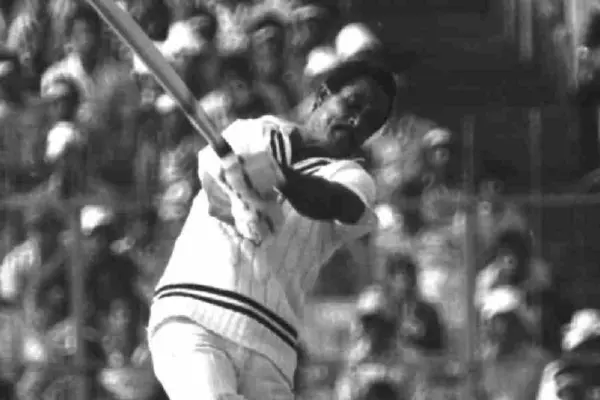
Two names will appear in every cricket follower’s world XI: Donald George Bradman and Garfield St Aubrun Sobers. Forever they will be enshrined in the ultimate XI of Test cricketers.
Till 31st December, 1958, we in Calcutta had not seen Garry Sobers. We had only known that he was the world record holder with 365 runs in an innings. And in the previous two Tests on this tour of India with Gerry Alexander’s West Indies team, he had scored two hundreds: 142 not out in Bombay and 198 run out in Kanpur.
At the Eden Gardens, the West Indies won the toss and batted. Openers Conrad Hunte and John Holt left early. At No. 3, the handsome Rohan Kanhai walked in. As the second wicket fell, the crowd stood up in expectation of the man they had come to watch.
In the NCC enclosure where I was, the spectators began to cheer: “Sobers, Sobers….”
The huge NCC scoreboard too put up Sobers’s name.
However, as an eight-year-old cricket-crazy youngster, I told my mom beside me that the player was not Garry Sobers but Collie Smith. The gentleman beside us gave me a condescending smile and furrowed his eyebrows. As Smith took guard as a right-hander, the scoreboard changed the name and the gentleman gave me a warm pat on the back.
Kanhai scored a blistering 256, followed by Basil Butcher’s 103. In the meantime, one left-handed artist – this time batting at number six – remained unbeaten on 106. His languid walk and the grace of his movements captivated the Eden Gardens connoisseur as well as the common man. He never seemed to hit the ball, merely to caress it.
On reaching his hundred, Sobers raised his bat but lowered his head in a gesture of the utmost modesty. What a lesson to learn.
The West Indies with their free-flowing manner and smiling faces transformed the Eden Gardens forever. Cricket at the Eden was never the same again. The mad rush for Test match tickets in Calcutta began with Sobers and Kanhai, Wes Hall and Roy Gilchrist.
Next, Sobers arrived in Calcutta with Jim Swanton’s XI, and then for Mohun Bagan AC’s platinum jubilee match in 1964. On both occasions, his sheer artistry flowed till the customary century was recorded. Wherever he went around the cricketing world, he overwhelmed as much with his lazy elegance and graceful athleticism as with his phenomenal performances.
The next time he was at the Eden was in 1966-67. Before the start of the first day’s play, Sobers, now the West Indies captain, was having a bat-ball “warm-up” knock-about on the practice pitch without nets in front of the NCC enclosure.
I was close to the scene, holding onto the low fencing, gaping at him. What I saw was amazing. One of the reserves, Rex Collymore, a left-arm spinner, was bowling to my cricketing God. He was softly pushing the ball back to the bowler. I was thunderstruck when I noticed he was using the narrow width of the bat!
He was not using the broad blade of the bat but batting with the edge! Batting with the edge without being beaten even once! In all my experience, never have I seen anybody else do this with such ease and elegance.
On the second day of the Test, the CAB organisers sold more tickets than the accommodation in the stadium. The crowd went berserk. They climbed the low iron fencing around the ground and chased the police and the administrators. The day’s game had to be abandoned.
The West Indies players were, quite rightly, unwilling to continue the Test because they felt insecure. The local manager of the West Indies team was Dilip Ghosh, an erudite man and superlative administrator. He rushed to former West Indies captain Sir Frank Worrell, who was on a lecture tour at Jadavpur University.
Worrell impressed upon Sobers, his protégé, that the representatives of the West Indies Federation had to be impeccable guests. The match continued. Within months, Sir Frank had passed away.
The greatness of two cricketing knights – Worrell was knighted in 1964 and Sobers in 1975 – showed the world what cricket and international relations were all about. They were two pioneer personalities whose selfless sportsmanship helped make the West Indians the most respected cricketers in the world, apart from being the best.
I met Sir Garry just once, at the Nottinghamshire CCC in 1977. I was in the second XI while the genius had finished his superlative career with the county club in 1974.
His prime message was: “Enjoy the game and give enjoyment to others.”
Wherever Sobers went, he was the foremost ambassador of cricket. His generosity, his genius and his sportsmanship were beyond words and ages.
Sobers needed no appellation or awards. But generations bowed their heads tohim and hailed him as “the greatest”.