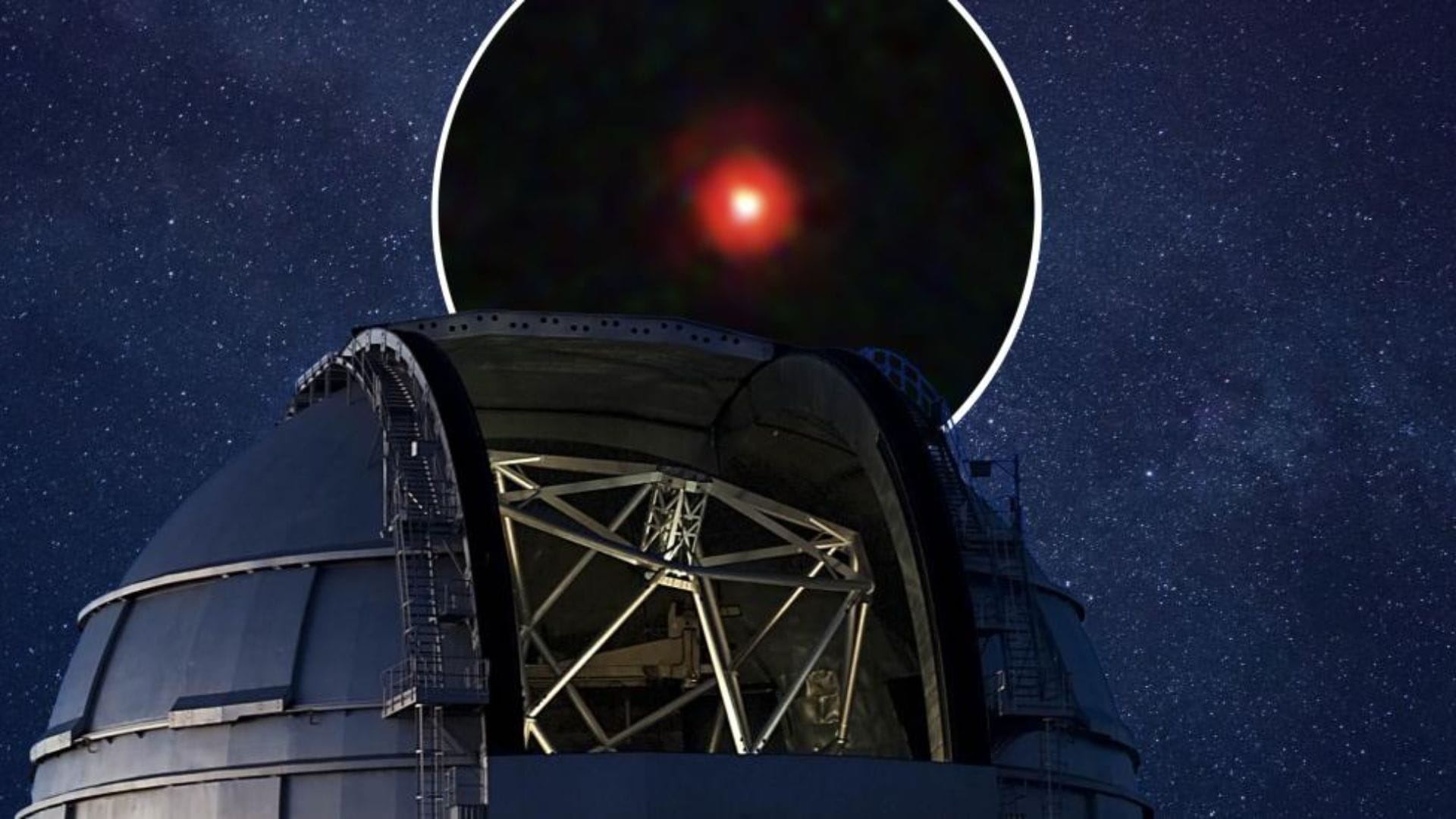
New Delhi: An international team of researchers have examined the first nearby analogues of the engimatic Little Red Dots (LRDs), first discovered by the James Webb Space Telescope in observations of the early universe. These new objects, located only a few billion light-years from the Earth, provide a new opportunity to study the formation and rapid growth of supermassive black holes in the early universe. LRDs were first detected in JWST deep surveys of the early or distant universe, during the cosmic dawn, when the first stars and galaxies started shining, within 1.5 billion years of the Big Bang.
These appear as compact objects hosting rapidly accreting supermassive black holes. Careful examination of the light from these remote objects reveal fast accretion, but unlike active galactic nuclei in the nearby universe, these LRDs are surprisingly weak in X-ray and infrared emissions, which has challenged conventional models of black hole growth. There just was not enough time for supermassive black holes to form so rapidly after the Big Bang according to conventional models, leading scientists to propose that these objects directly collapsed into black holes from vast molecular clouds, are exotic objects whose luminosity is driven by dark matter annihilation called dark stars, or that the universe itself is older than what scientists believe.
Observations by the Gran Telescopio Canarias
One defining characteristic is that the intense glow from hydrogen is partially obscured by the surrounding cooler gas, indicating that these accreting black holes are embedded in dense gas envelopes that obscure and alter the emitted light. The identification of nearby LRDs enables detailed studies impossible for the distant counterparts. Observations by the Gran Telescopio Canarias in Spain have confirmed that these objects are shrouded by dense gas, with comparable features in distant examples.
These local LRDs serve as unique laboratories for examining the dense gas environments that facilitated the rapid growth of black holes in the early universe. The current sample remains small, but the research has broad implications for the evolution of black holes and galaxies. The researchers have secured additional observation time on the GTC to enlarge the sample size, analyse gas envelopes, and enhancing the understanding of the high redshift equivalents. A paper describing the research has been published in the Monthly Notices of the Royal Astronomical Society.