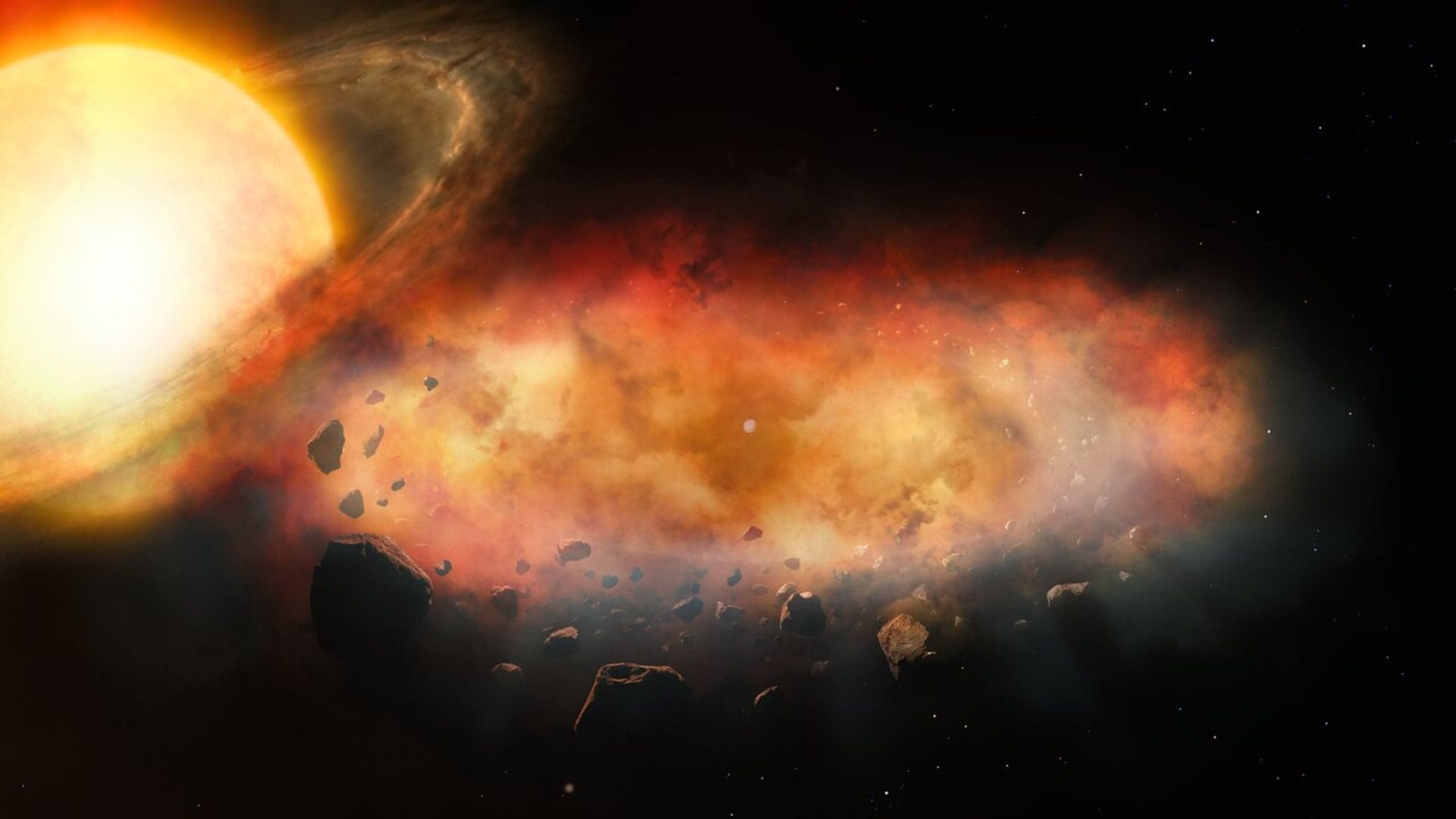
New Delhi: Between September 2024 and May 2025, a Sun-like star at a distance of 3,000 lightyears designated as J0705+0612 saw a sudden dip in brightness. Sun-like stars are not variable in brightness, with such dramatic dimming events being rare. Astronomers observed the star with multiple astronomical instruments, and combined the observations with archival data of the star to determine that it had been occulted, or temporarily obscured by a vast, slow-moving cloud of gas and dust. The cloud was measured to be at a distance of two billion km from the host star, and roughly about 200 million km wide.
The data also indicates that the cloud is gravitationally bound to a secondary object that orbits the star in the outer reaches of the planetary system. This object contains at least a few times the mass of Jupiter, but its identity reveals unknown. It may be a gas giant, or a brown dwarf, that are exotic objects that form just like stars but do not grow massive enough to sustain nuclear fusion, or an extremely low mass star. The gas cloud appears to be a disk, specifically a circumsecondary disk, which is the term for a disk around a secondary object in a binary system.
A highly metallic gas cloud
It might be the accretion disk feeding a young star, a circumplanetary disk where planets are being assembled, or a circumplanetary disk, similar to the ones suspected to be hosted by the gas giants during the infancy of the Solar System. The observations revealed multiple metals, which as far as astronomers are concerned, are all elements heavier than helium. The metal winds included iron and calcium. Such disks are typically found around newborn stars, but J0705+0612 is over two billion years ago. Scientists suspect that the cloud may be the result of a collision between two planets. A paper describing the research has been published in The Astronomical Journal.