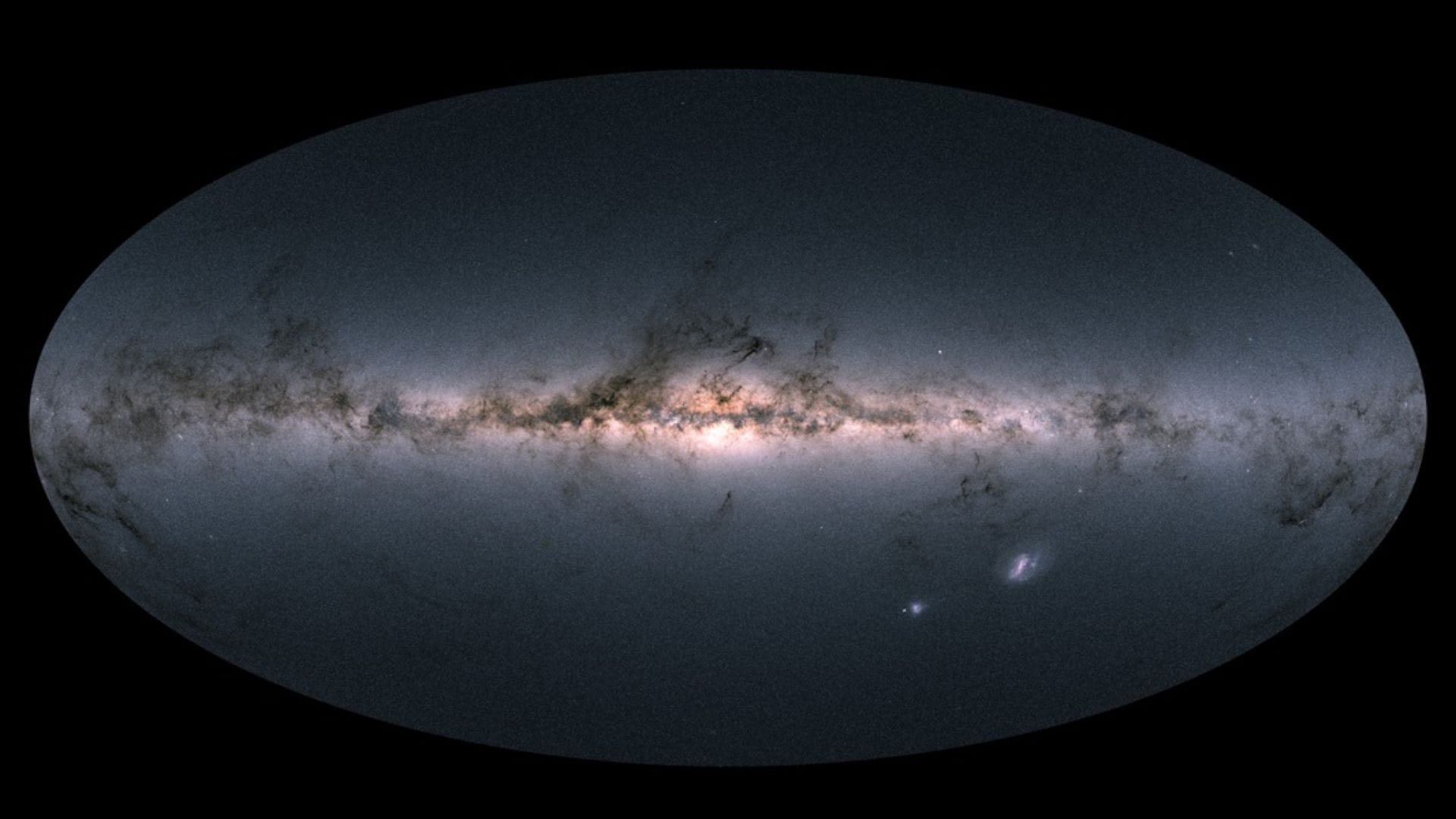
New Delhi: Astrophysicists from the University of Copenhagen have developed the most comprehensive model so far to map the galactic neutrino flux reaching Earth from all stars in the Milky Way. The researchers combined advanced models of stellar evolution with data captured by the Gaia telescope of ESA to map the number, origin and energy distribution of these elusive particles that barely interact with matter. Neutrinos are elementary particles with near-zero mass, no electric charge, and extremely weak interactions with matter. These ‘ghost particles’ are produced primarily from nuclear fusion in the cores of stars, with thermal processes contributing as well.
The model is the first complete estimate of the total amount of neutrinos from the stars in the Milky Way. It reveals that the flux covers a broad energy spectrum, with contributions from low-mass, intermediate-mass and high-mass stars. The neutrino production rates depend on the age and mass of the stars, with younger stars more massive than the Sun producing the most. The majority of neutrinos reaching the Earth originate from the dense stellar regions towards the core of the galaxy, within a diameter of a few thousand lightyears where the density of stars is the highest.
A window into the interiors of distant stars
The spatial distribution creates a strong signal in detectors that indicate the neutrinos originating from the galaxy core. Stars towards the centre of the galaxy dominate the overall flux because of their numbers as well as higher individual neutrino output. The map serves as a guide for large-scale neutrino observatories, that are typically located deep underground to prevent interference by cosmic rays. The map indicates optimal pointing directions to maximise the possibility of detections. Photons scatter or absorb over distances, but neutrinos travel in a straight line, unimpeded from the interiors of stars to galaxy scales. This property allows scientists to gain direct information on the remote cores of distant stars. Precise measurements of neutrinos can reveal details of stellar life cycles, internal structures and the production of elements, known as nucleosynthesis. A paper describing the research has been published in Physical Review D.