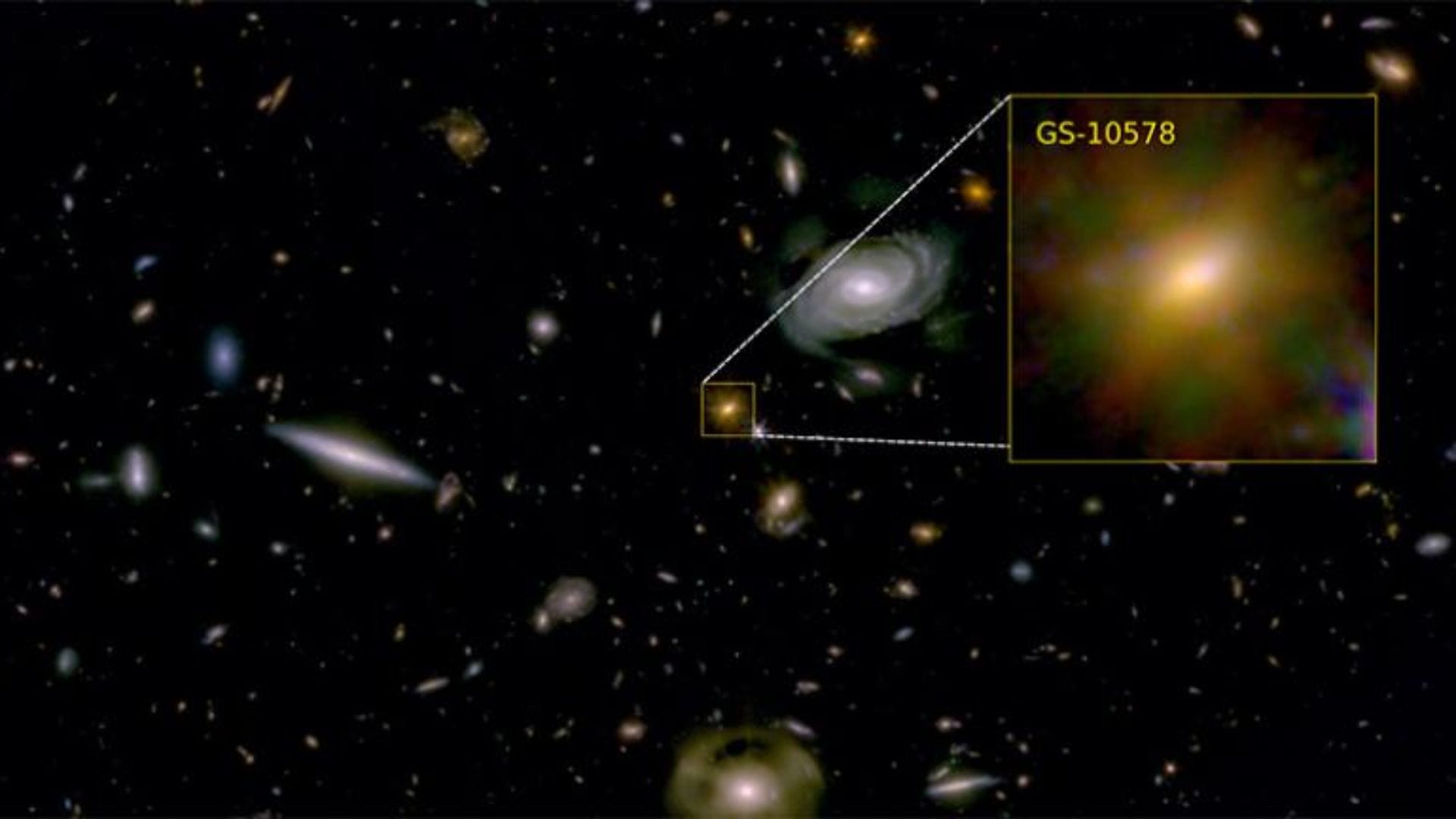
New Delhi: Astronomers have spotted one of the oldest ‘dead’ galaxies known, designated as GS-10578. (Image Credit: University of Cambridge). that formed about three billion years after the Big Bang. The galaxy has been dubbed ‘Pablo’s Galaxy’ after the astronomer who first observed it in detail. The galaxy contains about 200 billion solar masses, which is unusually massive for such an early galaxy. Most of the stars in the galaxy formed between 12.5 and 11.5 billion years ago. The galaxy appears to have lived fast and died young, and stopped forming new stars despite its relatively young age, because of the absence of gas and dust, the raw material from which stars are born.
The culprit appears to be the supermassive black hole occupying the core of the galaxy. The black hole repeatedly heated the gas in and around the galaxy, preventing the reservoirs of gas and dust from replenishing to form new stars. A supermassive black hole can tear a galaxy apart, but this one caused its host galaxy to suffer ‘death by a thousand cuts’. The researchers observed GS-10578 using the Atacama Large Millimetre/submillimetre Array (ALMA) instrument located in the deserts of northern Chile for the discovery. The telescope observed the object for nearly seven hours, hoping to discover carbon monoxide, a tracer for cold hydrogen gas, but found nothing.
Webb observed the galaxy too
The astronomers also used the James Webb Space Telescope to observe Atacama Large Millimetre/submillimetre Array, and found powerful winds of neutral gas streaming out of the central supermassive black hole at 400 kilometres per second, removing about 50 solar masses of gas every year. The observations indicate that the galaxy was depleted of fuel in as little as 16 to 220 million years, which far faster than the rate at which similar galaxies die, which can take a billion years or more. The galaxy is a calm, rotating disk which indicates a lack of disruptive merger with another galaxy. A paper describing the research has been published in Nature Astronomy.