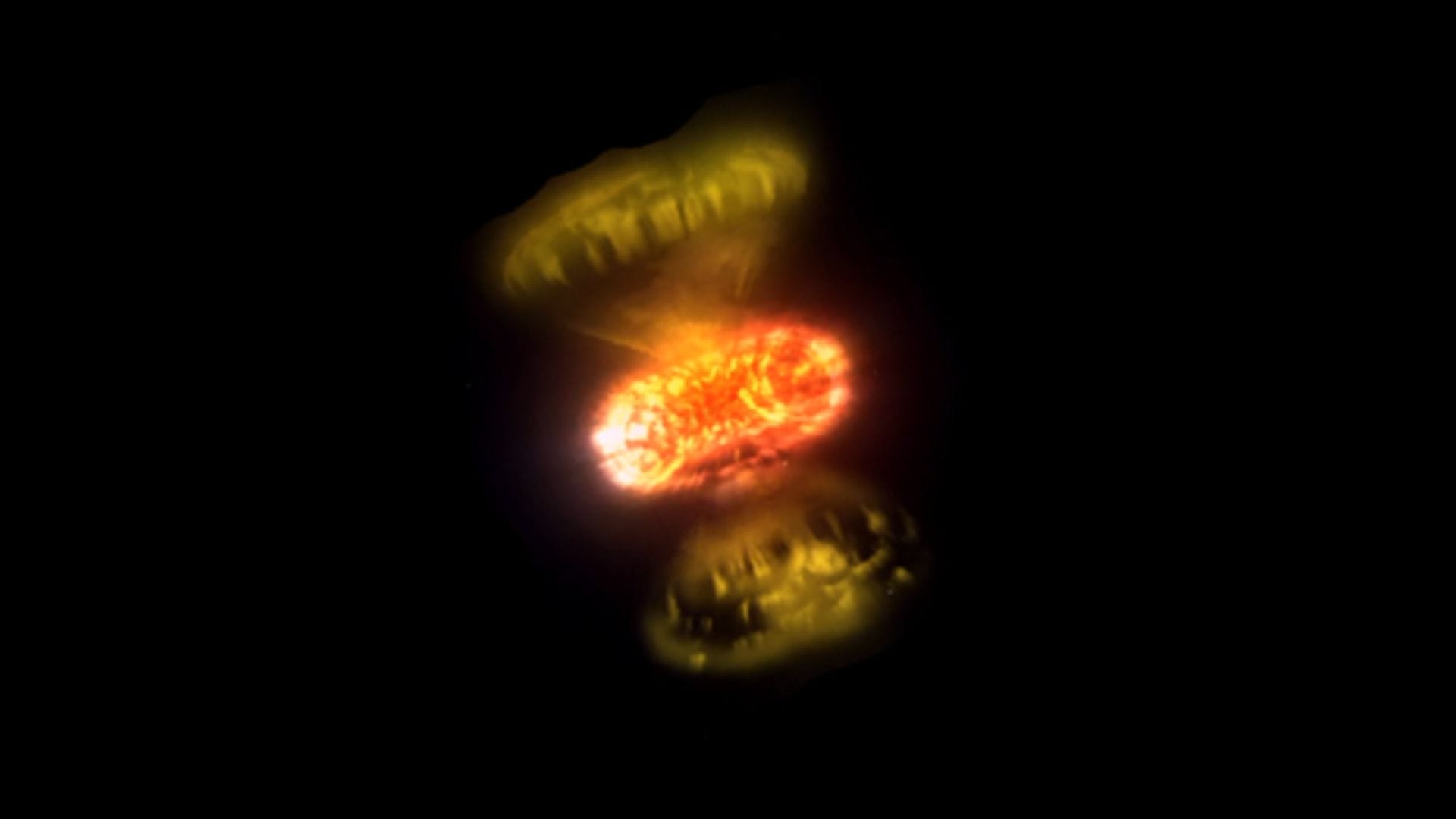
New Delhi: An international team of astronomers have captured two novae from 2021 in unprecedented detail, designated as V1674 Herculis and V1405 Cassiopeiae. These are stellar explosions where a white dwarf, the remnant core of a dead star accretes material from a binary companion, then periodically and violently sheds the material in thermonuclear outbursts called novae. Studying novae soon after their discovery has revealed that such explosions are more complex than previously thought. Until recently, astronomers could only infer the early stages of these eruptions indirectly, because the expanding cloud of material appeared as a single, unresolved point of light.
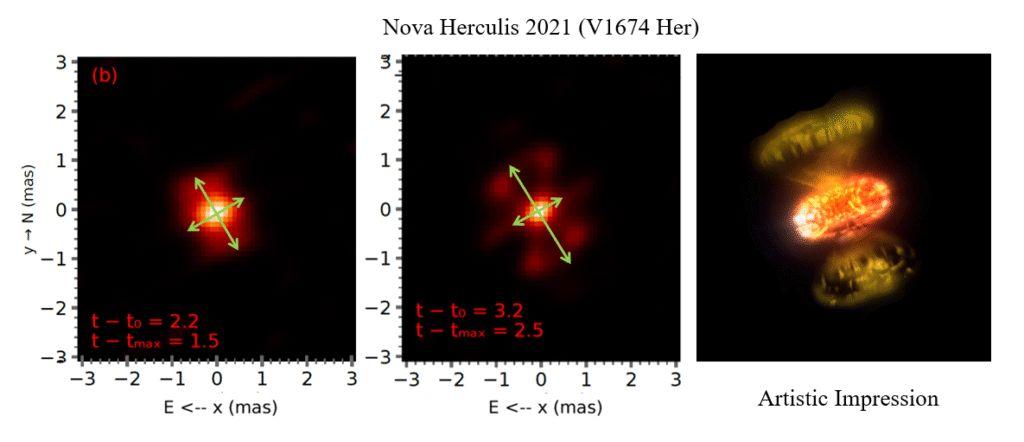
Images of V1674 Her. (Image Credit: CHARA Array/NASA GSFC).
Nova V1674 Herculis was among the fastest novas on record, brightening and fading in a matter of days. The imagery revealed two distinct, perpendicular outflows of gas, evidence that the explosion was powered by multiple interacting ejections. The second, Nova V14015 Cassiopeiae evolved much more slowly, holding on to its outer layers for more than 50 days before ejecting them, providing the first clear evidence of a delayed explosion. The ejection of the material triggered new shocks. A number of ground-based instruments was used to gather the data and confirm the interpretations. A paper describing the research has been published in Nature Astronomy.
The study challenges long-held assumptions
The findings challenge the view that novas are single, impulsive events, and points to a variety of ejection pathways, including multiple outflows and delayed envelope release. Coauthor of the paper, Laura Chomiuk explains, “Novae are more than fireworks in our galaxy—they are laboratories for extreme physics. By seeing how and when the material is ejected, we can finally connect the dots between the nuclear reactions on the star’s surface, the geometry of the ejected material and the high-energy radiation we detect from space.” The research improves the scientific understanding of the life cycles of stars.