New Delhi: American scientists have discovered a flexible, pliable material similar to chewed gum or soft plastic in the samples returned from asteroid Bennu. The translucent material became brittle on exposure to radiation, and was bendy and dimpled when pressure was applied. The research revealed that the mysterious substance that has never before been found on asteroids or meteorites, was deposited in layers on grains of ice and minerals present in the pristine asteroid in the infancy of the Solar System, before being warmed by the heat of the newborn Sun. The study was conducted on unusual carbon-rich grains rich in nitrogen and oxygen.
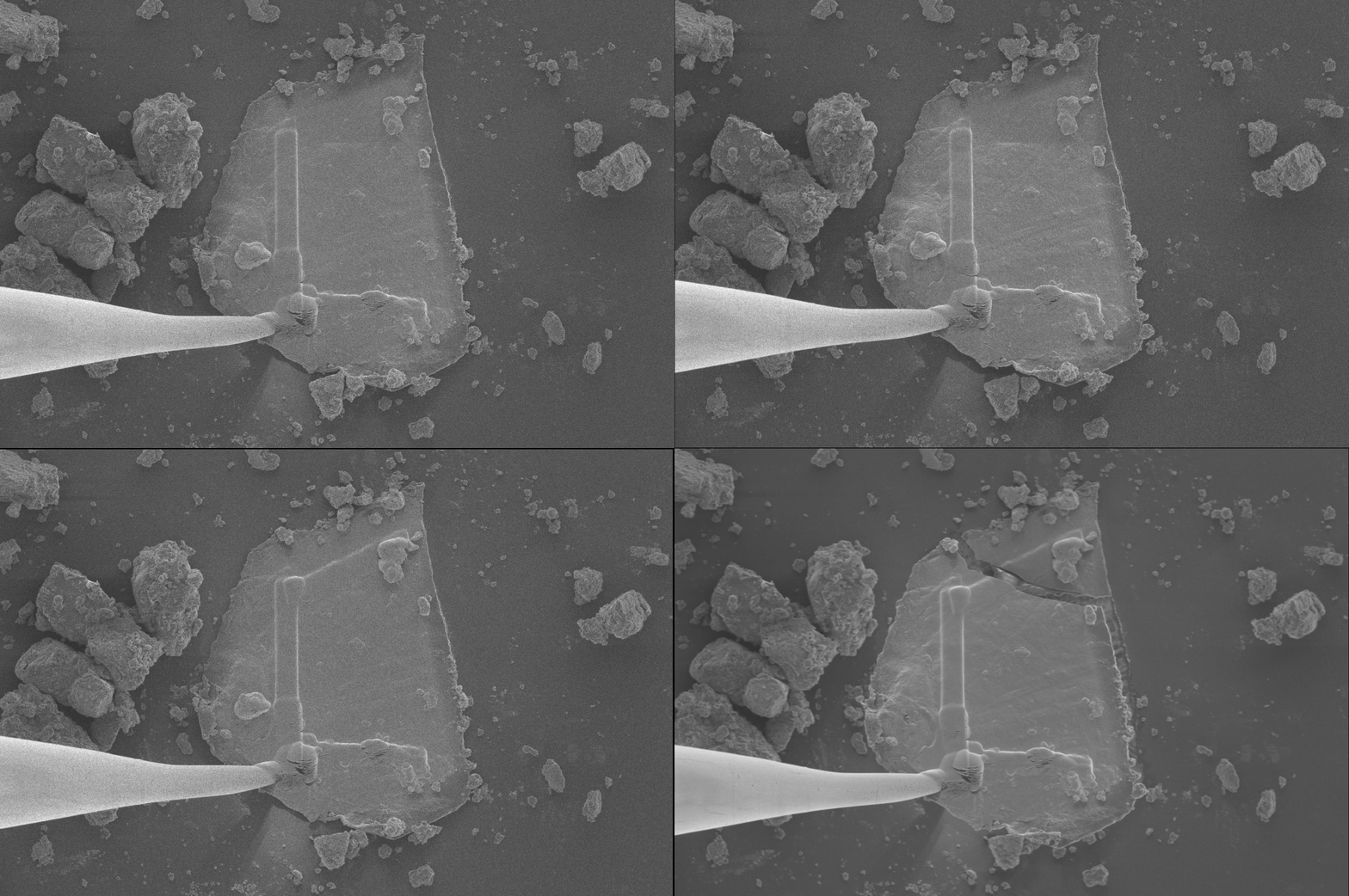
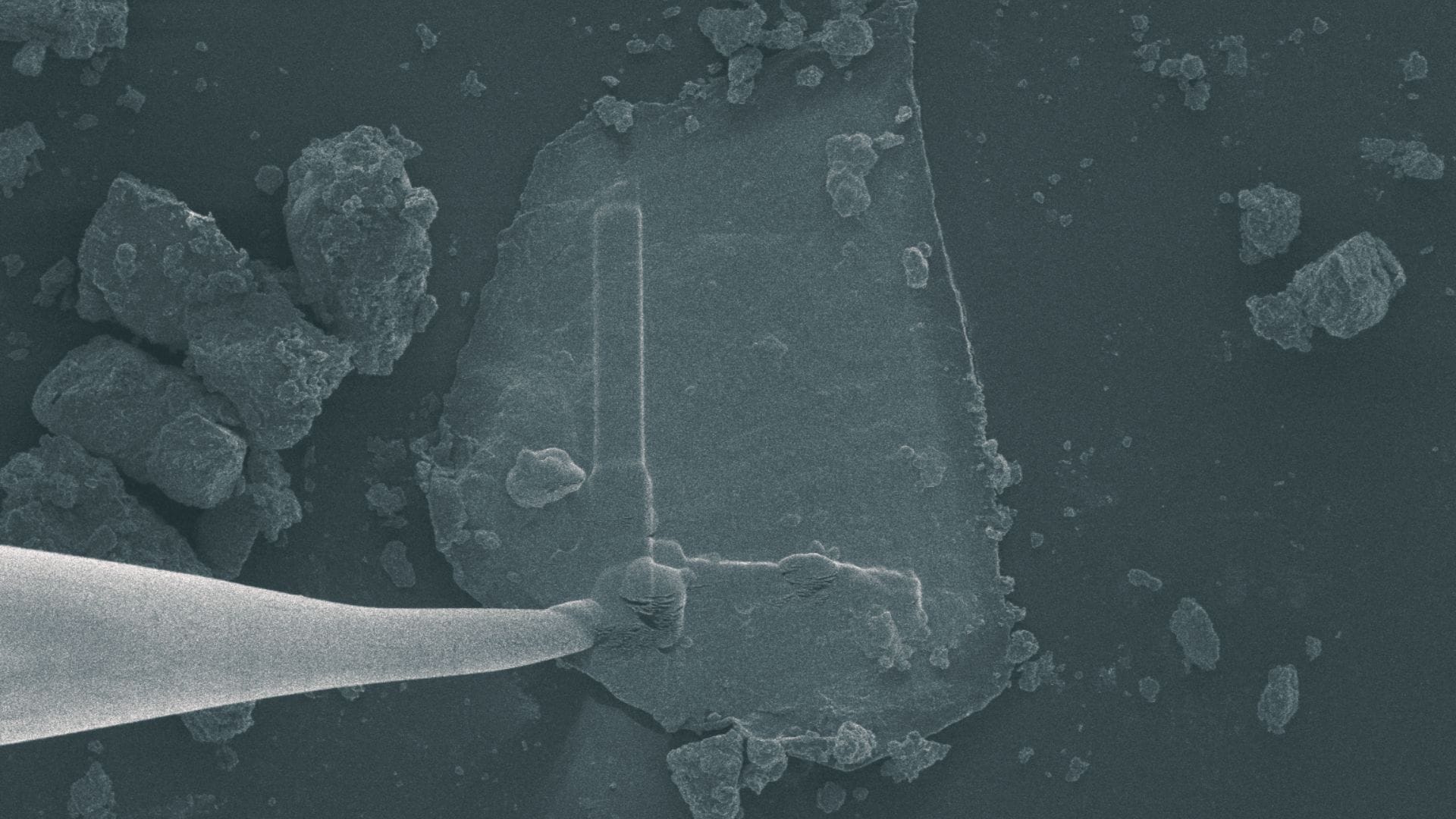
A microscopic flake of the Bennu samples used for the study. On the left is the tungsten needle. The L shape are the platinum layers. (Image Credit: NASA/University of California, Berkeley).
The researchers reinforced a flake of the sample with ultra-thin layers of platinum then welded a tungsten needle to lift off the grain, and then used a focus beam of charged particles to shave the fragment down. The characteristics of the material discovered were novel, so the researchers explored a number of possible theories to explain the observations. The polymers are rich in hydrocarbons and amides, and are likely to be formed when the parent body of Bennu was heated up by the Sun. The research indicates that asteroids similar to Bennu go through a phase of nitrogen-rich organic chemistry, in the absence of water.
The Alchemy of Life
The research is providing scientists a glimpse into the processes at work in the infancy of the Solar System. The previous discovery of phosphate in the Bennu samples indicate that chemistry occurred in the presence of liquid water on the surface. The parent body of Bennu may have been a water world that was battered to bits after being pummelled by asteroids in the chaotic infancy of the Solar System. All the ingredients necessary to form RNA have also been found in the samples, supporting the RNA world hypothesis. The evidence for life being an astrophysical process as against a geochemical one is piling up.