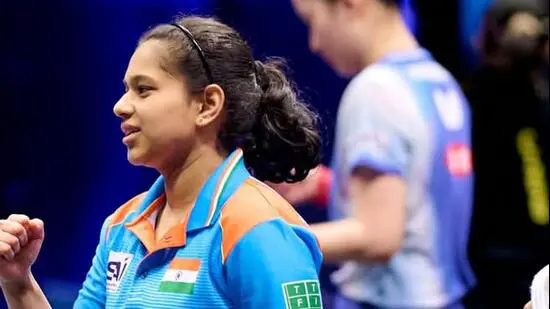
Mumbai: Without the points against Singapore, reckoned Indian TT’s foreign coach Massimo Costantini, the win against Thailand wouldn’t have happened.
And without the win against Thailand, the match against North Korea wouldn’t have happened.
The Indian women’s table tennis team’s run was halted there, in the quarter-finals, one step short of a medal on Tuesday. North Korea, always a mysterious element on the table in multi-sport events, proved too strong for India in their 3-0 sweep on Tuesday evening.
The women’s squad, without its current No.1 Manika Batra who wasn’t selected, ought to be disappointed having come that far and fizzled out without a fight. Because fight it did against Singapore in the group tie and Thailand earlier on Tuesday in the knockouts, going one better than the Hangzhou Asian Games.
Thailand had beaten them there in the Round of 16, and Singapore upset them at the 2025 Asian Championships at home. India went past both at Aichi-Nagoya.
“A quarter-final, with this young team, was a motivating factor. The team was united and determined,” Costantini told HT from Japan.
North Korea can be the trickiest of opponents because their players largely stay away from competing on the WTT tour. They surprise you, and rankings belie them. Kim Kum Yong, for instance, is ranked 164th in the WTT charts but is a Paris Olympics medallist.
And Kim kicked off North Korea’s dominance in the last eight with a 3-0 (11-7, 11-6, 11-5) sweep of Sreeja Akula. Not a game was given to Yashaswini Ghorpade (lost to Pyon Song Gyong 4-11, 3-11, 6-11) or Diya Chitale (lost to Cha Su Yong 9-11, 7-11, 8-11) either.
It was a rather tame end to the team’s run that was defined by gritty fights and rallying wins, which saw them come back from two ties down against Thailand and Singapore. In both, Yashaswini, the MVP of India’s campaign, and Sreeja were protagonists.
Yashaswini, the India No.4 ranked 76th, lifted the team. The 21-year-old Games debutant won both her matches against Singapore – including against 48th-ranked Jian Zeng and the decider – and Thailand.
“The contribution of Yashaswini was essential in making the team confident,” said Costantini. “Because if not for the win against Singapore, and without the motivating feeling that winning gives you, I don’t think we could have beaten Thailand.”
The women had a bit of a history with their Round of 16 opponents. In Hangzhou, the Thais knocked India out at the same stage with a close 3-2 result. India led 2-1 then, and lost. India trailed 2-1 now, and won.
It didn’t begin that tight. Sreeja made a fast start until Orawan Paranang plotted a battling turnaround to pull off a 3-2 (7-11, 1-11, 11-9, 11-6, 12-10) win. A composed Yashaswini pulled off her own 3-2 (11-8, 5-11, 7-11, 11-9, 11-9) victory against Suthasini Sawettabut. Diya Chitale going down from two match points up against Jinnipa Sawettabut (7-11, 11-5, 11-7, 7-11, 11-13) though meant India were under pressure again.
That’s when Yashaswini and Sreeja stepped up again. The former brushed aside Orawan 3-0 (11-5, 11-8, 11-9) while Sreeja dusted off her disappointment with a 3-1 (9-11, 11-6, 12-10, 11-8) win over Suthasini.
Men ousted by South Korea
The men, meanwhile, had chances galore – one match point, six game points – against Hangzhou Asian Games silver medallists South Korea in the Round of 16, but blew it all to crash out with a 3-0 defeat.
Harmeet Desai took the first game against world No.11 Jang Woojin but lost 3-1. Manush Shah had a match point in his fourth game and a 4-1 lead in the decider before world No.23 Oh Junsung eked out a 3-2 win. Manav Thakkar had six game points in the first game only to let An Jaehyun off the hook.
It capped an underwhelming team campaign for the men who made Iran look like powerhouses in the group tie.