India is emerging as a frontrunner across many fields as it develops. Economically, as a nation it ranks fourth in the world in competitive terms.
It has become the most populous country. Both in terms of nuclear capabilities and theoretical scientific progress, it is moving forward on the path of development, while preserving its identity and avoiding getting entangled in conflicts of other countries whenever possible, with the primary focus being on growth.
At times, history unexpectedly gives rise to bitter events. That is what happened: Pakistan, weakened internally for many reasons and looking to divert public attention, staged the Pahalgam incident. Tourists’ lives were thrown to the winds. Countries seeking peace wondered whether a state could be behind such incidents that are carried out in the name of terrorism. While India’s Prime Minister Narendra Modi remained publicly silent, the country executed Operation Sindoor and effectively thwarted Pakistan’s move.
Many countries, including China and the United States, have realised India’s strength and its unstoppable progress. For the moment, Beijing has decided that friendship with New Delhi, while Russia has always stood by India.
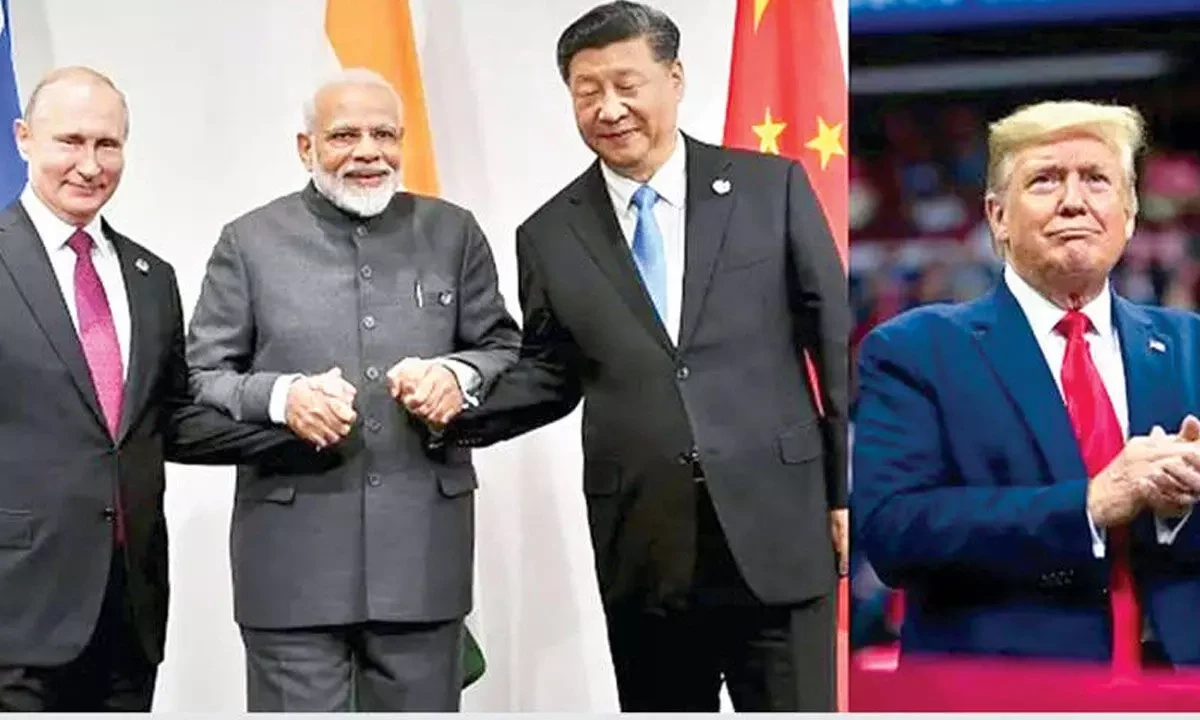
Russian President Vladamir Putin, Modi, and Chinese President Xi Jinping met at the Shanghai Cooperation Organisation (SCO) summit – and in response to G7 meetings and some of their decisions, the United States and many European nations recognized shifts in the foreign-policy orientations of those major nations and saw the need to adjust their own diplomatic approaches accordingly.
The global reality has become clear: the world’s leading powers are not just the US and European countries-Asian nations must also be counted. This changed equation has unsettled American President Donald Trump as the developments spell trouble for the United States, which is long accustomed to economic dominance and keeping the world’s leadership in its grasp.
It is more so for Trump personally. But he is not a conventional politician; he did not take cautious, measured steps. He continued to approach politics like a businessman, reshaping foreign policy according to that outlook. In the India-Pakistan clashes, Trump’s transactional style was exposed: for a while he claimed credit for halting the conflict, then he made bold, sometimes inconsistent, statements suggesting the parties themselves had reached terms, acting in ways that diminished America’s standing.
In these circumstances, the way summits are being held is signaling a growing closeness between China and India with the latter adjusting its foreign policy to accommodate the evolving changes. The possibility that India might be strengthening like another China worries the United States. India has begun taking steps to resolve some issues with China, and that has not gone unnoticed by rival countries-especially the US and some European nations.
India is working to bring the Kashmir (Pakistan-occupied Kashmir) issue and the Ladakh border disputes to a resolution for now. Unexpectedly, the Taliban government in Afghanistan has shown a positive stance toward India and has clashed with Pakistan, which surprised Islamabad. Pakistan is gradually losing forces capable of stabilising the situation. Balochistan has risen like a rolling tide and adopted guerrilla warfare, creating deep trouble within Pakistan. On top of that, the country’s nominally democratic government is effectively in the hands of Field Marshal Munir (the army); the Pakistani prime minister is weak. To consolidate power, General Munir even altered Pakistan’s constitution with support from Trump. Scholars and experts into international affairs are wondering whether global leadership is shifting away from a unified system toward one dominated by several countries.
Noting that India is moving from a position of asking the U.S. or China for cooperation to one where it is cooperating with China and Russia and, with the support of other Asian countries, is rising to offer Asian leadership to the world, US envoy to India Sergio Gore reviewed global circumstances and made a proposal to the US. He urged that, along with efforts to keep India away from China, India should stop buying Russian oil.
However, Modi immediately clarified that India’s future cannot be decided by others. It’s notable that the U.S. Secretary of State told the Senate plainly that the 21st century’s history will be written in Asia. Changes are happening in Asia now. Where Western powers once advanced through colonialism, today Asia is drawing countries closer through shared values, friendship, and cooperation-without violating global rules.
India is not, as before, uncertain or wavering in shaping its foreign policy. While pursuing national progress and withstanding pressure from the United States, it is becoming a country with strong growth and increasing human capital. Rather than concentrating power in a single leader, India is promoting collective welfare and fostering multilateral leadership so that Asian countries can lead.
Alongside China and Russia, it is taking steps to check the United States’ chaotic leadership and to bring Asian nations together in international forums. For several decades India preserved its distinctive course by encouraging that approach. It has advocated building a new society-based on equidistance, equality, economic development, and shared values.
Now, as India grows stronger, it is clearly placing moral values at the forefront and positioning itself as a supporter of leadership among Asian countries.