New Delhi: Across the world, firefighting is undergoing a quiet but significant transformation. From industrial plants and oil refineries to nuclear facilities and military depots, armed forces and emergency services are now increasingly turning to unmanned systems to tackle fires that can prove dangerous for humans. The Indian Army’s decision to procure indigenously developed firefighting robots reflects this broader global shift—one that places technology between personnel and extreme risk.
Against this backdrop, the Indian Army has moved to strengthen the protection of its ammunition depots and other sensitive installations by signing an agreement to induct firefighting robots, signalling a change in how fires at strategic military assets will be handled.
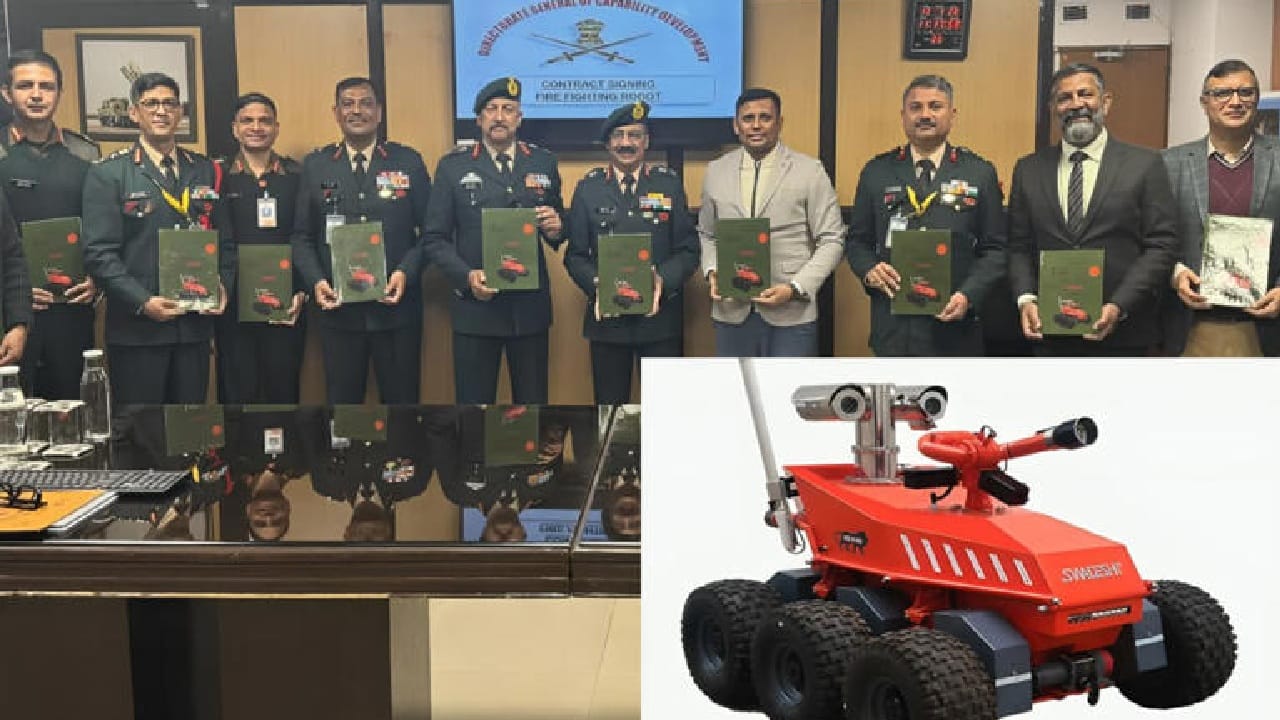
On January 13, the Army’s Directorate of Capability Development signed a contract to procure 18 Fire Fighting Robots (FF BOTs) at a cost of Rs 62 crore. The systems are intended for deployment at armament and ammunition depots and other high-risk facilities, where fires can escalate rapidly and pose a threat not only to personnel but also to operational readiness.
The FF BOT has been developed by Indian start-up Swadeshi Empresa Pvt Ltd under the Ministry of Defence’s Innovations for Defence Excellence (iDEX) initiative. It is an unmanned ground system designed to operate in environments involving explosions, toxic smoke, extreme heat and the risk of structural collapse—conditions that increasingly define firefighting at modern military and industrial facilities worldwide.
Globally, such robots are being used to enter fire zones first, gather real-time information and suppress flames while keeping human responders at a safe distance. The Army’s induction of the FF BOT mirrors this approach–especially for ammunition depots where even a minor fire can trigger secondary explosions and cascading damage.
Although the robot was originally developed for the Indian Navy under the iDEX framework, the Army is procuring the system for the first time by using provisions that allow one Service to acquire iDEX products developed and cleared by another. The system was approved following a Single Stage Composite Trial. The Army Design Bureau supported the project, underlining the service’s effort to promote indigenously developed solutions and defence start-ups under the Make in India programme.
Officials said the move reflects a growing focus on safeguarding critical infrastructure that underpins military preparedness. Fires at ammunition depots and fuel storage sites can disrupt logistics chains, destroy critical stocks and affect operational timelines. Introducing unmanned systems into firefighting roles allows faster initial response. It also reduces direct exposure of soldiers and firefighters to lethal hazards.
The contract includes a two-year warranty and five years of comprehensive maintenance, along with on-site service support, taking the total support period to seven years. Induction of the FF BOTs is scheduled to begin in the first week of April, with deployment planned across various cantonments in the country.
Designed for use at ammunition depots, fuel storage facilities, oil refineries and industrial plants, the FF BOT is operated remotely. It is equipped with optical and thermal cameras which transmit live video feeds to operators. They enable the identification of hotspots and hidden flames in smoke-filled or low-visibility conditions.
Officials said this capability also highlights the robot’s potential beyond military installations, including at power stations, airports, fuel storage sites and during disaster-response operations where human access is restricted.
The FF BOT was the first iDEX SPRINT project under DISC-7 to receive Acceptance of Necessity in 2023. The iDEX initiative aims to build an innovation ecosystem in defence and aerospace by engaging start-ups and private industry.
The firefighting robot was showcased by Swadeshi Empresa at Army House during Vijay Diwas celebrations in December last year.
Officials stressed that the system is intended to support, not replace, human firefighters. By allowing unmanned platforms to enter the most hazardous zones first, the Army is aligning with a global firefighting trend—one that prioritises technology-led risk reduction while ensuring that critical military assets remain secure during fire emergencies.